
Scientists found hidden antibiotics building up in rivers and fish, raising new concerns about pollution and food safety.
Scientists from the Center for Nuclear Energy in Agriculture at the University of São Paulo (CENA-USP) have discovered residues of several antibiotic types in the Piracicaba River, one of the main rivers in São Paulo state, Brazil. Their research, published in Environmental Sciences Europe, also examined how these drugs build up in fish and whether a common aquatic plant called Salvinia auriculata could help reduce contamination.
The project was led by Patrícia Alexandre Evangelista and funded by FAPESP. Researchers combined environmental monitoring with experiments on pollutant buildup, genetic damage in aquatic organisms, and phytoremediation, a process that uses plants to remove contaminants from the environment. This broader approach helped the team evaluate ecological risks while exploring possible low-cost solutions for pollution linked to both human medicine and livestock production.
Samples were collected near the Santa Maria da Serra dam and the Barra Bonita reservoir, an area where pollutants from across the Piracicaba River basin tend to accumulate. The region receives treated sewage, household wastewater, runoff from agriculture, and waste linked to fish farming and pig farming.
Dry Season Intensifies Antibiotic Pollution
Researchers analyzed water, sediment, and fish samples during both rainy and dry periods. The monitoring included 12 commonly used antibiotics from groups such as tetracyclines, fluoroquinolones, sulfonamides, and phenols. “The results showed a clear pattern of seasonality. During the rainy season, most antibiotics had concentrations below detection limits. In the dry season, however, when water volume decreases and contaminants become concentrated, different compounds were detected,” says Evangelista.
Levels in the water measured in nanograms per liter, while sediment concentrations reached micrograms per kilogram. Some compounds, including enrofloxacin and sulfonamides, were found in sediment at concentrations higher than those reported in similar studies around the world.
According to the researchers, the sediment acts like a storage area for these contaminants because it contains large amounts of organic matter and nutrients such as phosphorus, calcium, and magnesium. Over time, these antibiotics can potentially be released back into the environment.
Banned Antibiotic Detected in Fish
“One of the most significant findings of the study was the detection of chloramphenicol in lambari fish (Astyanax sp.) collected from local fishermen in the Barra Bonita region. Chloramphenicol is an antibiotic whose use in livestock is prohibited in Brazil precisely because of the risks associated with its toxicity,” the researcher states.
The banned antibiotic was detected only during the dry season, at concentrations reaching tens of micrograms per kilogram. Since lambari fish are commonly sold and eaten in the area, the findings point to a possible route of human exposure through food consumption.
Evangelista said chloramphenicol and enrofloxacin were selected for laboratory testing because of their environmental importance and health relevance. “Enrofloxacin is widely used in animal husbandry, including aquaculture, as well as in human medicine. Chloramphenicol, on the other hand, is still used in humans despite being banned for food-producing animals and serves as a historical marker of persistent contamination,” she explains.
Aquatic Plant Removes Some Antibiotics
Beyond identifying contamination, the researchers also tested whether Salvinia auriculata, a floating aquatic plant often considered a nuisance species, could help clean polluted water.
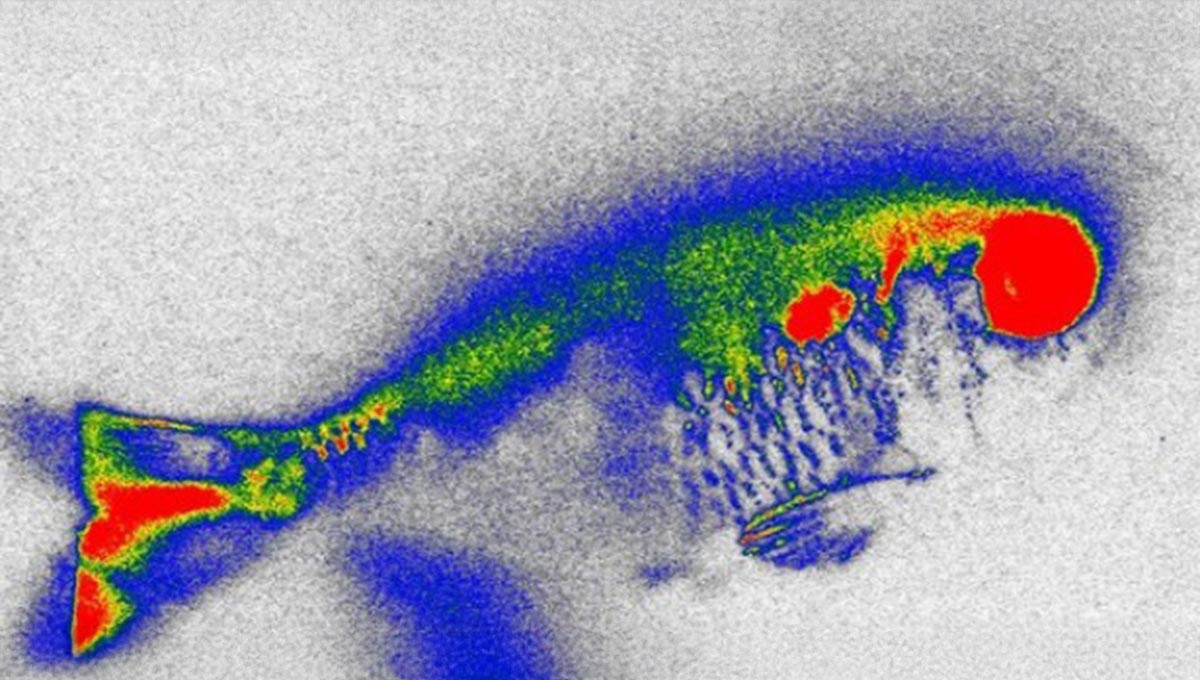
In laboratory experiments, the plant was exposed to environmental concentrations and concentrations 100 times higher of enrofloxacin and chloramphenicol. The scientists used carbon-14-radiolabeled compounds to precisely track where the antibiotics moved within the water, plants, and fish.
“The results showed the high efficiency of Salvinia in removing enrofloxacin. In treatments with higher plant biomass, more than 95% of the antibiotic was removed from the water within a few days. The half-life of the compound dropped to about two to three days. In the case of chloramphenicol, removal was slower and partial. The plant was able to remove 30% to 45% of the antibiotic from the water, with half-lives ranging from 16 to 20 days, indicating the greater persistence of the compound in the environment,” the researcher reports.
Images from autoradiography tests showed that both antibiotics accumulated mainly in the roots of the plant, suggesting that root absorption and rhizofiltration are central to the cleanup process.
Fish Absorption and DNA Damage
One of the more complicated findings involved how fish absorb antibiotics. Controlled studies showed that lowering the concentration of antibiotics in the water did not always reduce uptake by fish.
Enrofloxacin mostly stayed dissolved in the water and was eliminated relatively quickly by lambari fish, with a half-life of about 21 days. Its bioconcentration factor was low, meaning it was less likely to build up in tissues. Chloramphenicol behaved differently. It remained in the fish for much longer, with a half-life greater than 90 days and a high bioconcentration factor indicating stronger retention in tissue.
The presence of Salvinia auriculata also changed how fish absorbed the drugs. Although the plant lowered antibiotic levels in the water, fish sometimes absorbed the compounds more quickly. Researchers believe the plant may partially transform the antibiotics into forms that are more easily taken up by aquatic organisms.
“This shows that using plants as ‘sponges’ for contaminants is not a trivial matter. The presence of the macrophyte changes the entire system, including the way the organism comes into contact with the contaminant,” Evangelista notes.
The team also examined genetic damage in fish. Chloramphenicol significantly increased DNA damage, including micronuclei formation and abnormalities in blood cell nuclei. However, when Salvinia auriculata was present, the damage dropped closer to levels seen in control groups. For enrofloxacin, the plant did not significantly reduce harmful genetic effects.
“The interpretation we propose is that, in the case of chloramphenicol, the plant may generate fewer genotoxic byproducts or release antioxidant compounds into the rhizosphere, reducing oxidative stress in the fish. On the other hand, enrofloxacin is chemically more stable and may produce persistent and potentially toxic metabolites whose action is not neutralized by the macrophyte,” the researcher comments.
Promise and Limits of Natural Cleanup Strategies
Evangelista stressed that Salvinia auriculata should not be viewed as a complete solution to antibiotic contamination. The study demonstrated both advantages and limitations. One major concern is the handling of contaminated plant material. If the plants are not properly removed and treated, they could release antibiotics back into the environment and become another source of pollution.
Even so, the findings suggest aquatic plants could become part of affordable, nature-based cleanup strategies, especially in areas where advanced treatment methods like ozonation and oxidative technologies are too expensive.
“The study shows that the problem is real, measurable, and complex. And any strategy to address it must consider not only the removal of the contaminant, but also its biological and ecological effects,” the researcher concludes.
“The detection of antibiotic residues in the water, sediments, and fish of the Piracicaba River shows just how harmful human activities can be. The resistance of microorganisms to antibiotics can lead to the emergence of superbugs in the environment. The research yielded positive results with low-cost environmental solutions and enabled a better understanding of the integrated functioning of aquatic ecosystems and the use of effective natural techniques for impact mitigation,” adds Valdemar Luiz Tornisielo, supervisor of Evangelista’s research and co-author of the article.
Reference: “Integrated approach for assessing and mitigating antibiotic contamination in natural waters using bioaccumulation and phytoremediation” by Patrícia Alexandre Evangelista, Ítallo Cristian da Silva de Oliveira, Felipe Machado de Oliveira Lourenço, Nicoli Gomes de Moraes, Rodrigo Floriano Pimpinato, Henrique Alves de Moraes, Walther Henrique Almeida Meneghini and Valdemar Luiz Tornisielo, 19 December 2025, Environmental Sciences Europe.
DOI: 10.1186/s12302-025-01275-7
The radiolabeled molecules used in the research were supplied by the International Atomic Energy Agency (IAEA).
Never miss a breakthrough: Join the SciTechDaily newsletter.
Follow us on Google and Google News.
1 Comment
This should be seen not as a problem, but as a ‘canary in the coal mine’ warning about the overuse of antibiotics, particularly in first and second-tier economies. The problem is NOT newly discovered, as demonstrated in https://scitechdaily.com/worlds-rivers-overdosing-on-human-antibiotics-study-finds/
The fact that the concentration of the banned antibiotics is greatest in the dry season, strongly suggests that the source is the waste treatment facilities that maintain constant flows even when precipitation is reduced.
While concern is appropriate, the solution to too much waste antibiotics needs to be given priority over remediation because bio-removal will be selective. Probably the most effective bio-removal plants should be grown in holding ponds before the waste water is released. The plants should then be harvested, dried, and burned to evaporate water (distilled) with the distillate finally released to dilute the natural waters. There will probably be economic pressure to sell the distilled water, which should be resisted because the dilution has social value. Osmotic filters should be looked at to supplement the antibiotic removal of water that can’t be distilled. However, most importantly, the consumption of antibiotics needs to be reduced!