
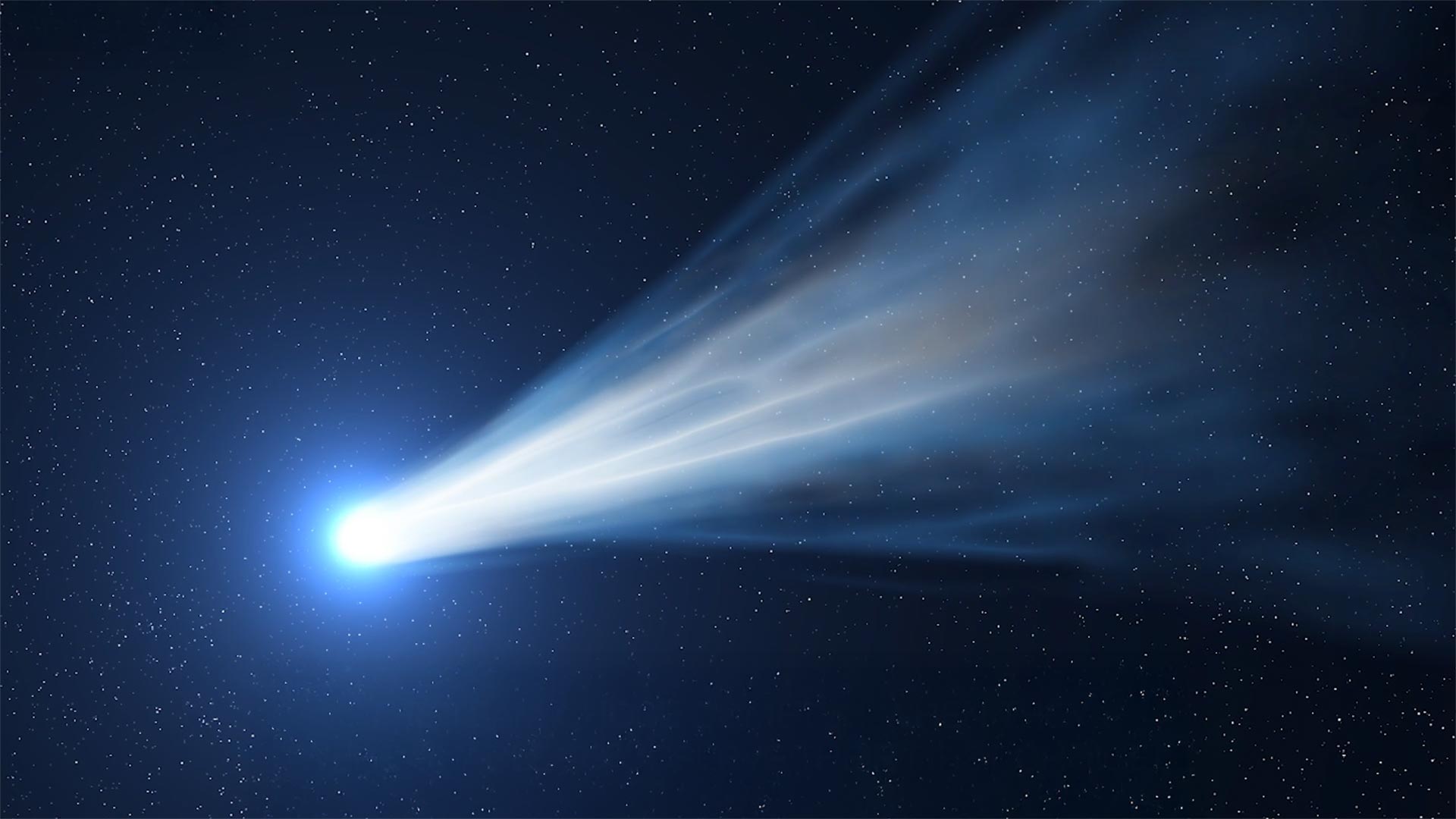
In a stunning stroke of luck, Hubble witnessed a comet splitting apart almost in real time. The rare observation is giving scientists an unprecedented look inside one of the solar system’s ancient icy leftovers.
In an extraordinary stroke of luck, NASA’s Hubble Space Telescope observed a comet breaking apart in real time. The odds of Hubble catching such an event at exactly the right moment are incredibly small. The discovery was published in the journal Icarus.
The comet, officially named C/2025 K1 (ATLAS)—not to be confused with interstellar comet 3I/ATLAS—was not even the original target of the observation campaign.
“Sometimes the best science happens by accident,” said co-investigator John Noonan, a research professor in the Department of Physics at Auburn University in Alabama. “This comet got observed because our original comet was not viewable due to some new technical constraints after we won our proposal. We had to find a new target — and right when we observed it, it happened to break apart, which is the slimmest of slim chances.”
Scientists Realize the Comet Has Split
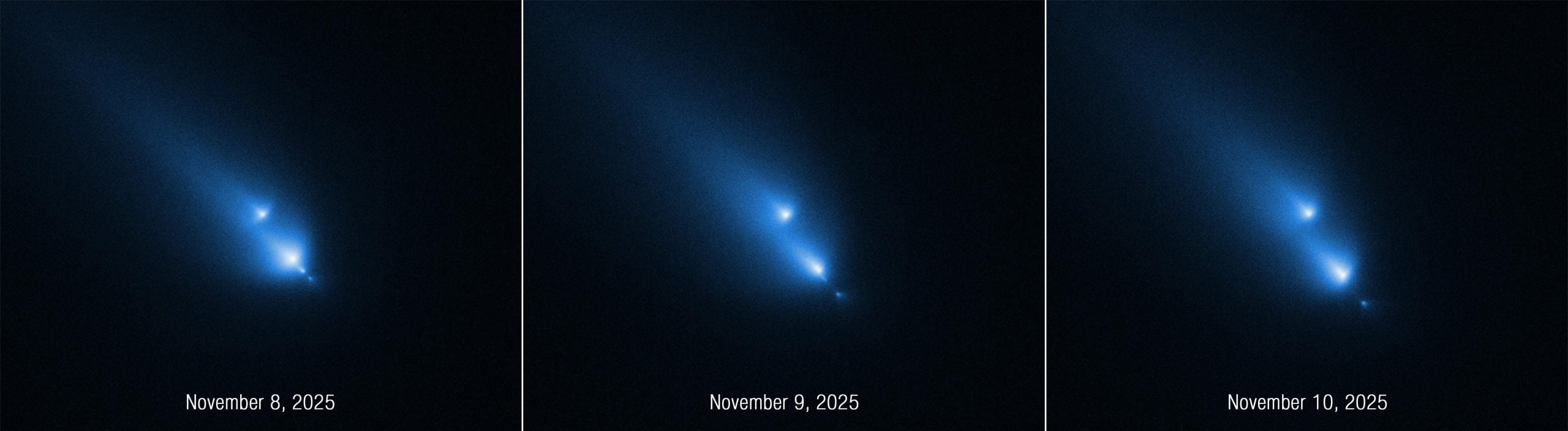
Noonan only discovered the breakup after reviewing Hubble’s images the next day. “While I was taking an initial look at the data, I saw that there were four comets in those images when we only proposed to look at one,” said Noonan. “So we knew this was something really, really special.”
Researchers had hoped for years to capture a comet fragmenting with Hubble. They submitted multiple proposals aimed at observing such an event, but the timing is notoriously difficult, and previous efforts never worked out.
“The irony is now we’re just studying a regular comet, and it crumbles in front of our eyes,” said principal investigator Dennis Bodewits, also a professor in Auburn University’s Department of Physics.
“Comets are leftovers of the era of solar system formation, so they’re made of ‘old stuff’—the primordial materials that made our solar system,” said Bodewits. “But they are not pristine—they’ve been heated, they’ve been irradiated by the Sun and by cosmic rays. So, when looking at a comet’s composition, the question that we always have is, ‘Is this a primitive property or is this due to evolution?’ By cracking open a comet, you can see the ancient material that has not been processed.”
Hubble Reveals Multiple Comet Fragments
Hubble detected K1 splitting into at least four separate pieces. Each fragment had its own coma, the glowing cloud of gas and dust surrounding a comet’s icy core. Hubble’s sharp images clearly separated the fragments, while ground-based telescopes could only see faint bright spots that were difficult to distinguish from one another.
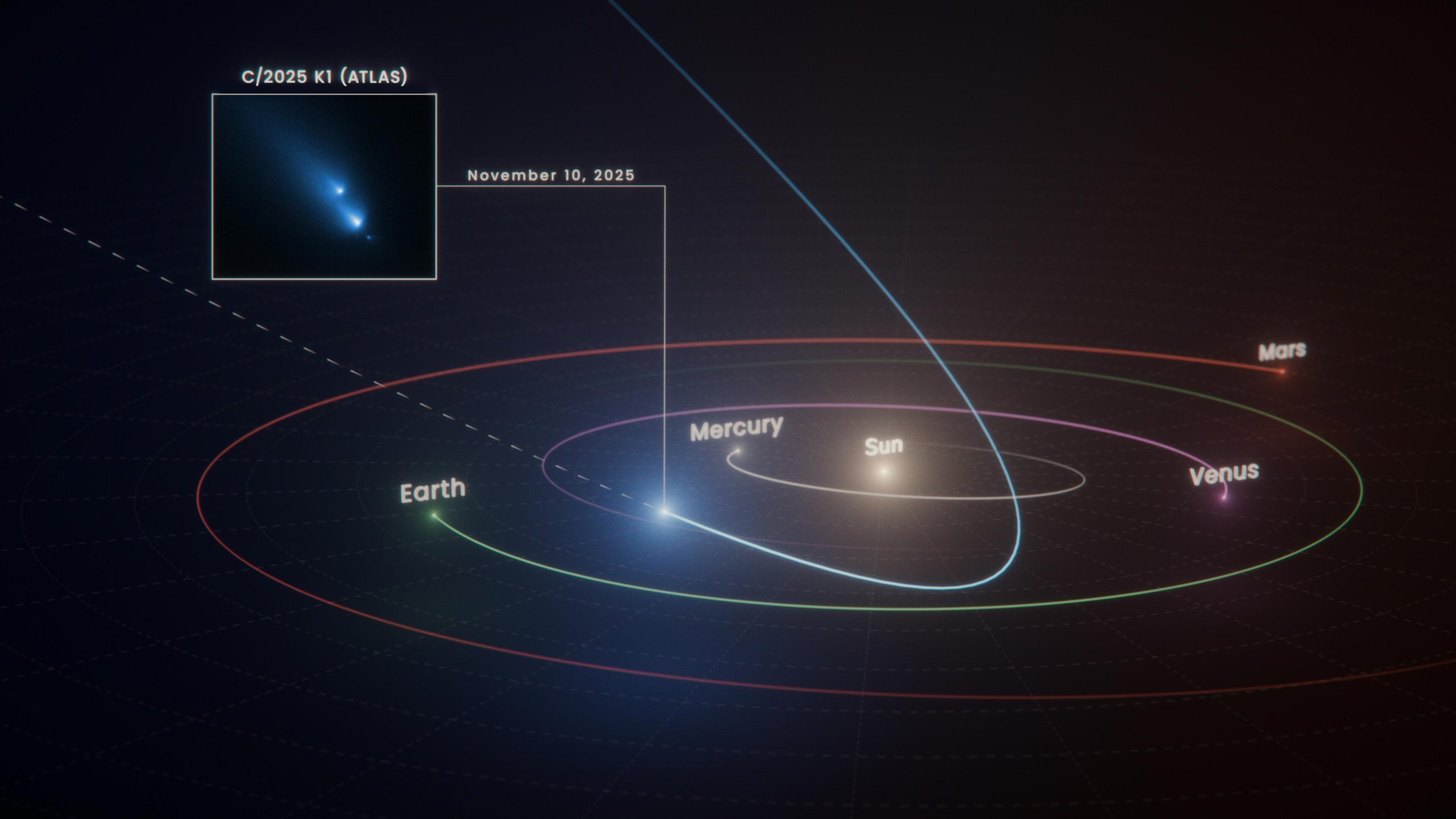
The observations took place about one month after K1 reached perihelion, its closest point to the Sun. At perihelion, the comet traveled inside Mercury’s orbit, roughly one-third of Earth’s distance from the Sun. This stage exposes comets to extreme heating and stress, and long-period comets like K1 often begin to break apart shortly afterward.
Before the breakup, K1 was likely somewhat larger than the average comet, measuring about 5 miles across. Scientists estimate the fragmentation process began around eight days before Hubble observed it. The telescope captured three 20-second exposures taken on November 8, 9, and 10, 2025. During those observations, one of the smaller fragments also split apart.
A Mystery About Comet Brightness
Because Hubble can resolve extremely fine details, researchers were able to trace the fragments backward and determine when they had still been a single object. This helped the team reconstruct the timeline of the breakup. In the process, they encountered an unexpected mystery. Why did the comet take time to brighten after splitting apart? Once fresh ice was exposed, scientists expected the comet to become brighter almost immediately.
The researchers have several possible explanations. Most of a comet’s brightness comes from sunlight reflecting off dust particles. When a comet first cracks open, however, it exposes fresh ice rather than dust. One possibility is that a dry dust layer needs to form over the ice before it can be blown away. Another theory suggests heat slowly penetrates beneath the surface, building pressure until it ejects an expanding cloud of dust.
“Never before has Hubble caught a fragmenting comet this close to when it actually fell apart. Most of the time, it’s a few weeks to a month later. And in this case, we were able to see it just days after,” said Noonan. “This is telling us something very important about the physics of what’s happening at the comet’s surface. We may be seeing the timescale it takes to form a substantial dust layer that can then be ejected by the gas.”
Strange Chemistry and a One-Way Journey
Scientists are continuing to study gases released by the comet. Early ground-based observations already show that K1 has unusual chemistry. Compared with most comets, it appears to contain far less carbon. Additional spectroscopic observations from Hubble’s STIS (Space Telescope Imaging Spectrograph) and COS (Cosmic Origins Spectrograph) instruments could reveal more about the comet’s makeup and provide clues about the early solar system.
K1 is now a drifting collection of fragments located about 250 million miles from Earth in the constellation Pisces. It is traveling away from the solar system and is unlikely to ever return.
Hubble’s Long Legacy of Discovery
The Hubble Space Telescope has operated for more than 30 years and continues to produce discoveries that deepen scientists’ understanding of the universe. Hubble is a joint project between NASA and ESA (European Space Agency). NASA’s Goddard Space Flight Center in Greenbelt, Maryland, manages the mission and telescope operations, with additional support from Lockheed Martin Space in Denver. The Space Telescope Science Institute in Baltimore, operated by the Association of Universities for Research in Astronomy, oversees Hubble’s science operations for NASA.
Reference: “Sequential fragmentation of C/2025 K1 (ATLAS) after its near-sun passage” by D. Bodewits, J.W. Noonan, M.S.P. Kelley, C.E. Holt, T.A. Lister, H. Usher, C. Snodgrass, B.J.R. Davidsson and S. Greenstreet, 6 February 2026, Icarus.
DOI: 10.1016/j.icarus.2026.116996
Never miss a breakthrough: Join the SciTechDaily newsletter.
Follow us on Google and Google News.