
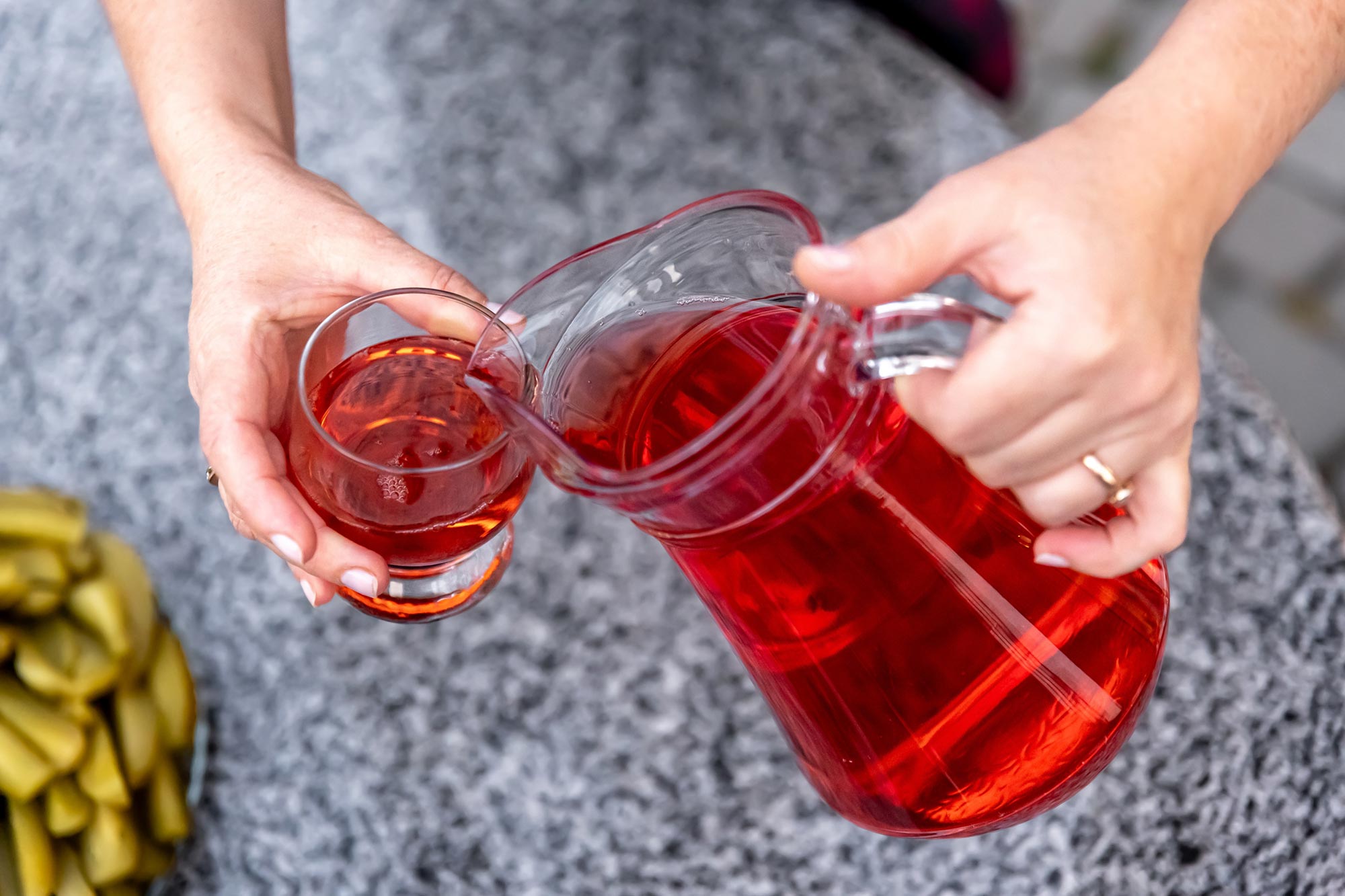
Laboratory tests show cranberry juice may strengthen a common UTI antibiotic and reduce bacterial resistance.
Urinary tract infections affect more than 400 million people worldwide each year, and some epidemiological studies suggest that over half of all women will experience at least one during their lifetime. Most UTIs are caused by harmful strains of Escherichia coli bacteria, and fosfomycin is commonly used as a first-line antibiotic treatment. But growing antibiotic resistance is pushing researchers to explore new treatment strategies.
A new study suggests cranberry juice could help antibiotics work better, at least in laboratory-grown bacterial strains. Writing in Applied and Environmental Microbiology, researchers reported that cranberry juice improved fosfomycin’s antibiotic activity in 72% of the uropathogenic E. coli strains tested. It also reduced the appearance of mutations linked to antibiotic resistance. Lead author Eric Déziel, Ph.D., a microbiologist at the Institut National de la Recherche Scientifique in Montreal, Canada, said the results are encouraging but still early.
The research does not show whether drinking cranberry juice would produce the same effects in people. “We don’t know if the metabolites will reach the infection,” he said. If they do, he explained, cranberry juice could potentially improve the effectiveness of antibiotic treatment. Additional studies will be needed to determine how much juice, if any, might provide a benefit.
How Cranberry Compounds Affect Bacteria
Cranberry juice has long been used as a folk remedy for urinary tract infections. Researchers once believed its acidity was responsible for the effect, but more recent studies point to compounds that may prevent bacteria from sticking to the cells lining the urethra. Until now, scientists had not closely studied how cranberry juice interacts with antibiotics.
The researchers found that cranberry juice appears to influence how bacteria absorb fosfomycin. The antibiotic enters bacterial cells through the same transport channels bacteria use to take in certain sugars. According to Déziel, scientists still do not know which compounds in cranberry juice are responsible, but something in the juice seems to increase sugar uptake through one of these channels. As a result, the bacteria also absorb more fosfomycin. Antibiotic resistance often develops through mutations affecting other nutrient transport channels.
Déziel’s laboratory studies how bacteria communicate and searches for natural compounds that could interfere with those signals to help treat dangerous infections. Earlier lab work from his team showed that cranberry extracts could strengthen the effects of antibiotics against resistant bacterial strains.
Research Funding and Real-World Questions
Those earlier findings drew interest from the Cranberry Institute, which supports research into the health effects of cranberries and funded the new study. The organization wanted to know whether cranberry juice itself could produce the same bacterial effects as concentrated cranberry extracts.
“It’s a very good question. People actually drink juice,” Déziel said. “They don’t consume these very specific extracts.”
Déziel emphasized that the study does not prove drinking cranberry juice can make antibiotics more effective in patients. Still, he said the findings justify further investigation. He also believes the results support broader efforts to use natural compounds to help fight antibiotic resistance. Substances that improve the performance of existing antibiotics are especially attractive because they could reduce the need to develop entirely new drugs.
“With the challenge of the multi-drug resistance,” Déziel said, “we need to work from many different directions.”
Reference: “Cranberry juice potentiates sensitivity of uropathogenic Escherichia coli (UPEC) strains to fosfomycin and decreases occurrence of spontaneous resistance” by Marie-Christine Groleau, Sébastien Houle, Ana C. Quevedo, Geoffrey McKay, Dao Nguyen, Charles M. Dozois, Nathalie Tufenkji and Eric Déziel, 4 May 2026, Applied and Environmental Microbiology.
DOI:10.1128/aem.02521-25
Never miss a breakthrough: Join the SciTechDaily newsletter.
Follow us on Google and Google News.