
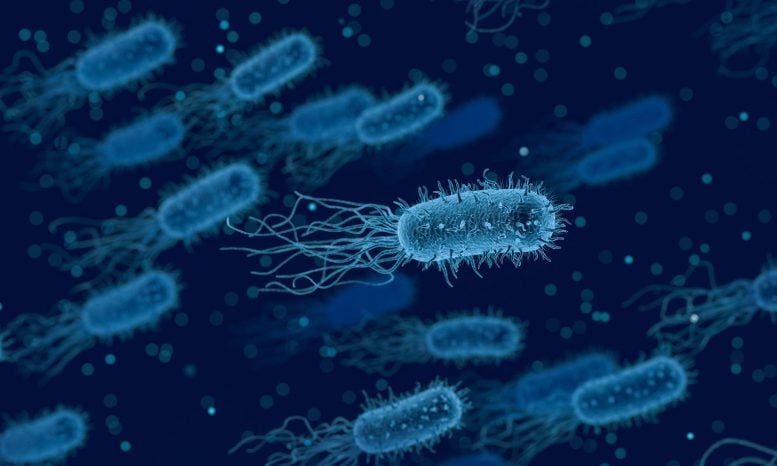
Most types of Escherichia coli are harmless, but the ones that aren’t can cause severe life-threatening diarrhea. These problematic bacteria launch infections by inducing intestinal cells to form tiny structures, called pedestals, that anchor the pathogens in place and help the colonies grow.
This week in mBio, microbiologists describe an Achilles heel for disabling pedestal formation. Lab experiments on enteropathogenic and enterohemorrhagic E. Coli (EPEC and EHEC) showed that when the pathogens were prevented from injecting a protein called EspG into intestinal hosts, the hosts were slower and less effective in producing pedestals that fixed the bacteria in place. Further investigations revealed the cellular pathways hijacked by EspG.
The findings can help reveal the mechanics of infection and suggest new avenues of treatment, said microbiologist and study co-leader Peter Hume, Ph.D., at the University of Cambridge in the United Kingdom.
“By learning how these pathways work, we think we can develop new ways of interfering with the infection process,” he said.
Worldwide, more than 500,000 children die every year from diarrheal diseases, and pathogenic strains of E. Coli are among the most common causes, according to the World Health Organization. But treating these infections can be tricky. Using antibiotics to treat a person with EHEC, for example, can trigger the bacteria to release Shiga toxin, which can lead to a life-threatening infection similar to sepsis. That means healthcare providers need treatments other than antimicrobials to keep these infections in check, Hume said.
Researchers have long known that pathogenic E. coli injects its host with a variety of proteins, including EspG. Until now, however, those interactions have been linked only to other biochemical functions. “People had tried to find a link to pedestals before, but they hadn’t found one,” said Hume, whose work focuses on how bacterial pathogens affect the cytoskeletons of host cells. The current study was carried out in the lab of Vassilis Koronakis, by Hume in collaboration with Cambridge colleagues Vikash Singh and Anthony Davidson.
Previously, the researchers studied the effects of EspG on macrophages, and those findings suggested the protein may have an overlooked role in pedestal formation with intestinal hosts.
For the current study, they infected one group of Hap1 cells with wild-type EHEC and EPEC, and infected another with the same types of E. Coli, but lacking the genes responsible for producing EspG. Using fluorescence microscopy, the researchers studied the results. The cells infected by E. Coli lacking EspG took longer to produce pedestals the those by wild-type strains, and what pedestals were produced were shorter.
Follow-up experiments revealed that the EspG protein hijacks the host cell by scavenging an active enzyme called PAK. Although previous work has shown a link between EspG and PAK, the new study is the first to connect the two to the formation of pedestals.
That connection may help researchers study other diseases, as well. PAK has been implicated in some cancers, and other studies have shown that some viruses — including HIV — can activate it.
“This study may well have implications with other pathogens that manipulate the same pathways,” Hume said.
###
The American Society for Microbiology is the largest single life science society, composed of more than 30,000 scientists and health professionals. ASM’s mission is to promote and advance the microbial sciences.
ASM advances the microbial sciences through conferences, publications, certifications, and educational opportunities. It enhances laboratory capacity around the globe through training, and resources. It provides a network for scientists in academia, industry and clinical settings. Additionally, ASM promotes a deeper understanding of the microbial sciences to diverse audiences.
Never miss a breakthrough: Join the SciTechDaily newsletter.
Follow us on Google and Google News.