
TU Delft scientists found that E. coli bacteria can synchronize their movements in engineered microcavities, opening new possibilities for studying and designing biological systems.
Researchers at TU Delft have discovered that E. coli bacteria can synchronize their movements, creating order in seemingly random biological systems. By trapping individual bacteria in micro-engineered circular cavities and coupling these cavities through narrow channels, the team observed coordinated bacterial motion.
Their findings, which have potential applications in engineering controllable biological oscillator networks, were recently published in Small.
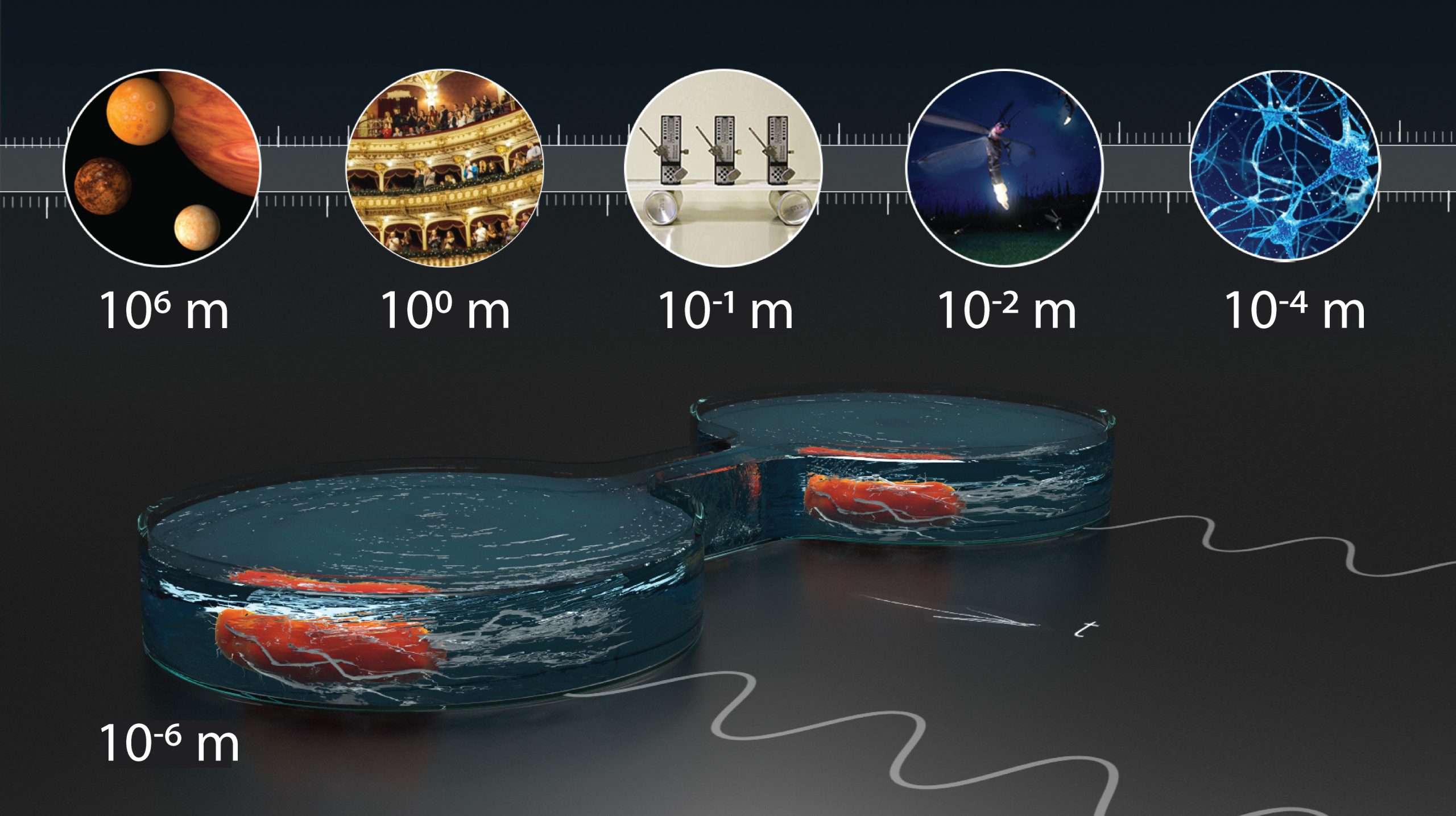
An audience clapping in rhythm, fireflies flashing in unison, or flocks of starlings moving as one – synchronization is a natural phenomenon observed across diverse systems and scales. First described by Christiaan Huygens in the 17th century, synchronization was famously illustrated by the aligned swinging of his pendulum clocks. Now, TU Delft researchers have shown that even E. coli bacteria – single-celled organisms only a few micrometers long – can display this same phenomenon.
“This was a remarkable moment for our team,” said Farbod Alijani, associate professor at the Faculty of Mechanical Engineering. “Seeing bacteria ‘dance in sync’ not only showcases the beauty of nature but also deepens our understanding of the microscopic origins of self-organization among the smallest living organisms.”
Synchronized movement
Alijani’s team, together with TU Delft professor Cees Dekker and the TU Delft spin-off SoundCell, achieved this by using precisely engineered microcavities that trap single E. coli cells from a bulk population. Inside these circular cavities, the bacteria began to exhibit rotary motion akin to pendulum clocks. By connecting two of these cavities with a tiny channel, the researchers observed that after some time, the two bacteria began to synchronize their movements.
Tiny dancers: Scientists synchronize bacterial motion. Credit: TU Delft
“This synchronization occurs because of hydrodynamic interactions induced by the movement of bacteria in the coupled system,” explains Alijani. The team quantified this coupling strength and found that the bacteria’s coordinated motion adhered to universal mathematical rules of synchronisation.
Towards a network of coordinated motion
The findings hold significant promise, paving the way for designing micro-tools capable of inducing controlled oscillations and synchronization in bacterial systems. Such tools could help scientists study bacterial motility and coordination in confined environments, providing a better understanding of microbial active matter.
The team is now exploring more complex systems by coupling multiple cavities to form networks of synchronized bacteria. “We want to uncover how these networks behave and whether we can engineer even more sophisticated dynamical movements,” Alijani adds.
Possibilities for drug screening
While this research is primarily fundamental, its potential applications are wide-ranging. “This could even provide a novel approach to drug screening, for instance, by measuring fluid flow changes and forces caused by bacterial movement before and after administering antibiotics,” Alijani suggests.
The study was inspired by earlier work where Alijani’s team recorded the first-ever sound of a single bacterium using a graphene drum. “We were curious if we could go a step further and create order out of the chaotic oscillations we observed,” says Alijani. With this study, they’ve moved from recording the soundtrack of a single bacterium to orchestrating their ‘tango’.
Reference: “Synchronization of E. coli Bacteria Moving in Coupled Microwells” by Aleksandre Japaridze, Victor Struijk, Kushal Swamy, Ireneusz Rosłoń, Oriel Shoshani, Cees Dekker and Farbod Alijani, 25 November 2024, Small.
DOI: 10.1002/smll.202407832
Never miss a breakthrough: Join the SciTechDaily newsletter.
Follow us on Google and Google News.
1 Comment
Really it has great scope for drug scanning and helpful in medical fraternity