
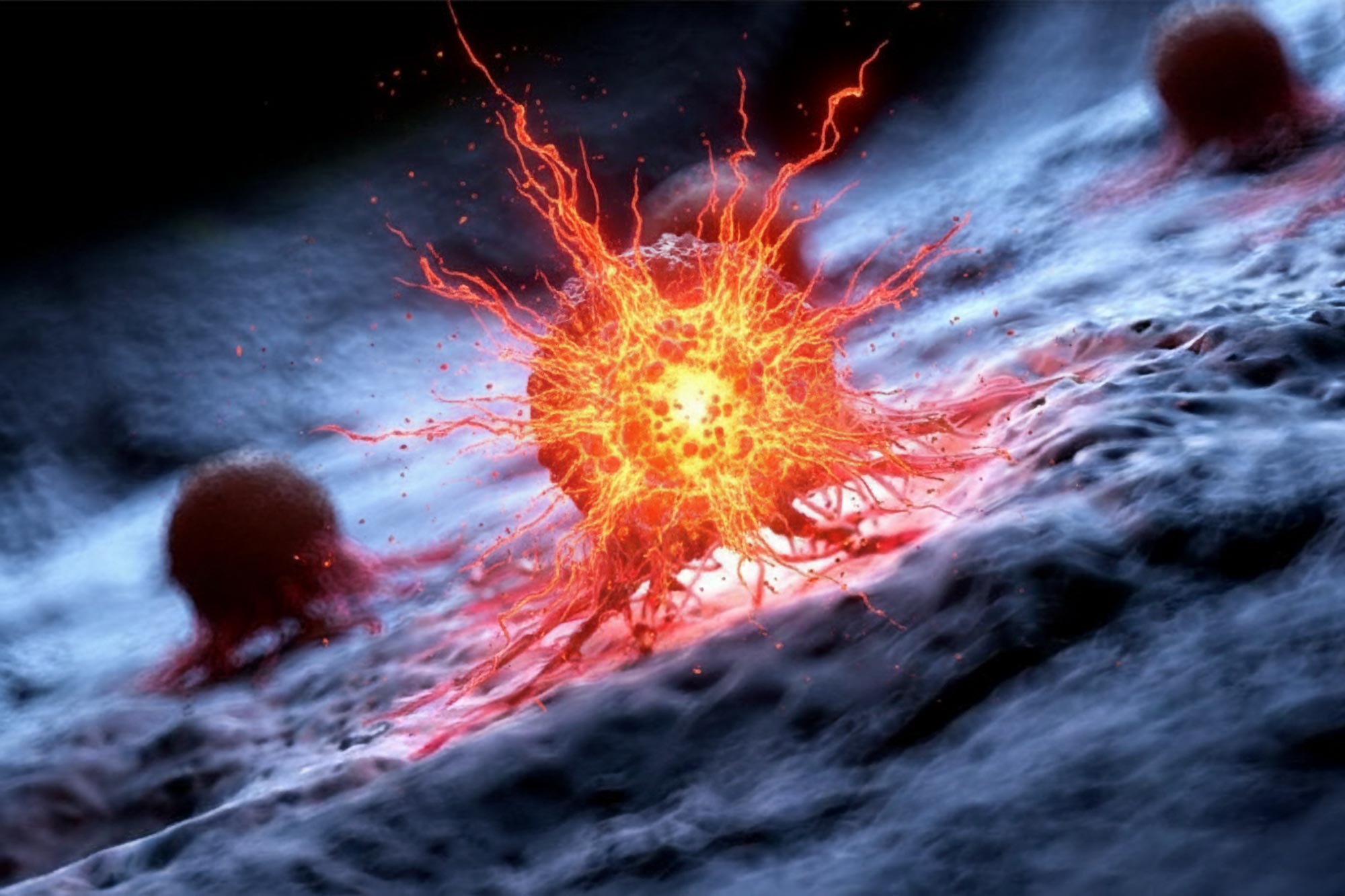
Researchers have uncovered an unexpected weakness in pancreatic cancer involving damaged mitochondria and a powerful inflammatory signal.
Researchers at The Wistar Institute and ChristianaCare’s Helen F. Graham Cancer Center & Research Institute have identified a weakness in pancreatic cancer that may open the door to new treatments. Their study, published in the Proceedings of the National Academy of Sciences, found that damaged mitochondria inside cancer cells trigger inflammation that tumors rely on to survive and grow. When that inflammatory process is blocked, the cancer cells die.
The findings point to a signaling pathway called TLR3/TRAF6 as a possible treatment target for pancreatic cancer, according to senior author Dario Altieri, M.D., president and CEO of The Wistar Institute, director of the Ellen and Ronald Caplan Cancer Center, and Robert and Penny Fox Distinguished Professor. He said this is the first time the mechanism has been linked to cancer development.
“It’s been known that mitochondria could release double-stranded RNA and generate inflammation, but not in cancer, and not as a cancer driver,” Altieri explained. “Similarly, this pair of molecules, TLR3 and TRAF6, were known to act as a sensor for double-stranded RNA, but again, not in cancer. So this could be a therapeutic target for pancreatic cancer, where we are in desperate need of therapeutic targets, but perhaps also for other types of cancers.”

“For pancreatic cancer patients, options remain far too limited and the prognosis far too often devastating,” said coauthor Nicholas Petrelli, M.D., director of the Cawley Center for Translational Cancer Research at ChristianaCare’s Helen F. Graham Cancer Center & Research Institute. “What makes this finding so exciting is that it points us toward a genuine vulnerability in the cancer itself—one we may be able to exploit therapeutically.”
Why Pancreatic Cancer Is So Deadly
Pancreatic cancer is among the deadliest forms of cancer and is notoriously difficult to treat. The disease is often diagnosed only after it has spread to other parts of the body, leaving patients with very limited treatment options and poor survival rates.
Mitochondria are structures inside cells that produce energy from nutrients. Earlier research showed that many tumor cells contain mitochondria with low levels of a structural protein called Mic60. Although heavily damaged, these mitochondria remain inside the cell. Scientists previously observed that these so-called “ghost mitochondria” acted as major sources of inflammatory signaling, but the reason was unclear.
The new study explains how that happens.
Healthy mitochondria are enclosed by a protective membrane. Researchers discovered that when Mic60 levels drop, the membrane becomes damaged and begins leaking double-stranded RNA into the cell. The cell’s defense system interprets the leaked material as a sign of infection.
Inflammation Pathway Fuels Tumor Survival
Altieri said the team identified two proteins that detect the escaped double-stranded RNA and trigger a strong inflammatory response. Cancer cells then use that inflammation to support their growth.
The researchers also found that pancreatic cancer cells become highly dependent on this inflammatory state for survival. When drugs were used to block the sensor proteins, cancer cells died while healthy cells remained unaffected. In mouse models, the treatment stopped pancreatic tumors from growing.
Altieri said the findings were unexpected.
“The idea that the reduction of a structural protein could play a role in the damaged mitochondria becoming hubs for stress response signaling, which would translate to a very potent inflammatory response—that was totally unexpected,” he said. “We had no idea that this was a possibility.”
Researchers now plan to investigate exactly how Mic60 damage causes mitochondrial membranes to release double-stranded RNA and whether that process can be interrupted. They also aim to continue developing inhibitors that target the TLR3/TRAF6 pathway as a possible treatment for pancreatic cancer.
Reference: “Mitochondrial double-stranded RNA fuels pancreatic cancer growth via RIG-I/TLR3 inflammation” by Andrew T. Milcarek, Minjeong Yeon, Camilla Esposito, Prerna Kulkarni, Andrew V. Kossenkov, Jozef Madzo, Anneliese M. Faustino, Hsin-Yao Tang, Alessandra M. Storaci, Alessandro Palleschi, Marco Locatelli, Valentina Vaira, Mary V. Iacocca, Andrea Ward, Arvind Sabesan, Nicholas J. Petrelli, Michela Perego and Dario C. Altieri, 28 April 2026, Proceedings of the National Academy of Sciences.
DOI: 10.1073/pnas.2528281123
Work supported by National Institutes of Health (NIH) grants R35 CA220446, R50 CA221838, and R50 CA211199; the Cotswold Foundation; and National Cancer Institute grant P30 CA10815.
Never miss a breakthrough: Join the SciTechDaily newsletter.
Follow us on Google and Google News.
16 Comments
Is Pancreatic cancer painfull
I can’t tell you personally but my Mum suffered greatly when she died.
Horribly painful. This is great news.
My daughter suffers badly and nobody seems to help her properly to manage pain sickness ,and awful bad stomachs ,so destructive to her having a normal life at all
Have you tested your child for gluten sensitivity and also may I ask if you are feeding your child a strictly organic diet so as to avoid roundup/glyphosate in your foods which can also cause similar problems and symptoms
My Mother suffered horrific pain with Pancreatic Cancer
Hi my mother just passed away from pancreatic cancer as it swept through every organ in her body, her mother also passed away of pancreatic cancer we did do
A DNA and found in can pass down to generations. I’d be interested if you can contact me or send me information who to contact .
They treat you like your an inconvenience if your ill…never get to the bottom of any run bloods and tell you your fine when your in constant pain try to tell you your not it may feel like you are but what it is your body gets so used to the brain telling you your in pain it recognises the slightest thing as pain…so sympathetic and why am I on pain relief 4 hourly then and why if they know this golden nugget have they not found anything to turn the pain off if its not physical it’s in the brain why aren’t they sending you for brain scan and trying to solve the issue
I have the same problem. Was denied pain management. Have chronic pancreatitis. Had stents x3 Understand why people go looking for drugs on the street. Have to wait till malignant before I get help
I’m saving this article for future reference. It seems that whenever we read something positive about a possible cancer treatment, we never hear anything about it again.
Because big pharma makes more on chemotherapy and all their cancer drugs. They never want a cure
Many in Big pharma have family and friends that have died of cancer Many were motivated to become a cancer researcher after losing a loved one.Your opinion is a Myth And YES finding a cure for cancer is far more difficult then building a space shuttle and traveling through space
Recent news concernng teatments for bone cancer?
We did a DNA and found pancreatic cancer passes to generations
Please contact me for more testing
My mother and her mother passed away from pancreatic cancer.
If this leads to a powerful new treatment that significantly prolongs life, or better yet, a cure, how wonderful this would be!
The cost of research isn’t cheap. With the US government cutting spending on medical research, this great slows new and further research, potentially robbing many patients of cancer treatment.
Call or write your legislators, representatives, and senators. Let them know that medical research is critical for everyone. Don’t waste our money on bombs.
What does it mean when your liver is in large to 18 an your alkaline level is high