
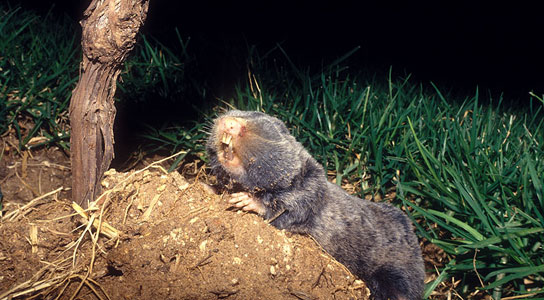
New cell cultures from two species of blind mole rats, Spalax judaei and Spalax golani, behave in ways that render them impervious to the growth of tumors.
The scientists published their findings in the journal PNAS. Vera Gorbunova, from the University of Rochester in New York, and her colleagues have shown that the rodents have evolved a different way of dealing with cancer than a similarly cancer-resistant cousin, Heterocephalus glaber.
23% of humans die of cancer, but blind mole rats, which can live up to 21 years, seem to be mostly immune to the disease. These animals are subject to terrific stresses underground, darkness, scarcity of food, immense numbers of pathogens, and low oxygen levels, states co-author Eviatar Nevo, from the University of Haifa in Israel. They evolved a range of molecular mechanisms to cope with these difficulties.
In naked mole rats, culture of their cells indicates that they cease to divide much sooner than cells from other species. It was thought that blind mole rats used the same mechanism as the naked mole rats, but they don’t. Rather than ceasing to divide, the cells of blind mole rats reach a point where they die en masse in a concerted cell
This is triggered by the collective release of the signaling molecule interferon-beta, although what exactly causes this remains unclear. “The cells have some way of sensing when they are overproliferating, but we still don’t know precisely how they sense that,” Gorbunova says. “This is what we need to find out next, because it could provide some clue as to how we could activate the same process in human cells.”
“It is possible the researchers simply have not worked out adequate methods to maintain these cells long-term in culture,” Jerry Shay, who studies mechanisms of cellular aging and death at the University of Texas Southwestern Medical Center in Dallas, says. “It’s possible that the culture conditions are causing increased stress on the cells, resulting in cell death.”
While it is true that biologists haven’t worked out how to keep the cells alive long-term in culture, some believe the mass cell death might be the very thing that makes the animals so long-lived. It may be a natural mechanism their bodies use to clear precancerous cells, stopping tumors in their tracks.
Reference: “Cancer resistance in the blind mole rat is mediated by concerted necrotic cell death mechanism” by Vera Gorbunova, Christopher Hine, Xiao Tian, Julia Ablaeva, Andrei V. Gudkov, Eviatar Nevo and Andrei Seluanov, 5 November 2012, Proceedings of the National Academy of Sciences.
DOI: 10.1073/pnas.1217211109
Never miss a breakthrough: Join the SciTechDaily newsletter.
Follow us on Google and Google News.
3 Comments
This research is in the area of the Programmed Cell Death. Instead of every single cell dying at a normal pre-determined rate, a mass of cells are programmed to die together, which makes the division of cells very slow till the target mass is achieved. Slowing the cellular death somehow will make one live longer because ageing is retarded. You should note that if the cells refuse to die, it will lead to proliferation and this is nothing but cancer. If the cells die very fast it means apoptosis which indicates disease at a later stage and required in the embryology stage to stave of unnecessary organs developing. Genesis, Growth and Death are the three cardinals of living being which should be carefully monitored. Telomeres and Telomerases are the tools of ageing. This research shows a different root to slow down ageing and consequently to conquer cancer. I wish them all well. Thank You.
Wow, this article is truly amazing. If only one day we can discover a cure for cancer, it would be great.
Regards,
Richard Teo
this paper was published because one of the coauthor is a member of the national academy of science of USA and pratically can put in any paper he wishes in PNAS. Especially if he is, as Nevo is, an unrestrained, ego-maniac with no moral and ethics. He will send papers that he coauthored and has no expertise in the subject of the study so he has his name on yet another paper, to a dozen reviewers from his friends, and send to pnas editorial the two positives and get a free ride into the journal with no screening.
AS to the results: the paper is full of contradictions,there is no direct conection to cancer. There is no control to the experiment of interferone accumulation, like adding externally interferone and see if it is indeed the causative agent, and not just a result of contamination in the cell culture as known to every beginner that just got his 1st lesson in working with cell culture.