
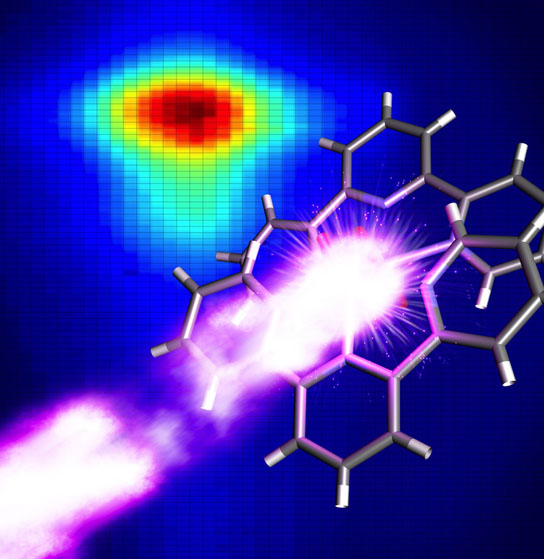
Using X-ray emission spectroscopy, a team of researchers reveal chemical information about molecules before they are destroyed.
Research at SLAC National Accelerator Laboratory demonstrates that ultrashort, ultrabright X-ray laser pulses can reveal details of chemically important molecules at room temperature and in their natural state. The technique could aid studies of photosynthesis and industrial catalysts, and opens the door to development of other analytic tools at SLAC’s Linac Coherent Light Source.
In the experiments, researchers used a technique known as X-ray emission spectroscopy to learn about the chemical makeup of samples and chemical changes occurring over time.
While spectroscopy has long been used at synchrotron facilities, sensitive samples are typically frozen to protect them from radiation damage, which in turn makes it very challenging to follow chemical reactions. The team has now shown that with the LCLS X-ray laser, these difficulties can be overcome.
A very simple example of a spectrometer is a prism that separates sunlight into a rainbow of colors. “The spectrometer used in the LCLS experiments works in a similar fashion, with an array of 16 specialized crystals that select the different ‘colors’ of emitted X-rays,” said Roberto Alonso-Mori, a research associate at SLAC who was in charge of building the new spectrometer.
He was the first author of a November 5 paper in Proceedings of the National Academy of Sciences detailing the research.
The team, led by Uwe Bergmann, deputy director for the LCLS, and Junko Yano and Vittal Yachandra at Lawrence Berkeley National Laboratory, focused on complexes containing manganese, an important element in the water-splitting step of photosynthesis. Similar complexes are also integral to some industrial catalysts.
Bergmann said the manganese compounds remained intact long enough to obtain detailed information about their chemical environment before being destroyed in the X-ray pulses.
“Previous experiments at LCLS have shown that the intact overall atomic structure of biological samples can be probed at room temperature before they are destroyed,” he said. “This study goes one step further, showing that even the local chemistry at the metal site can be probed.”
Team member Jan Kern, a research scientist at LCLS and Berkeley Lab, said, “The success of the experiments opens the door for more studies of metal-containing proteins and catalysts, especially the water-splitting catalyst in photosynthesis, and also to other types of spectroscopic techniques at LCLS.”
The technique can also be used in conjunction with X-ray diffraction, which reveals the overall structures of proteins and other molecules based on patterns produced when the X-ray light strikes the crystallized samples.
The research team has previously used diffraction at LCLS to study the structure of Photosystem II, and researchers have since conducted additional experiments using spectroscopy, with more experiments planned.
Bergmann said spectroscopy is the key to revealing chemical changes over time in sensitive samples studied at LCLS. “The atomic structure is important, but for a complete understanding of complex processes, like photosynthesis, the chemistry is what’s really important,” he said. “This paper is the first step.”
Reference: “Energy-dispersive X-ray emission spectroscopy using an X-ray free-electron laser in a shot-by-shot mode” by Roberto Alonso-Mori, Jan Kern, Richard J. Gildea, Dimosthenis Sokaras, Tsu-Chien Weng, Benedikt Lassalle-Kaiser, Rosalie Tran, Johan Hattne, Hartawan Laksmono, Julia Hellmich, Carina Glöckner, Nathaniel Echols, Raymond G. Sierra, Donald W. Schafer, Jonas Sellberg, Christopher Kenney, Ryan Herbst, Jack Pines, Philip Hart, Sven Herrmann, Ralf W. Grosse-Kunstleve, Matthew J. Latimer, Alan R. Fry, Marc M. Messerschmidt, Alan Miahnahri, M. Marvin Seibert, Petrus H. Zwart, William E. White, Paul D. Adams, Michael J. Bogan, Sébastien Boutet, Garth J. Williams, Athina Zouni, Johannes Messinger, Pieter Glatzel, Nicholas K. Sauter, Vittal K. Yachandra, Junko Yano and Uwe Bergmann, 5 November 2012, Proceedings of the National Academy of Sciences.
DOI: 10.1073/pnas.1211384109
The team also included scientists from SLAC’s Stanford Synchrotron Radiation Lightsource, the Stanford PULSE Institute, Technical University Berlin in Germany, Stockholm and Umeå universities in Sweden and the European Synchrotron Radiation Facility in France.
Never miss a breakthrough: Join the SciTechDaily newsletter.
Follow us on Google and Google News.