
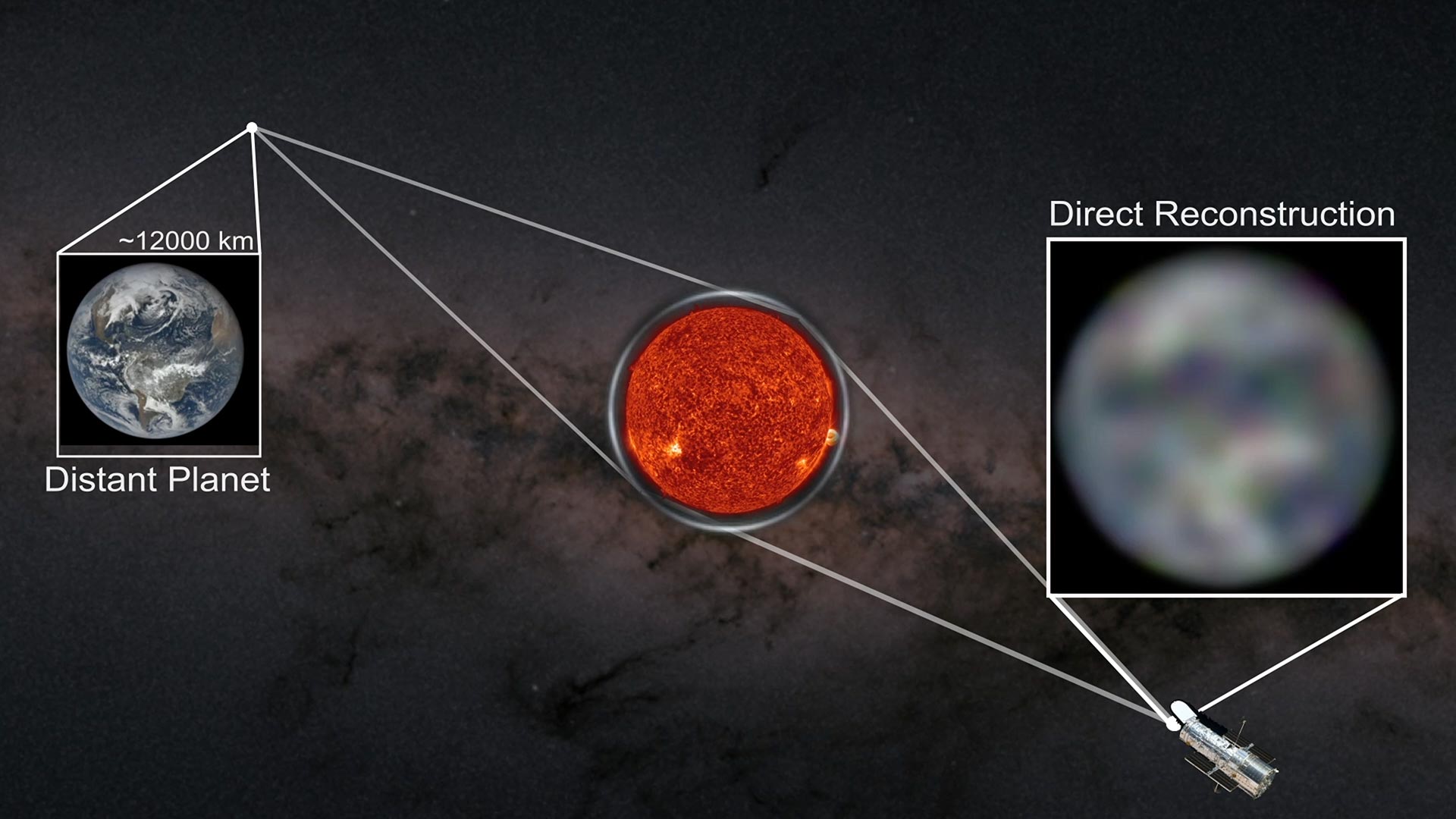
A futuristic “gravity telescope” technique conceptualized by Stanford astrophysicists could enable astronomical imaging significantly more advanced than any present today.
In the time since the first exoplanet was discovered in 1992, astronomers have discovered more than 5,000 planets orbiting other stars. However, when astronomers detect a new exoplanet, we learn relatively little about it: we know that it exists and a few features about it, but the rest is a mystery.
To sidestep the physical constraints of telescopes, Stanford University astrophysicists have been developing a new conceptual imaging technique that would be 1,000 times more precise than the strongest imaging technology currently in use. By taking advantage of gravity’s warping effect on space-time, called gravitational lensing, scientists could potentially manipulate this phenomenon to create imaging far more advanced than any currently available.
In a research paper published today (May 2, 2022) in The Astrophysical Journal, the astronomers describe a way to manipulate solar gravitational lensing to view planets outside our solar system. By positioning a telescope, the sun, and exoplanet in a line with the sun in the middle, scientists could use the gravitational field of the sun to magnify light from the exoplanet as it passes by. As opposed to a magnifying glass which has a curved surface that bends light, a gravitational lens has a curved space-time that enables imaging far away objects.
“We want to take pictures of planets that are orbiting other stars that are as good as the pictures we can make of planets in our own solar system,” said Bruce Macintosh, a physics professor at in the School of Humanities and Sciences at Stanford and deputy director of the Kavli Institute for Particle Astrophysics and Cosmology (KIPAC). “With this technology, we hope to take a picture of a planet 100 light-years away that has the same impact as Apollo 8’s picture of Earth.”
The catch, at present, is that their proposed technique would require more advanced space travel than is currently available. Still, the promise of this concept and what it could reveal about other planets, makes it worth continued consideration and development, said the researchers.
The Perks of Light Bending
Gravitational lensing wasn’t experimentally observed until 1919 during a solar eclipse. With the moon obstructing the light from the sun, scientists were able to see stars near the sun offset from their known positions. This was unequivocal proof that gravity could bend light and the first observational evidence that Einstein’s theory of relativity was correct. Later, in 1979, Von Eshleman, a Stanford professor, published a detailed account of how astronomers and spacecraft could exploit the solar gravitational lens. (Meanwhile, astronomers including many at Stanford’s KIPAC now routinely use the powerful gravity of the most massive galaxies to study the early evolution of the universe.)
But it wasn’t until 2020 that the imaging technique was explored in detail in order to observe planets. Slava Turyshev of California Institute of Technology’s Jet Propulsion Laboratory described a technique where a space-based telescope could use rockets to scan around the rays of light from a planet to reconstruct a clear picture, but the technique would require a lot of fuel and time.
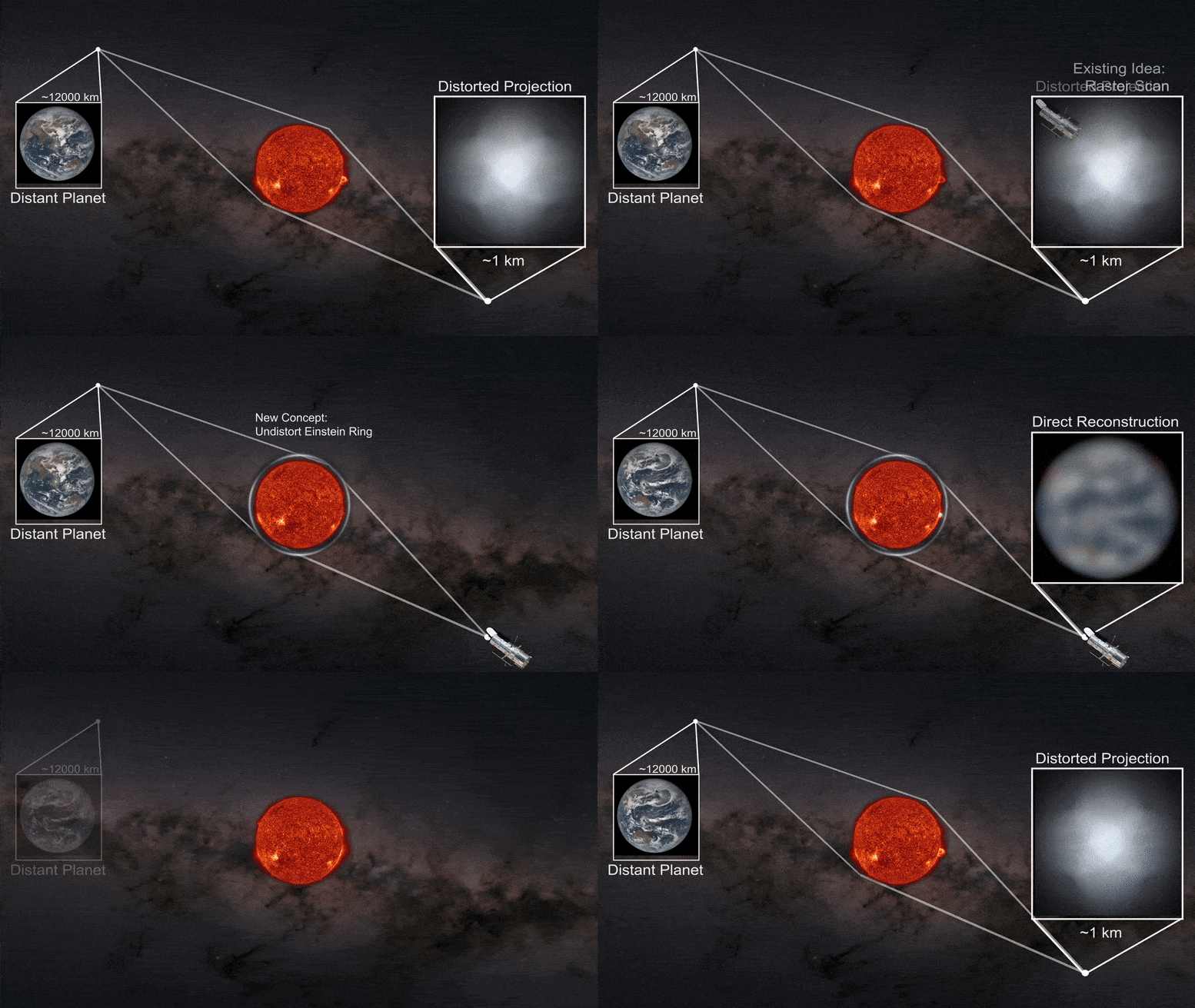
Building on Turyshev’s work, Alexander Madurowicz, a PhD student at KIPAC, invented a new method that can reconstruct a planet’s surface from a single image taken looking directly at the sun. By capturing the ring of light around the sun formed by the exoplanet, the algorithm Madurowicz designed can undistort the light from the ring by reversing the bending from the gravitational lens, which turns the ring back into a round planet.
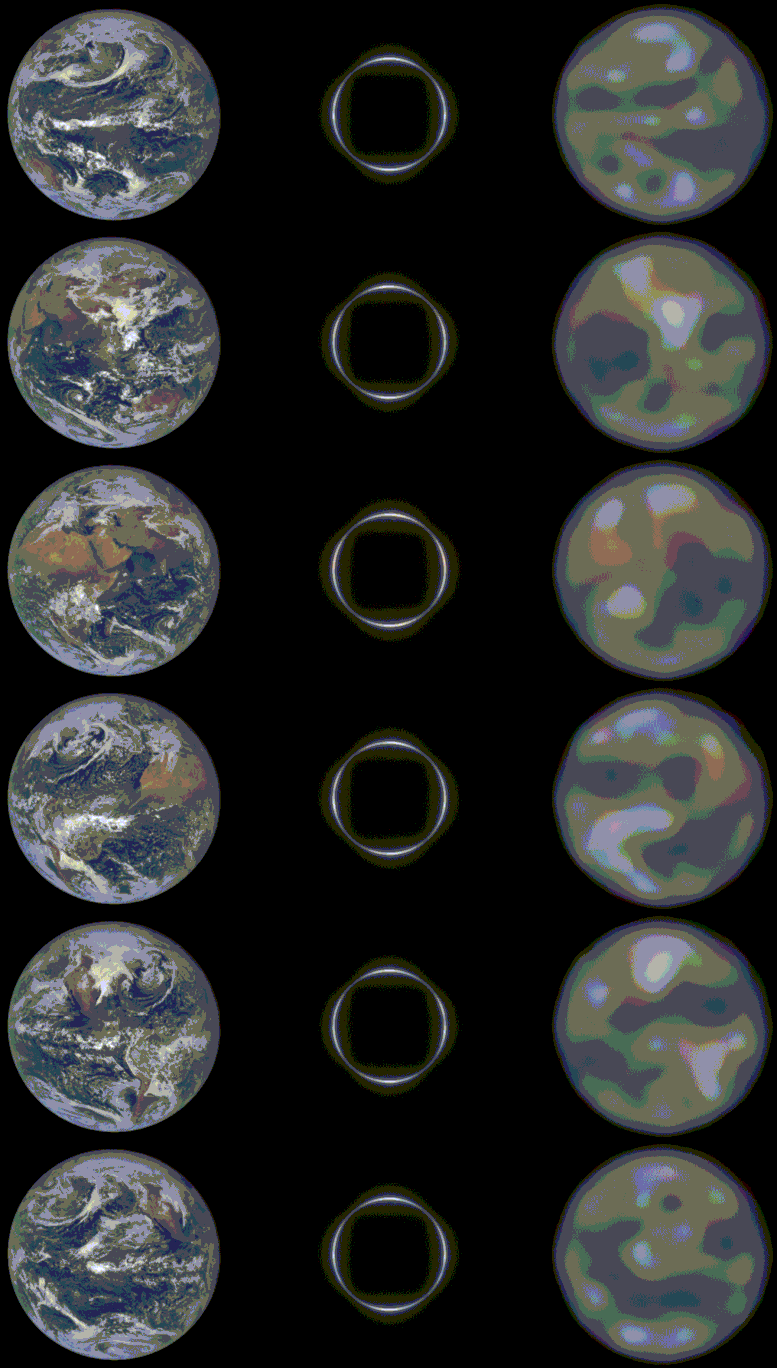
Madurowicz demonstrated his work by using images of the rotating Earth taken by the satellite DSCOVR that sits between Earth and the sun. Then, he used a computer model to see what Earth would look like peering through the warping effects of the sun’s gravity. By applying his algorithm to the observations, Madurowicz was able to recover the images of Earth and prove that his calculations were correct.
In order to capture an exoplanet image through the solar gravitational lens, a telescope would have to be placed at least 14 times farther away from the sun than Pluto, past the edge of our solar system, and further than humans have ever sent a spacecraft. But, the distance is a tiny fraction of the light-years between the sun and an exoplanet.
“By unbending the light bent by the sun, an image can be created far beyond that of an ordinary telescope,” Madurowicz said. “So, the scientific potential is an untapped mystery because it’s opening this new observing capability that doesn’t yet exist.”
Sights Set Beyond the Solar System
Currently, to image an exoplanet at the resolution the scientists describe, we would need a telescope 20 times wider than the Earth. By using the sun’s gravity like a telescope, scientists can exploit this as a massive natural lens. A Hubble-sized telescope in combination with the solar gravitational lens would be sufficient to image exoplanets with enough power to capture fine details on the surface.
“The solar gravitational lens opens up an entirely new window for observation,” said Madurowicz. “This will allow investigation of the detailed dynamics of the planet atmospheres, as well as the distributions of clouds and surface features, which we have no way to investigate now.”
Madurowicz and Macintosh both say that it will be a minimum of 50 years before this technology could be deployed, likely longer. In order for this to be adopted, we will need faster spacecraft because, with current technology, it could take 100 years to travel to the lens. Using solar sails or the sun as a gravitational slingshot, the time could be as short as 20 or 40 years. Despite the timeline’s uncertainty, the possibility to see whether some exoplanets have continents or oceans, Macintosh said, drives them. The presence of either is a strong indicator that there may be life on a distant planet.
“This is one of the last steps in discovering whether there’s life on other planets,” Macintosh said. “By taking a picture of another planet, you could look at it and possibly see green swatches that are forests and blue blotches that are oceans – with that, it would be hard to argue that it doesn’t have life.”
Reference: “Integral Field Spectroscopy with the Solar Gravitational Lens” by Alexander Madurowicz and Bruce Macintosh, 2 May 2022, The Astrophysical Journal.
DOI: 10.3847/1538-4357/ac5e9d
Macintosh is also a member of Stanford Bio-X. The research was sponsored by the NASA grant NNX15AD95G, which relies on the Nexus for Exoplanet System Science (NExSS) coordination network.
Never miss a breakthrough: Join the SciTechDaily newsletter.
Follow us on Google and Google News.
6 Comments
This is very clever and I am sure that Einstein is smiling! The only challenge that I have is how to explain this simplistically to my Grandkids, 7, 5 and 4 years old. Newton is easy; an apple falling out of our apple tree in season!
Keep up the good work.
What if there is a better way though?:
“There’s a trick that we’ve leveraged in very long wavelengths of light that could, in principle, work for optical wavelengths as well: very-long-baseline interferometry. If we could build a network of small optical telescopes distributed throughout the Solar System, we’d only get the light-gathering power of the sum of the areas of all of the individual telescopes, but we’d get the resolution of the separation between the telescopes! It’s an incredible challenge, but if we can rise to it, we just might be able to image a greater level of detail than optical astronomers have ever thought possible. Even though it’s a long shot, it might be our best technological hope of seeing what alien life actually looks like.”
The tricky part of VLBI is that you have to locate each detector to within a small fraction of a wavelength of the “light” you’re observing at. Easy for ground-based radio telescopes. Difficult but do-able for ground-based optical telescopes at the same facility (Keck in Hawaii). Quite challenging for independently orbiting detectors! Maybe you could use a synthetic star with femtosecond timing to sync them all?
This is a not a new idea it was proposed decades ago to do this. More recently the Earth was suggested to be used as a lens. Check out cool worlds youtube channel on terraearth.
Probably no need to go that far away to take a single picture – tou can have several telescopes closer and captchure the similar rays of light earlier. An array may be needed to get close as earlier commenter stated
Why aren’t black holes and neutron starts used for gravity lensing, or are they? Our sun’s gravity is tiny in comparison.