
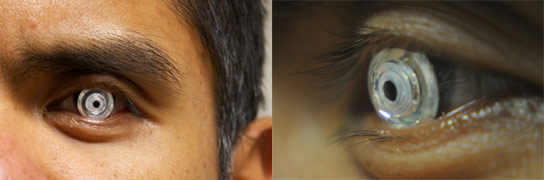
In an effort to help improve the vision of patients suffering from eye disease, engineers from the Jacobs School of Engineering at UC San Diego have developed a telescopic contact lens that can switch between normal and magnified vision.
A team of engineers has designed a telescopic contact lens that can switch between normal and magnified vision by using slightly modified off-the-shelf 3D television glasses. The researchers, led by Joseph Ford, a professor of electrical engineering at the University of California, San Diego, built a prototype of the lens and tested it on a mechanical eye. Researchers report their findings in the June 27 online issue of Optics Express, an open-access journal of the Optical Society.
The new lens could ultimately be used to improve vision for patients suffering from eye disease, including age-related macular degeneration, or AMD, a condition that causes loss of vision in the center of the visual field. Patients typically cannot read or recognize faces.
Ongoing research on the lenses is funded through a larger research program. Last summer, UC San Diego researchers worked with partners at Innovega and Paragon Vision Sciences to conduct human clinical trials on a preliminary version of the wearable lens. A second round of clinical trials will occur later this year.
Said Ford, the principal investigator on the project, “While there is a great deal of work still ahead, we see a clear path to a comfortable low-vision aid powered by a contact lens, which will help a significant number of people who have impaired vision.”
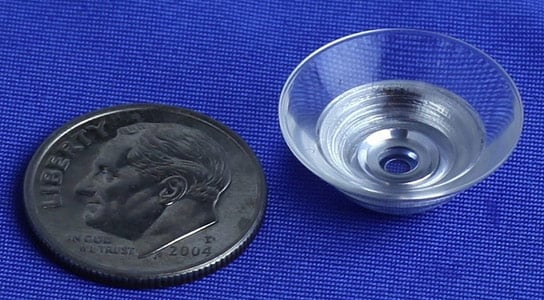
The contact lens developed by Ford’s team is one millimeter thick. Researchers used aluminum mirrors, fit tightly together, to create a ring-shaped telescope embedded in the contact lens. The center of the lens allows for normal, non-magnified vision. Its periphery, where the telescope is located, magnifies images 2.8 times.
The telescopic contact lens, once fine-tuned, will be less invasive than the miniature telescopes that can currently be implanted into patients’ eyes. In addition, the lens the researchers developed does a better job at collecting light. The lens is also less bulky than telescopes mounted on glasses that are currently available to help patients with impaired vision. The contact lens’ optics make it possible to switch between normal and magnified vision by combining the contact lenses with glasses such as the “active shutter” glasses worn to watch some 3D televisions.
Switching between normal and magnified vision
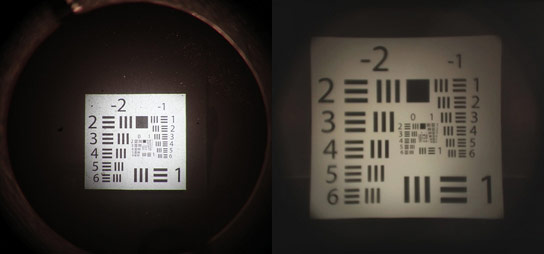
Without the glasses, the contact lenses superimpose both normal and magnified images. With the glasses on, a liquid crystal shutter will switch open a window for normal or telescopic vision. Researchers are working on a hands-free switch that uses a low-power infrared LED to monitor when the user blinks with both eyes or winks with one eye to activate one of the two functions.
The lenses of the 3D glasses contain liquid crystals, which switch the two sections of the telescopic contact lens on and off. The crystals change the way light is refracted onto polarized films embedded in the contact lens, so that only light with a certain orientation, or polarization, passes through the glasses to the contact lens, hitting either the telescopic portion of the lens, or the area designed for normal vision.
Testing the lens
The researchers tested the lens on a life-size mechanical model of the eye that they built. The model was connected to a complex imaging system that allowed engineers to see on a computer screen what their mechanical eye saw. They also ran complex computer models to simulate the lens’ performance.
Tests performed with the mechanical eye showed that the lens’ magnified image provides a much larger field of vision than other magnification approaches currently in use. The quality of the images was also good.
Next steps
Researchers built the lens with a material commonly used in early rigid contact lenses, called polymethyl methacrylate, or PMMA, which is impermeable to gasses. As a result, contact lenses made of PMMA can only be worn for short periods of time, because they do not deliver much needed oxygen to the cornea.
The researchers chose PMMA for its robustness and because they had to carve tiny grooves that bend light onto the lens to correct for aberrant color. That aberration was caused by the lens’ shape, which was designed to fit the human eye. The grooves also meant that the contact lenses would have to be fitted with a soft “skirt” in order to be wearable—a process used with rigid contact lenses today.
Engineers are now working on a new telescopic contact lens design that uses a material permeable to gasses, which could be worn by users for longer periods of time. They also are working to correct aberrant color without carving grooves into the lens.
The finished contact lenses will have polarizers integrated into the center or edge of the contact lens surface. In early lab tests the polarizers were attached externally, and a pair of 3D TV glasses was modified to do the switching.
“In the future, it will hopefully be possible to go after the core of the problem with effective treatments or retinal prosthetics,” said Eric Tremblay, co-author on the paper and alumnus of Ford’s research group, now at the École Polytechnique Fédérale de Lausanne (EPFL) in Switzerland. “The ideal is really for magnifiers to become unnecessary. Until we get there, however, contact lenses may provide a way to make AMD a little less debilitating.”
The team
The Optics Express paper reported only on the initial optical design and laboratory testing, and researchers from UC San Diego, the École Polytechnique Fédérale de Lausanne, and Pacific Science and Engineering. A larger team is now involved in making a wearable form of the lens, and includes:
- Joseph Ford, principal investigator, Alex Groisman, Igor Stamenov, and Ash Arianpour at UC San Diego
- Eric Tremblay at the École Polytechnique Fédérale de Lausanne
- William Meyers, Goretty Alonso, and Josh Cummings at Paragon Vision Sciences
- Randy Sprague, Arthur Zhang, and Jerry Legerton at Innovega
- Dirk Beer at Pacific Science and Engineering
- LCDR Tyler Miles at the Naval Medical Center San Diego
- W. Lee Hendrick, Ty O’Brien, and Augusto Alvarez at Rockwell Collins
Reference: “Switchable telescopic contact lens” by Eric. J. Tremblay, Igor Stamenov, R. Dirk Beer, Ashkan Arianpour and Joseph E. Ford, 27 June 2013, Optics Express.
DOI: 10.1364/OE.21.015980
Never miss a breakthrough: Join the SciTechDaily newsletter.
Follow us on Google and Google News.
5 Comments
I am absolutely astounded with the new techological advancements and biomedical inventions for those with disabilities and impariments. I believe that a combination of this new invention and the bionic ear, people can live noral lives, without the obstacles of their impariments. I do have one question in regars to the Telescopic Lens, does it need to be placed in the eye daily? Somewhat like the normal way of having contact lenses, or can it be left on the eye during sleep? If it can, are there any potentially harmful effects that could damage the eye? Thank you.
what liquid crystals are going to be used here?
Hello, you are awesome! keep going!
Instead of contacts, put into eyeglass frame for super flat binoculars!!! Or just adjustable lenses, one pair fits all…
Victims of AMD will not be the only ones to benefit from this advance. Lenses such as these will have a much wider range of uses.
They are bound to be an improvement over the head mounted optics used by surgeons, dentists, and anyone else working with small components or where extreme precision is required.