
Close Menu
    Facebook X (Twitter) Instagram
    SciTechDaily
    • Biology
    • Chemistry
    • Earth
    • Health
    • Physics
    • Science
    • Space
    • Technology
    Facebook X (Twitter) Pinterest YouTube RSS
    SciTechDaily
    Home»Physics»Researchers Demonstrate “Teleportation” of a Quantum Gate
    Physics

    Researchers Demonstrate “Teleportation” of a Quantum Gate

    By Jim Shelton, Yale UniversitySeptember 6, 2018No Comments4 Mins Read
    Facebook Twitter Pinterest Telegram LinkedIn WhatsApp Email Reddit
    Share
    Facebook Twitter LinkedIn Pinterest Telegram Email Reddit
    Yale Scientists ‘Teleport’ A Quantum Gate
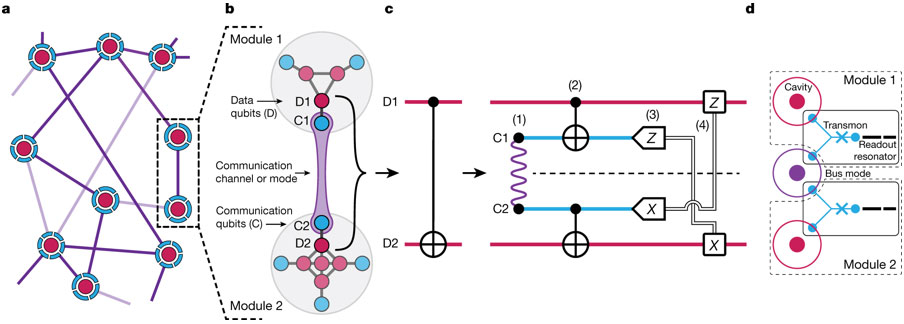
    a, Network overview of the modular quantum architecture. Modules are represented as nodes of a quantum network and are composed of data qubit(s) (magenta) and communication qubit(s) (cyan). Coupling between modules is generated through reconfigurable communication channels that may be enabled (dark purple lines) or disabled (light purple lines). b, Quantum modules. Each module houses a small quantum processor that is capable of high-fidelity operations among data qubits and communication qubits. In our experiment, we create two modules, each consisting of one data qubit (D1 and D2) and one communication qubit (C1 and C2). c, Teleported CNOT circuit between D1 and D2. The teleported CNOT circuit requires: (1) entanglement between C1 and C2 (purple meander), (2) local operations, (3) measurement of C1 in the ZˆZˆ basis and C2 in the XˆXˆ basis, where XˆXˆ and ZˆZˆ are Pauli operators, and (4) classical communication (double lines) and feedforward operations. d, Experimental realization (schematic top view) in a three-dimensional circuit-quantum-electrodynamics implementation. Each module consists of a data qubit defined as a coaxial quarter-wavelength (λ/4) three-dimensional cavity (magenta), a communication qubit defined as a Y-shaped transmon qubit (cyan) and a Purcell-filtered, quasi-planar, λ/2 stripline readout resonator (black). In this experiment, the two modules are linked by an additional mode realized as a coaxial λ/4 three-dimensional cavity (purple) that serves as a bus mode. Nature, 2018.

    Yale University researchers have demonstrated one of the key steps in building the architecture for modular quantum computers: the “teleportation” of a quantum gate between two qubits, on demand. The findings appear online on September 5 in the journal Nature.

    The key principle behind this new work is quantum teleportation, a unique feature of quantum mechanics that has previously been used to transmit unknown quantum states between two parties without physically sending the state itself. Using a theoretical protocol developed in the 1990s, Yale researchers experimentally demonstrated a quantum operation, or “gate,” without relying on any direct interaction. Such gates are necessary for quantum computation that relies on networks of separate quantum systems — an architecture that many researchers say can offset the errors that are inherent in quantum computing processors.

    Through the Yale Quantum Institute, a Yale research team led by principal investigator Robert Schoelkopf and former graduate student Kevin Chou is investigating a modular approach to quantum computing. Modularity, which is found in everything from the organization of a biological cell to the network of engines in the latest SpaceX rocket, has proved to be a powerful strategy for building large, complex systems, the researchers say. A quantum modular architecture consists of a collection of modules that function as small quantum processors connected into a larger network.

    Modules in this architecture have a natural isolation from each other, which reduces unwanted interactions through the larger system. Yet this isolation also makes performing operations between modules a distinct challenge, according to the researchers. Teleported gates are a way to implement inter-module operations.

    “Our work is the first time that this protocol has been demonstrated where the classical communication occurs in real-time, allowing us to implement a ‘deterministic’ operation that performs the desired operation every time,” Chou said.

    Fully useful quantum computers have the potential to reach computation speeds that are orders of magnitude faster than today’s supercomputers. Yale researchers are at the forefront of efforts to develop the first fully useful quantum computers and have done pioneering work in quantum computing with superconducting circuits.

    Quantum calculations are done via delicate bits of data called qubits, which are prone to errors. In experimental quantum systems, “logical” qubits are monitored by “ancillary” qubits in order to detect and correct errors immediately. “Our experiment is also the first demonstration of a two-qubit operation between logical qubits,” Schoelkopf said. “It is a milestone toward quantum information processing using error-correctable qubits.”

    Co-authors of the study are current and former Yale graduate students Jacob Blumoff, Christopher Wang, Philip Reinhold, Christopher Axline, and Yvonne Gao; senior research scientist Luigi Frunzio; and professors Michel Devoret and Liang Jiang.

    The Army Research Office and the Office for Naval Research supported the work.

    Reference: “Deterministic teleportation of a quantum gate between two logical qubits” by Kevin S. Chou, Jacob Z. Blumoff, Christopher S. Wang, Philip C. Reinhold, Christopher J. Axline, Yvonne Y. Gao, L. Frunzio, M. H. Devoret, Liang Jiang and R. J. Schoelkopf, 5 September 2018, Nature.
    DOI: 10.1038/s41586-018-0470-y

    Never miss a breakthrough: Join the SciTechDaily newsletter.
    Follow us on Google and Google News.

    Quantum Physics Quantum Teleportation Yale University
    Share. Facebook Twitter Pinterest LinkedIn Email Reddit

    Related Articles

    Scientists Achieve New Quantum Teleportation Record

    New Form of Quantum Friction Observed

    New Half-Light Half-Matter Quantum Particles

    Chip-Scale Device Enables Yale Engineers to ‘See Without Looking’

    UNIGE Physicists Teleport Quantum State of a Photon to a Crystal

    Physicists Track Quantum Errors in Real Time

    Physicists Create and Control a Large Quantum Mechanical System Built on Photons

    Theoretical Physicists Devise Rules for More Effective Teleportation

    The Quantum Teleportation Race Goes Into Space in 2016

    Leave A Reply Cancel Reply

    • Facebook
    • Twitter
    • Pinterest
    • YouTube

    Don't Miss a Discovery

    Subscribe for the Latest in Science & Tech!

    Trending News

    Breakthrough Bowel Cancer Trial Leaves Patients Cancer-Free for Nearly 3 Years

    Natural Compound Shows Powerful Potential Against Rheumatoid Arthritis

    100,000-Year-Old Neanderthal Fossils in Poland Reveal Unexpected Genetic Connections

    Simple “Gut Reset” May Prevent Weight Gain After Ozempic or Wegovy

    2.8 Days to Disaster: Scientists Warn Low Earth Orbit Could Suddenly Collapse

    Common Food Compound Shows Surprising Power Against Superbugs

    5 Simple Ways To Remember More and Forget Less

    The Atomic Gap That Could Cost the Semiconductor Industry Billions

    Follow SciTechDaily
    • Facebook
    • Twitter
    • YouTube
    • Pinterest
    • Newsletter
    • RSS
    SciTech News
    • Biology News
    • Chemistry News
    • Earth News
    • Health News
    • Physics News
    • Science News
    • Space News
    • Technology News
    Recent Posts
    • Harvard Breakthrough Brings Powerful UV Light Sources Onto a Chip
    • This Strange Quantum “Dance” Could Rewrite Superconductivity
    • Scientists Make Breakthrough in Turning Plastic Trash Into Clean Fuel Using Sunlight
    • Scientists Complete Largest 3D Map of the Universe to Probe Dark Energy
    • Hidden Parasite Found in Popular Portuguese Lake Raises Health Concerns
    Copyright © 1998 - 2026 SciTechDaily. All Rights Reserved.
    • Science News
    • About
    • Contact
    • Editorial Board
    • Privacy Policy
    • Terms of Use

    Type above and press Enter to search. Press Esc to cancel.