
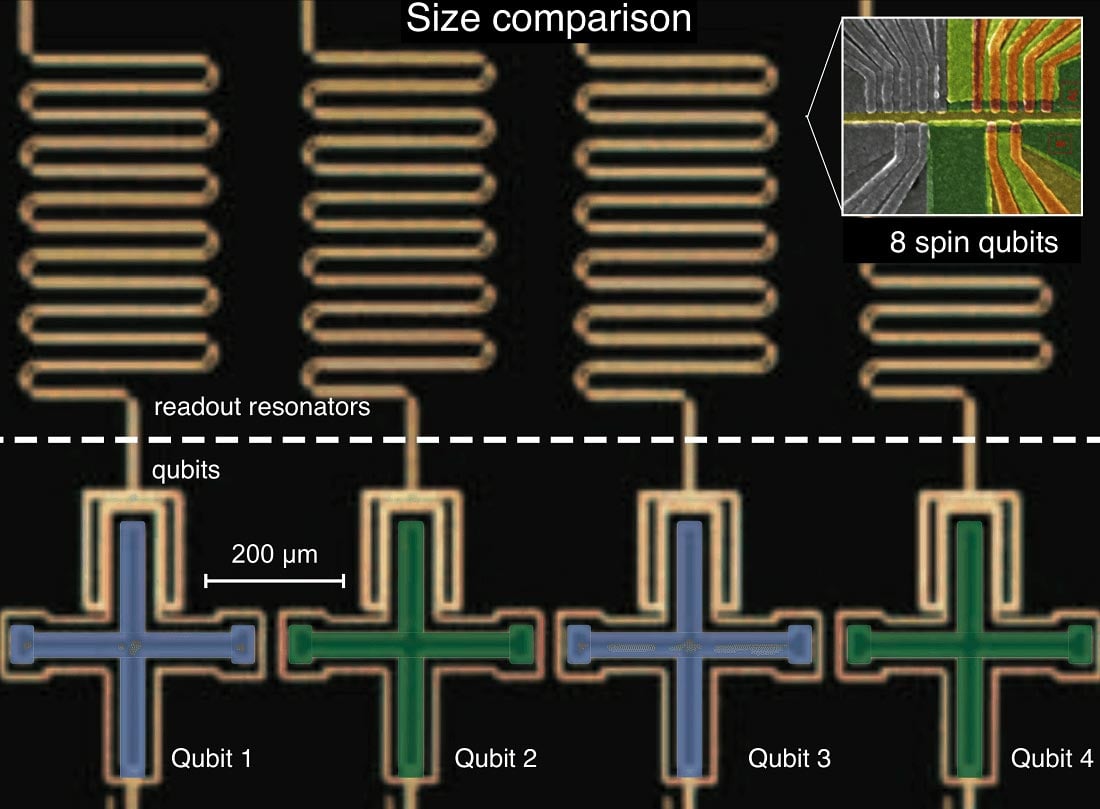
Quantum physicists at the University of Copenhagen are reporting an international achievement for Denmark in the field of quantum technology. By simultaneously operating multiple spin qubits on the same quantum chip, they surmounted a key obstacle on the road to the supercomputer of the future. The result bodes well for the use of semiconductor materials as a platform for solid-state quantum computers.
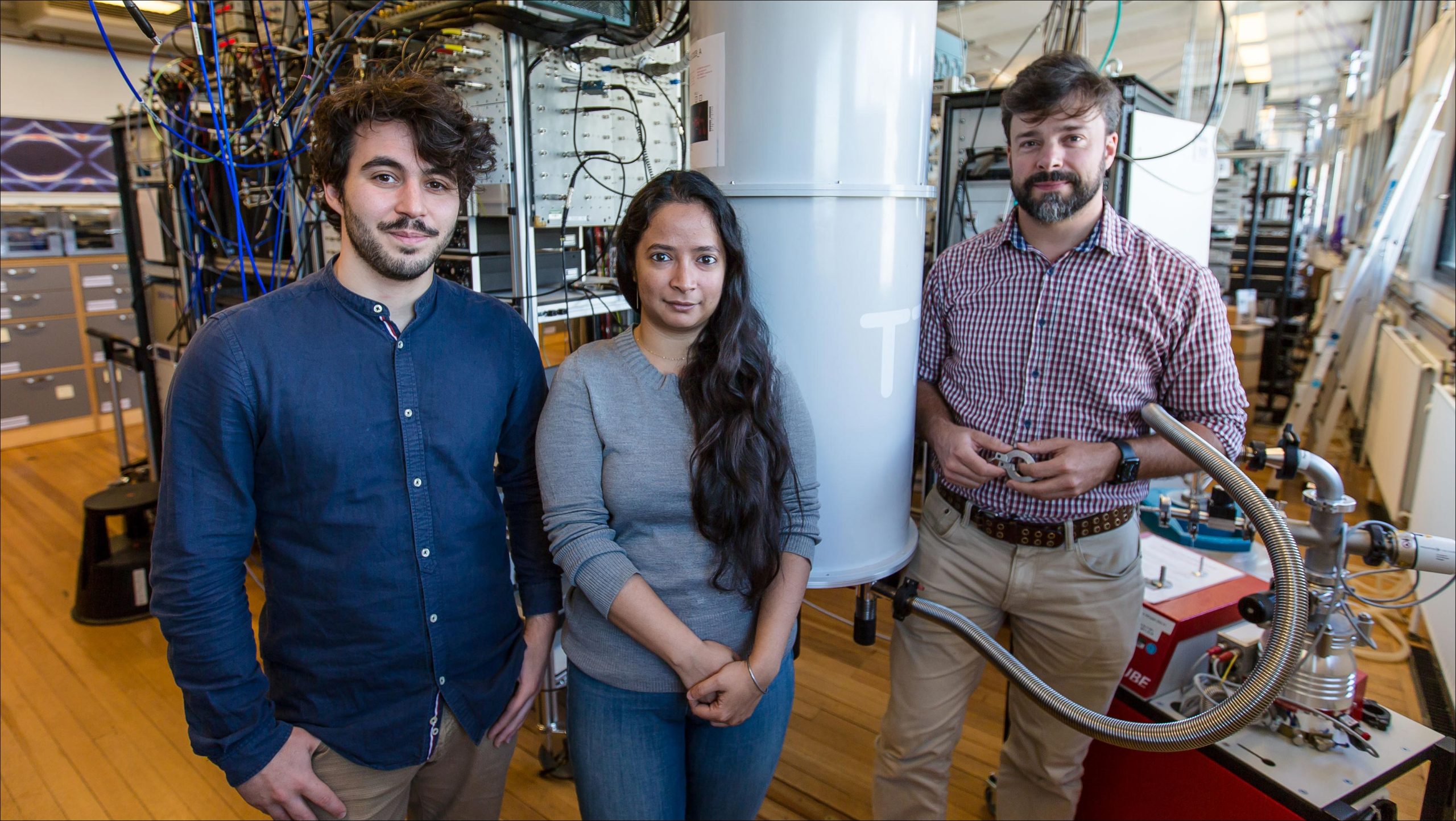
One of the engineering headaches in the global marathon towards a large functional quantum computer is the control of many basic memory devices – qubits – simultaneously. This is because the control of one qubit is typically negatively affected by simultaneous control pulses applied to another qubit. Now, a pair of young quantum physicists at the University of Copenhagen’s Niels Bohr Institute –PhD student, now Postdoc, Federico Fedele, 29 and Asst. Prof. Anasua Chatterjee, 32,– working in the group of Assoc. Prof. Ferdinand Kuemmeth, have managed to overcome this obstacle.
About Qubits
The brain of the quantum computer that scientists are attempting to build will consist of many arrays of qubits, similar to the bits on smartphone microchips. They will make up the machine’s memory.
The famous difference is that while an ordinary bit can either store data in the state of a 1 or 0, a qubit can reside in both states simultaneously – known as quantum superposition – which makes quantum computing exponentially more powerful.
Global qubit research is based on various technologies. While Google and IBM have come far with quantum processors based on superconductor technology, the UCPH research group is betting on semiconductor qubits – known as spin qubits.
“Broadly speaking, they consist of electron spins trapped in semiconducting nanostructures called quantum dots, such that individual spin states can be controlled and entangled with each other,” explains Federico Fedele.
Spin qubits have the advantage of maintaining their quantum states for a long time. This potentially allows them to perform faster and more flawless computations than other platform types. And, they are so minuscule that far more of them can be squeezed onto a chip than with other qubit approaches. The more qubits, the greater a computer’s processing power. The UCPH team has extended the state of the art by fabricating and operating four qubits in a 2×2 array on a single chip.
Circuitry Is ‘The Name of the Game’
Thus far, the greatest focus of quantum technology has been on producing better and better qubits. Now it’s about getting them to communicate with each other, explains Anasua Chatterjee:
“Now that we have some pretty good qubits, the name of the game is connecting them in circuits which can operate numerous qubits, while also being complex enough to be able to correct quantum calculation errors. Thus far, research in spin qubits has gotten to the point where circuits contain arrays of 2×2 or 3×3 qubits. The problem is that their qubits are only dealt with one at a time.”
It is here that the young quantum physicists’ quantum circuit, made from the semiconducting substance gallium arsenide and no larger than the size of a bacterium, makes all the difference:
“The new and truly significant thing about our chip is that we can simultaneously operate and measure all qubits. This has never been demonstrated before with spin qubits – nor with many other types of qubits,” says Chatterjee, who is one of two lead authors of the study, which has recently been published in the journal Physical Review X Quantum.
About the Chip
The four spin qubits in the chip are made of the semiconducting material gallium arsenide. Situated between the four qubits is a larger quantum dot that connects the four qubits to each other, and which the researchers can use to tune all of the qubits simultaneously.
Being able to operate and measure simultaneously is essential for performing quantum calculations. Indeed, if you have to measure qubits at the end of a calculation – that is, stop the system to get a result – the fragile quantum states collapse. Thus, it is crucial that measurement is synchronous, so that the quantum states of all qubits are shut down simultaneously. If qubits are measured one by one, the slightest ambient noise can alter the quantum information in a system.
Milestone
The realization of the new circuit is a milestone on the long road to a semiconducting quantum computer.
“To get more powerful quantum processors, we have to not only increase the number of qubits, but also the number of simultaneous operations, which is exactly what we did” states Professor Kuemmeth, who directed the research.
At the moment, one of the main challenges is that the chip’s 48 control electrodes need to be tuned manually, and kept tuned continuously despite environmental drift, which is a tedious task for a human. That’s why his research team is now looking into how optimization algorithms and machine learning could be used to automate tuning. To allow fabrication of even larger qubit arrays, the researchers have begun working with industrial partners to fabricate the next generation of quantum chips. Overall, the synergistic efforts from computer science, microelectronics engineering, and quantum physics may then lead spin qubits to the next milestones.
Reference: “Simultaneous Operations in a Two-Dimensional Array of Singlet-Triplet Qubits” by Federico Fedele, Anasua Chatterjee, Saeed Fallahi, Geoffrey C. Gardner, Michael J. Manfra and Ferdinand Kuemmeth, 8 October 2021, PRX Quantum.
DOI: 10.1103/PRXQuantum.2.040306
Never miss a breakthrough: Join the SciTechDaily newsletter.
Follow us on Google and Google News.