
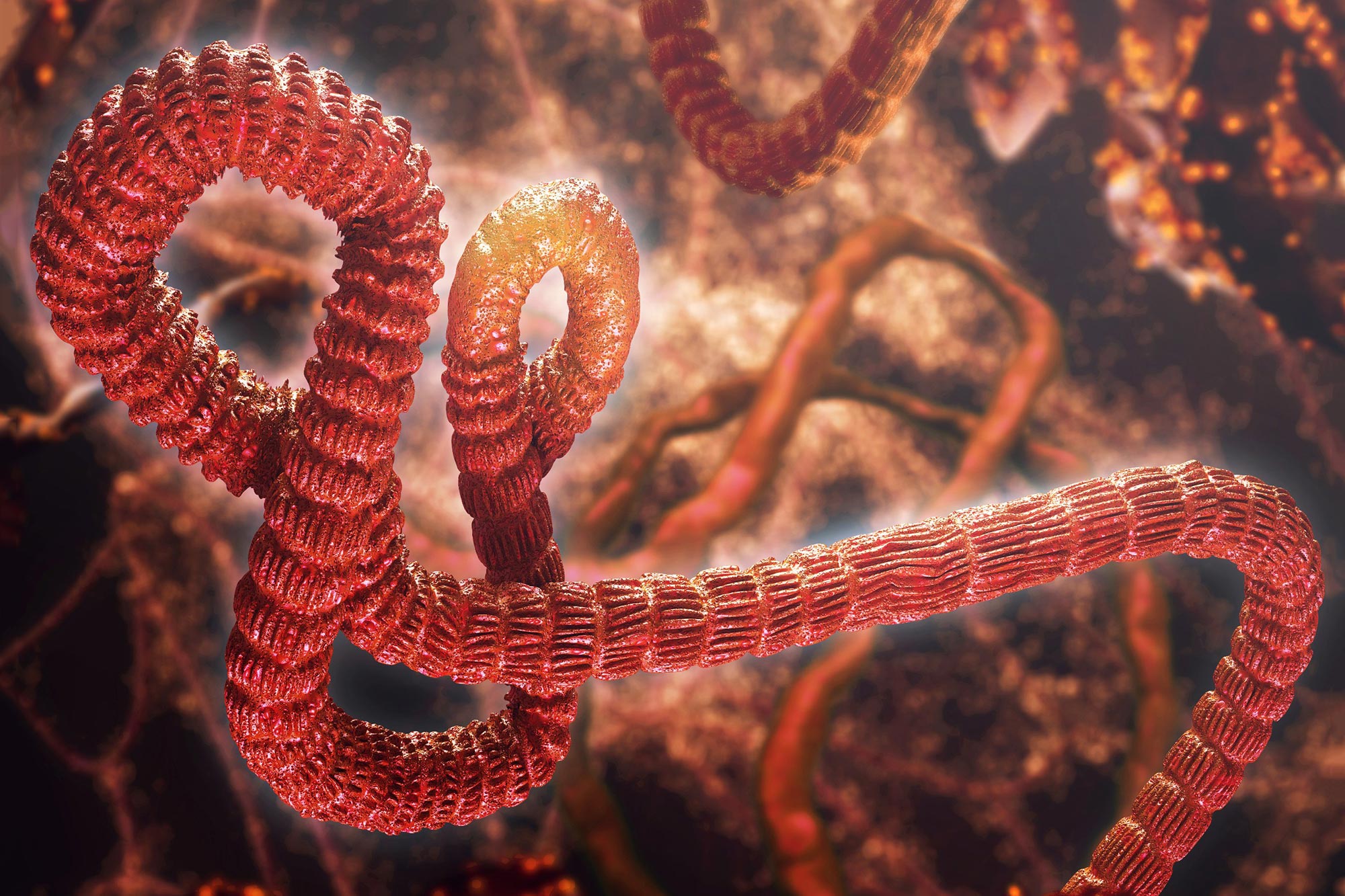
A U.S.-Canada study co-led by UdeM researchers offers key understanding of Ebola virus replication and potential therapeutic targets.
Scientists in Canada and the U.S. have discovered a new way in which Ebola – an often deadly virus affecting people mostly in sub-Saharan Africa – reproduces in the body.
By shedding light on how the virus interacts with a human protein called ubiquitin, the researchers have also identified a potential target for new drugs to prevent the disease.
Published in PLOS Biology, the study involves pharmacologists at Université de Montréal, infectious-disease specialists at Rutgers University, and microbiologists, immunologists and pathologists at the University of Texas Medical Branch (Galveston).
Understanding Viral Replication
“We used a combination of experimental and computational methods to investigate the interaction between the Ebola virus VP35 protein and ubiquitin chains,” said co-author Rafael Najmanovich, a professor in the pharmacology department of UdeM’s medical faculty.
“Advanced computational modeling by our team here at UdeM predicted the binding interface between a viral protein, VP35, and the ubiquitin chains in human cells, and identified potential chemical compounds that could disrupt this interaction,” he said.
“This discovery not only deepens our understanding of how the virus works, but also offers a promising avenue for the creation of more effective therapies. In particular, it paves the way for the design of drugs capable of disrupting this interaction and slowing down viral replication.”
Implications for Ebola Treatment
Notorious for its devastating outbreaks and high mortality rates, Ebola virus poses a significant threat to public health. Understanding the intricate processes by which the virus replicates within the human body is essential for developing effective treatments.
The new study unravels some of the molecular intricacies of Ebola virus replication, shedding light on key proteins and pathways involved in the process. Using advanced molecular and cell biology, biophysics and computational techniques, the researchers were able to clarify structural and functional aspects of viral and human proteins interacting in a manner critical for viral replication.
One of the key findings of the study is the identification of one additional interaction for VP35, a multifunctional viral protein that plays a central role in viral replication. The study revealed insights into the intricate interplay between Ebola virus and the host immune system. By evading detection and subverting host defenses, the virus is able to establish a foothold within the body, leading to unchecked replication and severe disease progression.
“This research underlines the importance of trying to understand the complex workings of viruses such as Ebola, and to develop innovative strategies to combat them,” said Najmanovich.
“And importantly, with our study we’re contributing to the broader goal of finding accessible and effective treatments for Ebola virus infections, an important cog in the fight against infectious diseases.”
Reference: “Ebola virus VP35 interacts non-covalently with ubiquitin chains to promote viral replication” by Carlos A. Rodríguez-Salazar, Sarah van Tol, Olivier Mailhot, Maria Gonzalez-Orozco, Gabriel T. Galdino, Abbey N. Warren, Natalia Teruel, Padmanava Behera, Kazi Sabrina Afreen, Lihong Zhang, Terry L. Juelich, Jennifer K. Smith, María Inés Zylber, Alexander N. Freiberg, Rafael J. Najmanovich, Maria I. Giraldo and Ricardo Rajsbaum, 29 February 2024, PLOS Biology.
DOI: 10.1371/journal.pbio.3002544
Never miss a breakthrough: Join the SciTechDaily newsletter.
Follow us on Google and Google News.