
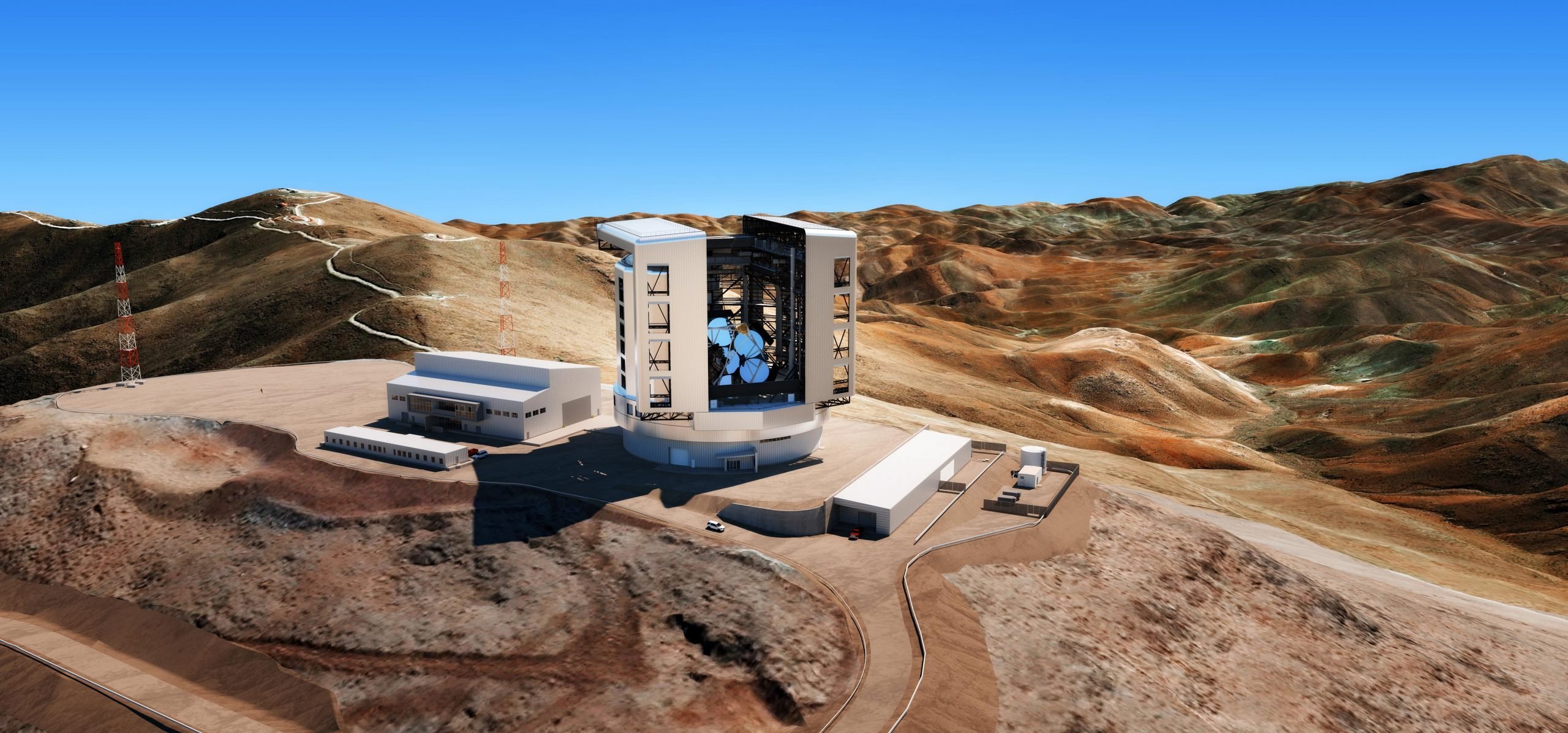
The Giant Magellan Telescope will offer unmatched clarity and power to explore exoplanets, dark matter, and the origins of stars and galaxies.
The Giant Magellan Telescope will be one of the few super giant earth-based telescopes that promises to revolutionize our view and understanding of the universe. It will be constructed at the Las Campanas Observatory in Chile. Commissioning of the telescope is scheduled to begin in 2021.
The GMT is a segmented mirror telescope that employs seven of today’s largest stiff monolithic mirrors as segments. Six off-axis 8.4-meter (27.6-foot) segments surround a central on-axis segment, forming a single optical surface 24.5 meters (80.3 feet) in diameter, with a total collecting area of 368 square meters (3,961 square feet). Harvard University and the Smithsonian Institution are both members of the GMT project, which also includes Astronomy Australia Ltd., the Australian National University, the Carnegie Institution for Science, the Korea Astronomy and Space Science Institute, the São Paulo Research Foundation, the University of Texas at Austin, Texas A&M University, the University of Arizona, and the University of Chicago.
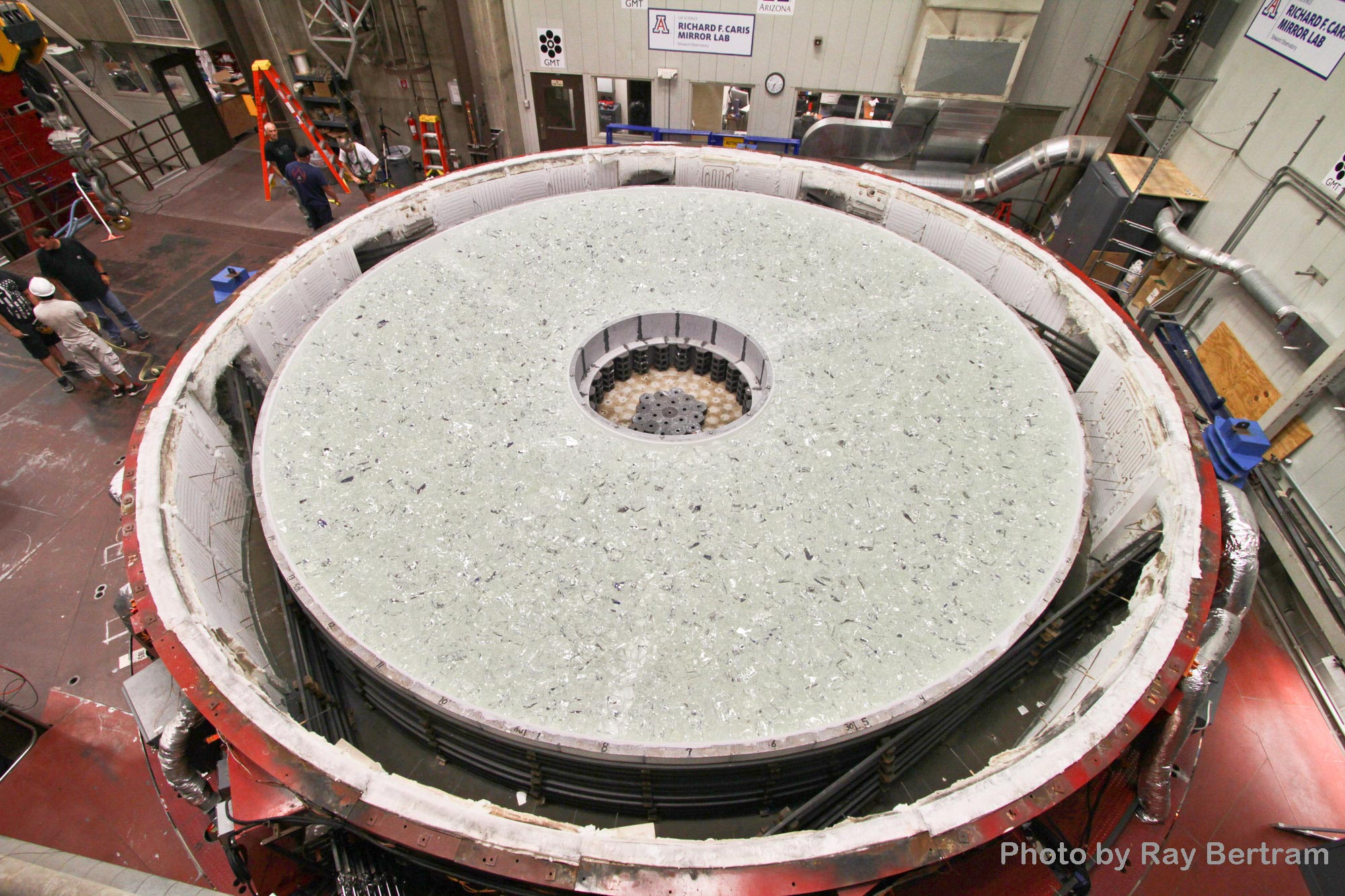
The GMT primary mirrors are made at the Steward Observatory Mirror Lab in Tucson, Arizona. They are a marvel of modern engineering and glassmaking; each segment is curved to a very precise shape and polished to within a wavelength of light—approximately one-millionth of an inch. Light from the edge of the universe will first reflect off of the seven primary mirrors, then reflect again off of the seven smaller secondary mirrors to travel down through the center primary mirror hole to form a single focus on one of various advanced instruments that will analyze the light.
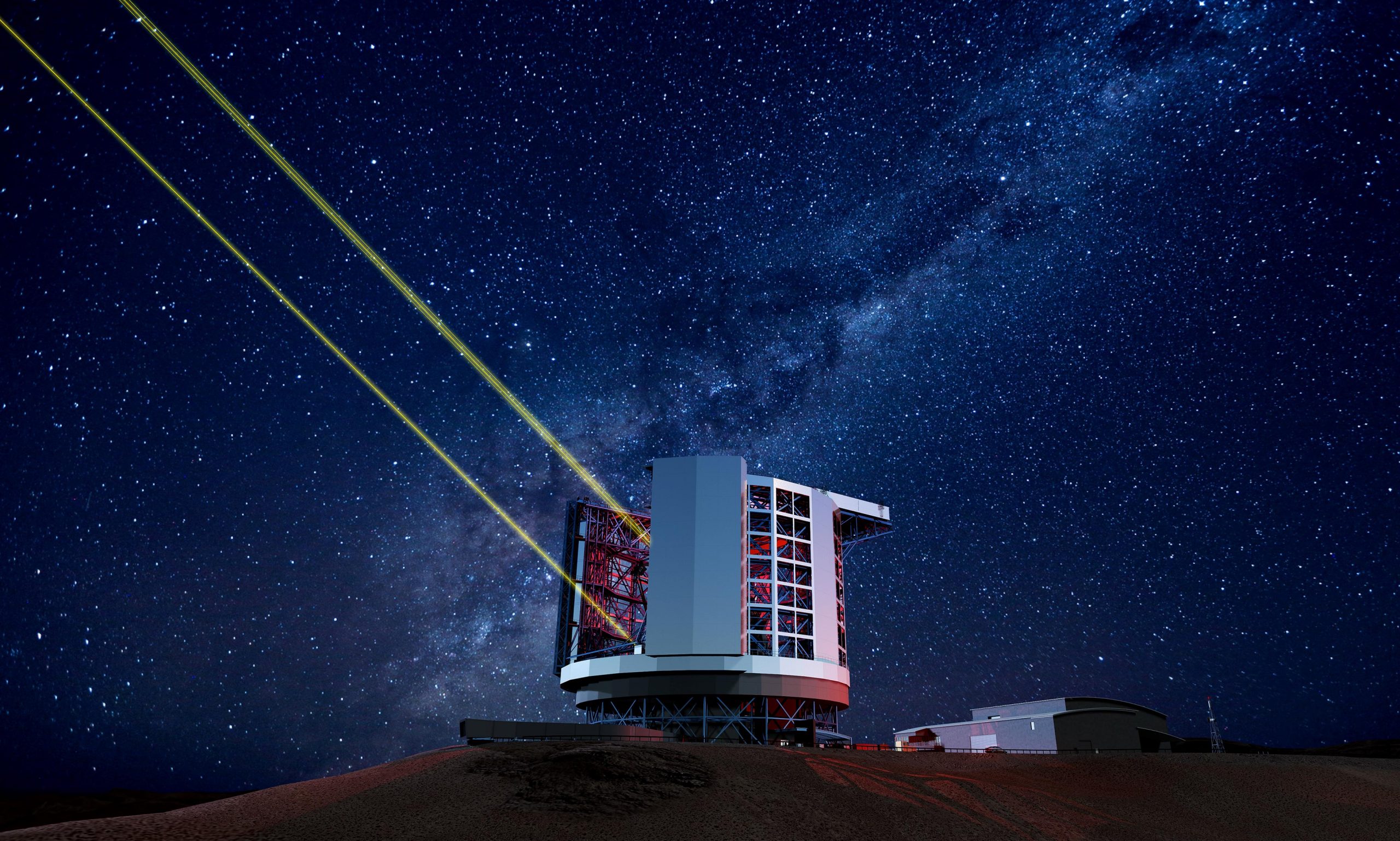
One of the most sophisticated engineering aspects of the telescope is what is known as “adaptive optics.” The telescope’s secondary mirrors are flexible. Under each secondary mirror surface, there are hundreds of actuators that will constantly adjust the mirrors to counteract atmospheric turbulence. These actuators, under the command of advanced control systems, will transform twinkling stars into clear steady points of light 10 times sharper than possible with the Hubble Space Telescope. Scientists and engineers at the Center for Astrophysics are playing a crucial role in the design and construction of these control systems.
The location of the GMT also offers a key advantage in terms of seeing through the Earth’s atmosphere. Chile’s Atacama Desert is one of the highest and driest locations on earth, where the GMT will have spectacular conditions for more than 300 nights a year. Las Campanas Peak, has an altitude of over 2,550 meters (8,500 feet) and is almost completely barren of vegetation due to lack of rainfall. The combination of seeing, number of clear nights, altitude, weather and vegetation make Las Campanas Peak an ideal site for the GMT.
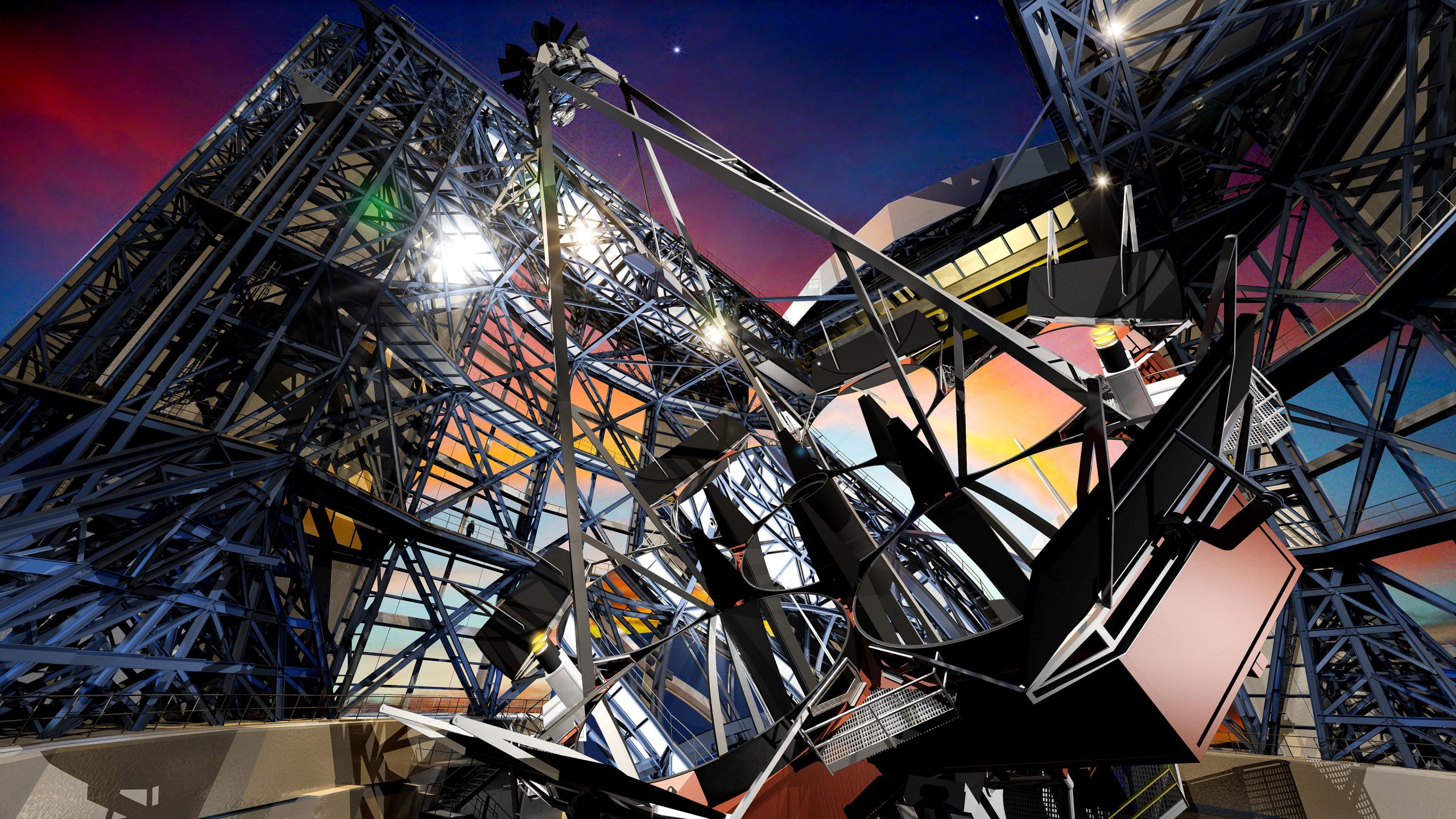
Perhaps one of the most exciting questions yet to be answered by astronomy is: are we alone? That question will be addressed by the first advanced instrument planned for GMT, the GMT-Consortium Large Earth Finder, or G-CLEF, whose design and construction are being supervised at the Center for Astrophysics. G-CLEF has been optimized to have extreme precision velocity capability, which will allow it to detect the presence of an Earth-mass exoplanet orbiting Sun-like stars.
The unprecedented light gathering ability and resolution of GMT will help with many other fascinating questions in 21st century astronomy as well. What is dark matter and what is dark energy, two mysterious things that comprise most of our universe? How did the first stars form from the diffuse gas of the Big Bang? How did the first galaxies form? What is the fate of the universe?
Never miss a breakthrough: Join the SciTechDaily newsletter.
Follow us on Google and Google News.
7 Comments
Sadly, the night sky is being ruined for astronomers by Elon Musk and his Starlink satellites.
No, it isn’t. Less than 1 % of these telescope exposures will be affected. There are plenty of papers studying it that comes to the same conclusion – the old style geostationary or else high orbit satellites are actually more of a disturbance per satellite.
The problem with low orbit constellations comes with the long time exposure observatories such as the Vera C. Rubin telescope, where several percent of exposures will be affected. But its work will be delayed and cost more proportionally, not become “ruined”.
“Six off-axis 8.4 meter segments surround a central on-axis segment, forming a single optical surface 24.5 meters in diameter, with a total collecting area of 368 square meters.
“The location of the telescope is Las Campanas Observatory,[10] which is also the site of the Magellan Telescopes, some 115 km (71 mi) north-northeast of La Serena, Chile and 180 km (112 mi) south of Copiapó, Chile, at an altitude of 2,516 m (8,255 ft). … First light 2029.”
[“Giant Magellan Telescope” @ Wikipedia]
[Extremely Large Telescope:] “Puny telescopes!”
“Part of the European Southern Observatory (ESO) agency, it is located on top of Cerro Armazones in the Atacama Desert of northern Chile. The design consists of a reflecting telescope with a 39.3-metre-diameter (130-foot) segmented primary mirror and a 4.2 m (14 ft) diameter secondary mirror, and will be supported by adaptive optics, eight laser guide star units and multiple large science instruments. … Collecting area 978 m^2. … First light 2025.”
[“Extremely Large Telescope” @ Wikipedia]
That said, it is good to have (a) little competition. 😀
Time to give the positive statements about the “presence of dark matter/energy” a rest. People have become used to blarney in the news media, but it looks very bad in a publication like this.
I suppose that depends on how you define “dark matter”
What negative statements or null statements could you say on those two facts of nature that has been part of our accepted cosmology theory for decades (or a century for dark matter)? The theory is even called Lambda-Cold Dark Matter for dark energy respectively dark matter. And the telescope has researching those two phenomena further as two large goals.
Maybe it is better that popular opinion stopped pushing nonsense on science sites – it reflects badly on comments like that. [Ah, sophistry – nice to spice with now and then.] You *can*have your own opinion, but you can’t have your own facts. And facts are mentioned in a positive sense – they exist, we know about some properties, et cetera.
If anything I wish the press center at HARVARD-SMITHSONIAN CENTER FOR ASTROPHYSICS – who wrote this making it the university responsibility, not the responsibility of “news media” – didn’t describe those two theory simple (2 out of 6 parameters in LCDM theory) as “mysterious”.
Dark energy looks sufficiently like vacuum energy density (constant, not zero). And the latter needs a value, so it fits like a glove.
And dark matter we now know as needed for structure formation. Without its presence we would have very few stars and galaxies and if it were all normal matter we wouldn’t have long lived stars. So some matter acting purely gravitationally is necessary to find in a habitable universe, and that too fits like a glove.
What is mysterious with phenomena we now expect to find (and have found)!? I can’t see it. Yes, we don’t know for sure dark energy is vacuum energy and we don’t know what kind of particle (quantum field type and exact mass) that dark matter is. But is that “mysterious”? Neutrinos had the same status for years, and we still don’t know their masses for sure. But people stopped complaining about it.
Same with black holes, especially after we have an image of a black hole shadow. Only difference is that when people stopped complaining about black holes, they found two new things to complain about. And ironically, if history is any guide, when cosmologists know enough people will stop complaining about cosmologists trying to find out “enough” (and more) about them.
There is other life out there. Problem is, to send a signal from 1000 light years away, which is about the average distance between life forms intelligent enough to send and receive, signals, would require millions of years of the earth’s electricity, if we wanted to send a one second signal. We would need to send and receive signals on the order of 10^-18 seconds and be capable of receiving signals on the order of 10^-18 seconds. This would be a great feat. If we are looking at animal intelligent life forms, those are likely to be very close, perhaps the closest stars.