

Close Menu
    Facebook X (Twitter) Instagram
    SciTechDaily
    • Biology
    • Chemistry
    • Earth
    • Health
    • Physics
    • Science
    • Space
    • Technology
    Facebook X (Twitter) Pinterest YouTube RSS
    SciTechDaily
    Home»Technology»Spintronic Computing Breakthrough: Taking 2D Materials for a Spin
    Technology

    Spintronic Computing Breakthrough: Taking 2D Materials for a Spin

    By University of TsukubaMarch 5, 2021No Comments3 Mins Read
    Facebook Twitter Pinterest Telegram LinkedIn WhatsApp Email Reddit
    Share
    Facebook Twitter LinkedIn Pinterest Telegram Email Reddit
    Spintronic Computing Artistic Concept
    Spintronic computing artistic concept illustration.

    Scientists at the University of Tsukuba and the Institute of High Pressure Physics fabricate a novel molybdenum disulfide transistor and create an image of the spins of the electrons passing through which may open the way for new spintronic computers.

    Scientists from the University of Tsukuba and a scientist from the Institute of High Pressure Physics detected and mapped the electronic spins moving in a working transistor made of molybdenum disulfide. This research may lead to much faster computers that take advantage of the natural magnetism of electrons, as opposed to just their charge.

    Spintronics is a new area of condensed matter physics that attempts to use the intrinsic magnetic moment of electrons, called “spins,” to perform calculations. This would be a major advance over all existing electronics that rely solely on the electron charge. However, it is difficult to detect these spins, and there are many unknowns regarding materials that can support the transport of spin-polarized electrons.
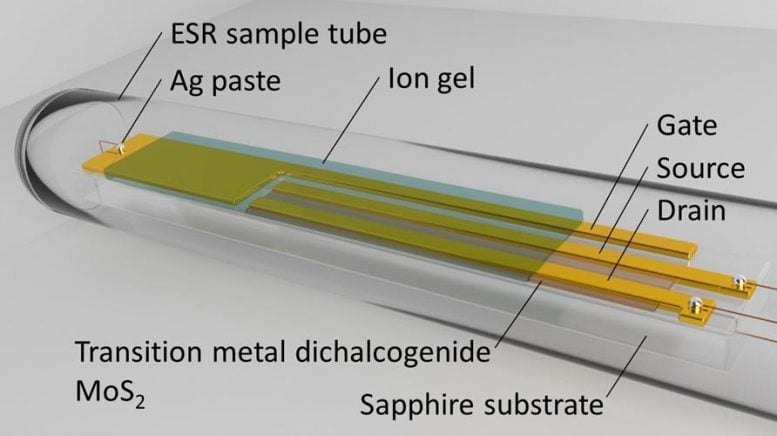
    MoS2 Transistor in ESR Sample Tube
    Schematic diagram of the MoS2 transistor in an ESR sample tube. Credit: University of Tsukuba

    Now, an international research team led by the Division of Materials Science at the University of Tsukuba has successfully used electron spin resonance (ESR) to monitor the number and location of unpaired spins coursing through a molybdenum disulfide transistor. ESR uses the same physical principle as the MRI machines that create medical images. The spins are subject to a very strong magnetic field, which creates an energy difference between electrons with spins aligned and anti-aligned with the field. The absorbance of photons that match this energy gap can be measured to determine the presence of unpaired electron spins.

    The experiment required the sample to be cooled to just four degrees above absolute zero, and the transistor to be in operation while the spins are being measured. “The ESR signals were measured simultaneously with the drain and gate currents,” corresponding author Professor Kazuhiro Marumoto says. “Theoretical calculations further identified the origins of the spins,” coauthor Professor Małgorzata Wierzbowska says. Molybdenum disulfide was used because its atoms naturally form a nearly flat two-dimensional structure. The molybdenum atoms form a plane with a layer of sulfide ions above and below.

    The team found that charging the system with the additional electrons in a process called n-type doping was important for creating the spins. “In contrast with previous work on other 2D materials, the n-type doping allowed us to achieve better control of the electronic spins,” Professors Marumoto and Wierzbowska explain. The scientists believe that molybdenum disulfide will prove to be an important testbed for spintronic devices as the technology advances towards future consumer products.

    Reference: “Spin-states in MoS2 thin-film transistors distinguished by operando electron spin resonance” by Naho Tsunetomo, Shohei Iguchi, Małgorzata Wierzbowska, Akiko Ueda, Yousang Won, Sinae Heo, Yesul Jeong, Yutaka Wakayama and Kazuhiro Marumoto, 5 March 2021, Communications Materials.
    DOI: 10.1038/s43246-021-00129-y

    Never miss a breakthrough: Join the SciTechDaily newsletter.
    Follow us on Google and Google News.

    2D Materials Electromagnetics Nanotechnology Spintronics University of Tsukuba
    Share. Facebook Twitter Pinterest LinkedIn Email Reddit

    Related Articles

    Spintronics Breakthrough: Unlocking the Quantum Potential of Graphene With Cobalt

    Main Attraction: Scientists Create World’s Thinnest Magnet – Just One Atom Thick!

    Towards 2D Spin-Logic Memory Technology Using Magnetic Graphene

    Progressing Electronics Beyond Moore’s Law With Graphene and 2D Materials

    3D Microchip Allows Information to Travel in Three Dimensions

    HARPES Technique Reveals Ferromagnetic Secrets of Dilute Magnetic Semiconductors

    “Patterned Regrowth” May Lead to Graphene-Based Circuits

    Electronic Read-Out of the Quantum State of an Atom

    Converting Heat to Electricity in a Non-Magnetic Semiconductor

    Leave A Reply Cancel Reply

    • Facebook
    • Twitter
    • Pinterest
    • YouTube

    Don't Miss a Discovery

    Subscribe for the Latest in Science & Tech!

    Trending News

    Millions of People Have Osteopenia Without Realizing It – Here’s What You Need To Know

    Researchers Discover Boosting a Single Protein Helps the Brain Fight Alzheimer’s

    World-First Study Reveals Human Hearts Can Regenerate After a Heart Attack

    Why Your Dreams Feel So Real Sometimes and So Strange Other Times

    This Simple Home Device May Boost Brain Power in Adults Over 40

    Enormous Prehistoric Insects Puzzle Scientists

    Scientists Develop Bioengineered Chewing Gum That Could Help Fight Oral Cancer

    After 37 Years, the World’s Longest-Running Soil Warming Experiment Uncovers a Startling Climate Secret

    Follow SciTechDaily
    • Facebook
    • Twitter
    • YouTube
    • Pinterest
    • Newsletter
    • RSS
    SciTech News
    • Biology News
    • Chemistry News
    • Earth News
    • Health News
    • Physics News
    • Science News
    • Space News
    • Technology News
    Recent Posts
    • This New “Sound Laser” Could Measure Gravity With Stunning Precision
    • Quantum Breakthrough: New Algorithm Solves “Impossible” Materials in Seconds
    • Could the Universe’s Hidden Shape Solve One of Physics’ Biggest Mysteries?
    • Rewriting Dinosaur Evolution: Scientists Unearth Remarkable 150-Million-Year-Old Stegosaur Skull
    • Scientists Identify Two Simple Treatments for Cancer-Related Cognitive Impairment
    Copyright © 1998 - 2026 SciTechDaily. All Rights Reserved.
    • Science News
    • About
    • Contact
    • Editorial Board
    • Privacy Policy
    • Terms of Use

    Type above and press Enter to search. Press Esc to cancel.