
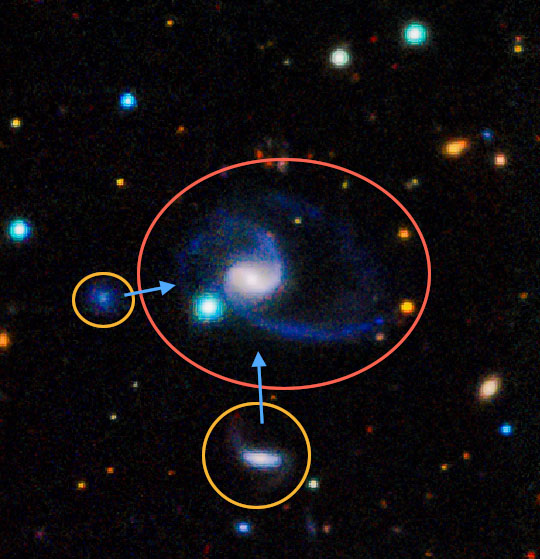
Using data from the Galaxy and Mass Assembly survey, astronomers found 14 galaxy systems that are similar to the Milky Way, with two of those being an almost exact match.
Research presented today at the International Astronomical Union General Assembly in Beijing has found the first group of galaxies that is just like ours, a rare sight in the local Universe.
The Milky Way is a fairly typical galaxy on its own, but when paired with its close neighbors — the Magellanic Clouds — it is very rare, and could have been one of a kind, until a survey of our local Universe found another two examples just like us.
Astronomer Dr. Aaron Robotham, jointly from the University of Western Australia node of the International Center for Radio Astronomy Research (ICRAR) and the University of St Andrews in Scotland, searched for groups of galaxies similar to ours in the most detailed map of the local Universe yet, the Galaxy and Mass Assembly survey (GAMA).
“We’ve never found another galaxy system like the Milky Way before, which is not surprising considering how hard they are to spot! It’s only recently become possible to do the type of analysis that lets us find similar groups,” says Dr Robotham.
“Everything had to come together at once: we needed telescopes good enough to detect not just galaxies but their faint companions, we needed to look at large sections of the sky, and most of all we needed to make sure no galaxies were missed in the survey”
Sophisticated simulations of how galaxies form don’t produce many examples similar to the Milky Way and its surroundings, predicting them to be quite a rare occurrence. Astronomers haven’t been able to tell just how rare until now, with the discovery of not just one but two exact matches amongst the hundreds of thousands of galaxies surveyed.
“We found about 3% of galaxies similar to the Milky Way have companion galaxies like the Magellanic Clouds, which is very rare indeed. In total we found 14 galaxy systems that are similar to ours, with two of those being an almost exact match,” says Dr. Robotham.
The Milky Way is locked in a complex cosmic dance with its close companions the Large and Small Magellanic Clouds, which are clearly visible in the southern hemisphere night sky. Many galaxies have smaller galaxies in orbit around them, but few have two that are as large as the Magellanic Clouds.
Dr. Robotham’s work also found that although companions like the Magellanic Clouds are rare, when they are found they’re usually near a galaxy very like the Milky Way, meaning we’re in just the right place at the right time to have such a great view in our night sky.
“The galaxy we live in is perfectly typical, but the nearby Magellenic Clouds are a rare, and possibly short-lived, occurrence. We should enjoy them whilst we can, they’ll only be around for a few billion more years,” adds Dr. Robotham.
Dr. Robotham and colleagues have been awarded further time on telescopes in New South Wales and Chile to study these Milky Way twin systems now that they’ve been found.
Reference: “Galaxy and Mass Assembly (GAMA): In search of Milky-Way Magellanic Cloud Analogues” by A. S. G. Robotham, I. K. Baldry, J. Bland-Hawthorn, S. P. Driver, J. Loveday, P. Norberg, A. E. Bauer, K. Bekki, S. Brough, M. Brown, A. Graham, A. M. Hopkins, S. Phillipps, C. Power, A. Sansom and L. Staveley-Smith, 1 August 2012, Monthly Notices of the Royal Astronomical Society.
DOI: 10.1111/j.1365-2966.2012.21332.x
The Galaxy and Mass Assembly (GAMA) survey is an international collaboration led by ICRAR and the Australian Astronomical Observatory to map our local Universe in closer detail.
ICRAR is a joint venture between Curtin University and The University of Western Australia providing research excellence in the field of radio astronomy.
Never miss a breakthrough: Join the SciTechDaily newsletter.
Follow us on Google and Google News.