
Close Menu
    Facebook X (Twitter) Instagram
    SciTechDaily
    • Biology
    • Chemistry
    • Earth
    • Health
    • Physics
    • Science
    • Space
    • Technology
    Facebook X (Twitter) Pinterest YouTube RSS
    SciTechDaily
    Home»Space»Spacecraft to Explore Supermassive Black Holes at Center of Galaxies
    Space

    Spacecraft to Explore Supermassive Black Holes at Center of Galaxies

    By SciTechDailyMarch 14, 2012No Comments3 Mins Read
    Facebook Twitter Pinterest Telegram LinkedIn WhatsApp Email Reddit
    Share
    Facebook Twitter LinkedIn Pinterest Telegram Email Reddit
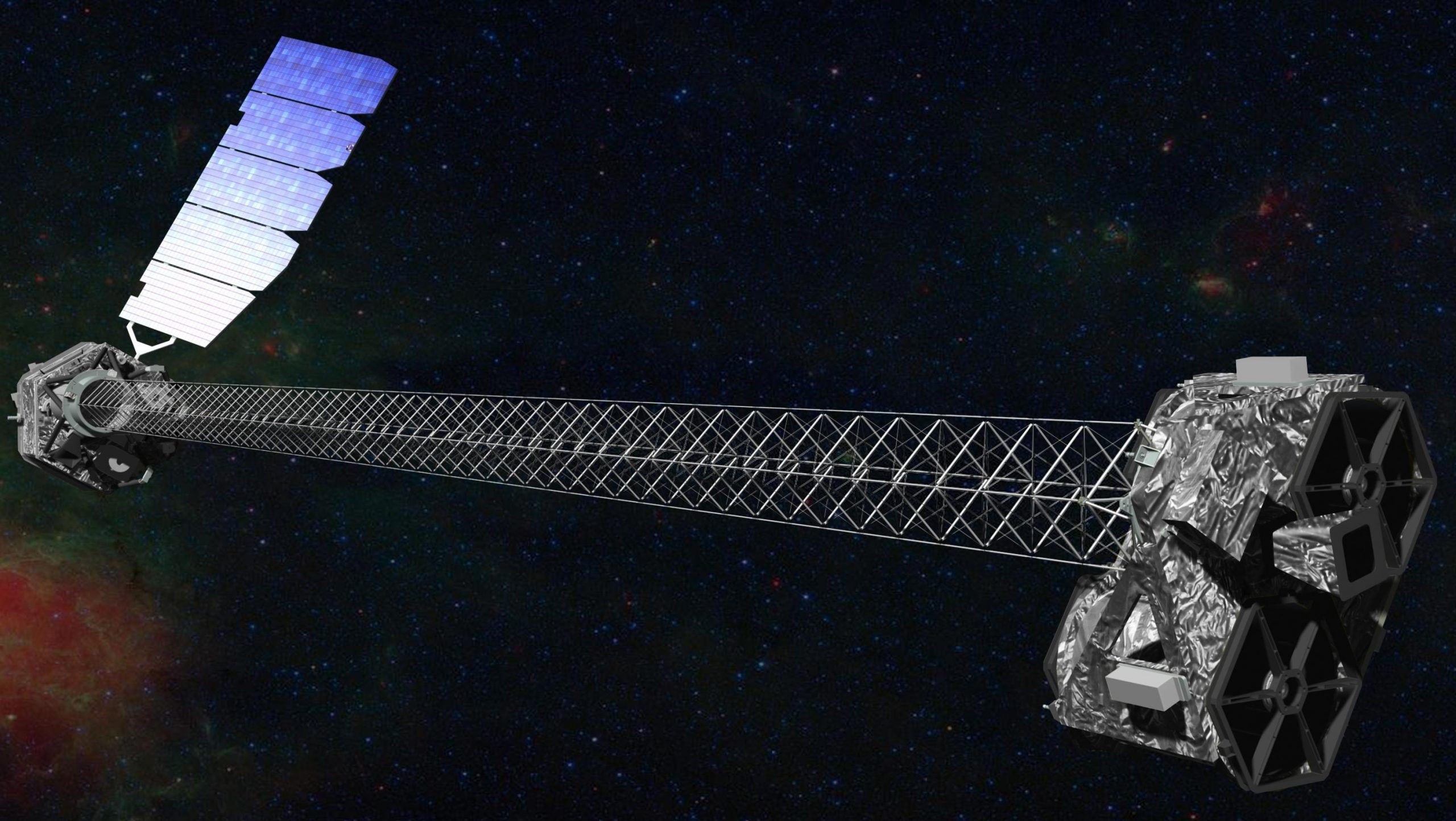
    NuSTAR Spacecraft
    Illustration of the NuSTAR spacecraft, which has a 30-foot (10-meter) mast that separates the optics modules (right) from the detectors in the focal plane (left). This separation is necessary for the method used to detect X-rays. Credit: NASA/JPL-Caltech

    By the standards of space-based astronomy, NASA’s new NuSTAR (Nuclear Spectroscopic Telescope Array) telescope that will be launched later this month has a modest budget of $165 million. However, it and XMM-Newton will try to probe the insides of the supermassive black holes hidden inside of galaxies.

    Both space-based telescopes are sensitive to high-energy photons produced at the thresholds of supermassive black holes. NuSTAR will be ferried into orbit by a Pegasus rocket launched in mid-air from a carrier jet. It will detect hard X-rays at 5 to 80 kiloelectronvolts, which is between the energy range probed by the Chandra X-ray Observatory and the γ-rays measured by satellites like the Fermi telescope.
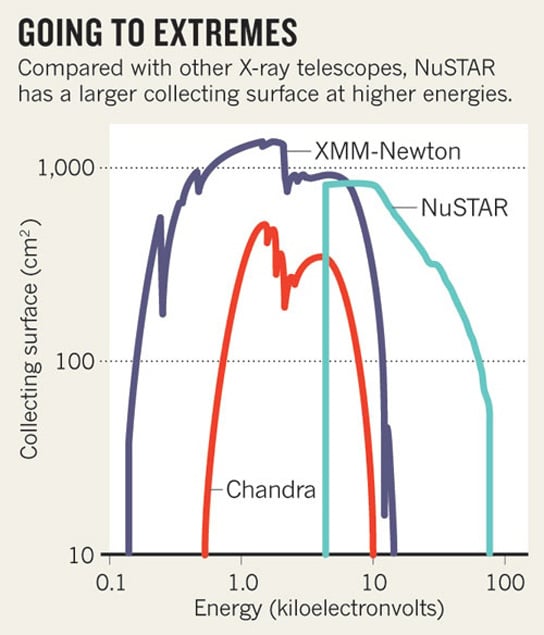
    x-ray-comparo

    This will be the first mission that can resolve these high-energy X-rays. Hard X-rays are difficult to focus because they penetrate mirrors, even those covered with dense metals such as gold and iridium. The new mirrors are coated with a sandwich of hundreds of thin metallic films. The thickness of each layer is tuned to reflect photons of a specific energy. Once these layers are added up, they will reflect a number of photons large enough to produce a strong reflection.

    The X-rays are so powerful that they can only be reflected at glancing angles, and the mirrors must be arranged in conical shells, like nested Russian dolls, which funnel the high-energy photons into a detector at the end of the structure. There are 133 of these mirror shells in two units and NuSTAR will be more powerful than the Chandra telescope, which has only four mirror shells, but they are stiffer and more finely polished, allowing Chandra to perceive objects in greater detail.
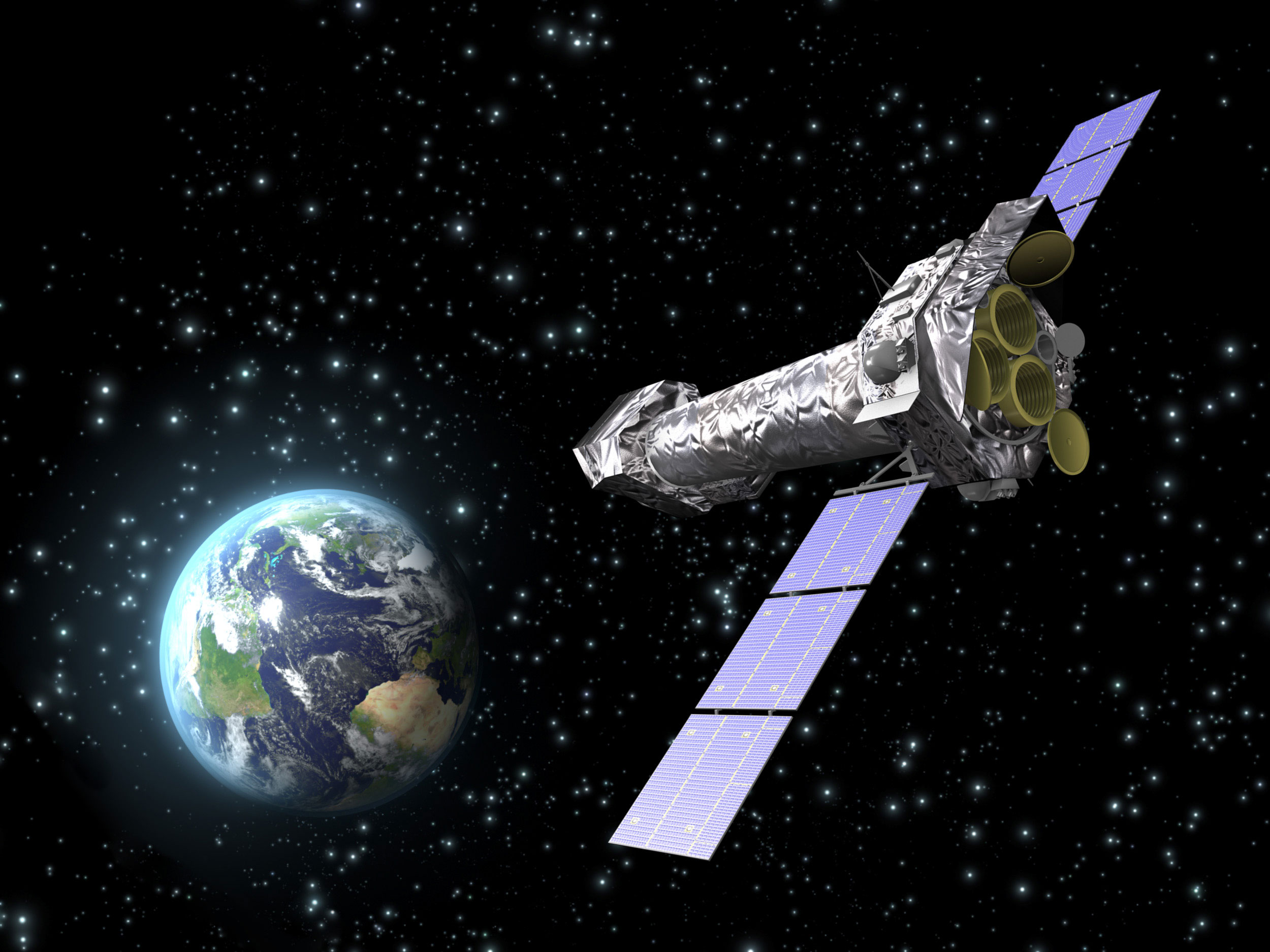
     

    XMM Newton
    An artist’s impression of XMM-Newton. Credit: ESA-C. Carreau

    This means that the optics need a long focal length, which implies a bulky, costly spacecraft. The $2-billion Chandra could barely be squeezed into the cargo bay of the Space Shuttle. NuStar measures 10 m and will be just as long, but it had to fit into the much smaller and cheaper Pegasus launcher. The telescope is built around a folded-up truss, which will only grow to full length once NuSTAR is deployed in low-Earth orbit.

    NuSTAR will focus on active galactic nuclei (AGN) in the hearts of distant galaxies that contain high-energy particles. NuSTAR should be able to stop several hundred new AGN that have been shrouded by gas from other detectors. This should allow astronomers to ascertain how common AGN are and what role they play in the growth and evolution of galaxies.
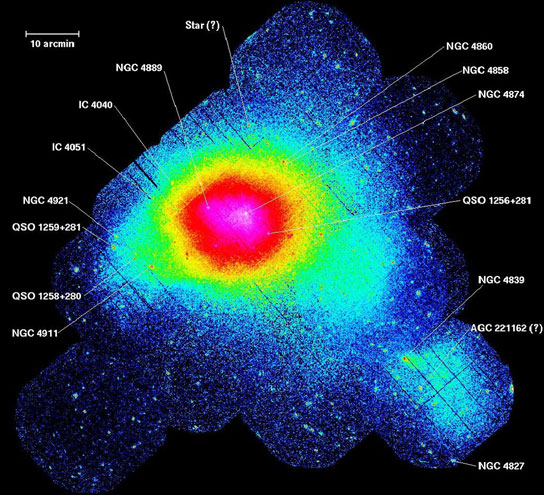
    data-xmm-newton

    Another large X-ray telescope by the ESA, XMM-Newton, will be looking for distortions in the X-ray spectra resulting from the spin of the central supermassive black holes in galaxies. The spin rates themselves could give insight into how the black holes in some AGN grew to masses of billions of Suns, by swallowing other AGN in galactic mergers or by steadily accumulating material from its host galaxy. XMM-Newton is devoting 10% of its time to a joint effort with NuSTAR.

    Never miss a breakthrough: Join the SciTechDaily newsletter.
    Follow us on Google and Google News.

    Astronomy Black Hole Chandra X-ray Observatory Galaxy NuSTAR Observatory Popular Spacecraft X-ray XMM-Newton
    Share. Facebook Twitter Pinterest LinkedIn Email Reddit

    Related Articles

    Mysterious ASASSN-14li: Massive Star Obliterated by a Giant Black Hole

    Chandra Discovers a Star in the Closest Known Orbit Around a Black Hole

    Chandra Telescope Reveals Evidence for a “Wandering” Black Hole

    ASASSN-14li Provides an Excellent Opportunity to Study the Environment around a Black Hole

    NuSTAR and XMM-Newton Telescopes Give Shape to Black Hole Winds

    NASA Telescopes Reveal That Sagittarius A* May Be Producing Neutrinos

    Astronomers Measure Distant Black Hole’s Spin

    Scientists Measure the Spin Rates of Supermassive Black Holes

    Evidence Suggests Black Holes Can “Change Gears”

    Leave A Reply Cancel Reply

    • Facebook
    • Twitter
    • Pinterest
    • YouTube

    Don't Miss a Discovery

    Subscribe for the Latest in Science & Tech!

    Trending News

    Even Occasional Binge Drinking May Triple Liver Damage Risk

    Liftoff! NASA’s Artemis II Launch Sends Astronauts Around the Moon for First Time in 50 Years

    Scientists Discover New Way To Eliminate “Zombie Cells” Driving Aging

    This New Quantum Theory Could Change Everything We Know About the Big Bang

    This One Vitamin May Help Protect Your Brain From Dementia Years Later

    Stopping Weight-Loss Drugs Like Ozempic Can Quickly Erase Heart Benefits

    A 500-Million-Year-Old Surprise Is Forcing Scientists to Rethink Spider Evolution

    Coffee and Blood Pressure: What You Need To Know Before Your Next Cup

    Follow SciTechDaily
    • Facebook
    • Twitter
    • YouTube
    • Pinterest
    • Newsletter
    • RSS
    SciTech News
    • Biology News
    • Chemistry News
    • Earth News
    • Health News
    • Physics News
    • Science News
    • Space News
    • Technology News
    Recent Posts
    • Scientists Finally Crack Decades-Old Mystery Behind Statins’ Painful Side Effects
    • Popular Vitamin B3 Supplements May Help Cancer Cells Survive, Scientists Warn
    • Chemists Thought Phosphorus Was Fully Understood – They Were Wrong
    • Scientists Discover Strange Property of Rice and Turn It Into a Smart Material
    • New Water Filter Removes up to 98% of Hard-To-Catch “Forever Chemicals”
    Copyright © 1998 - 2026 SciTechDaily. All Rights Reserved.
    • Science News
    • About
    • Contact
    • Editorial Board
    • Privacy Policy
    • Terms of Use

    Type above and press Enter to search. Press Esc to cancel.