
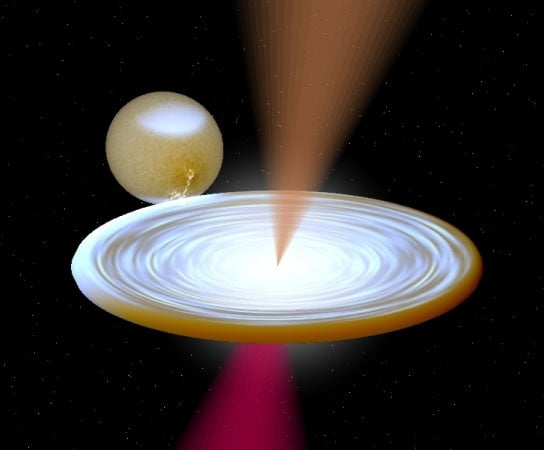
Using X-ray observations from NASA’s Chandra X-ray Observatory and radio observations from the Expanded Very Large Array in New Mexico, astronomers studied two black hole systems as they feed on matter, finding evidence that suggests that black holes can change between two different regimes, like changing gears of an engine.
Black holes are extremely powerful and efficient engines that not only swallow up matter, but also return a lot of energy to the Universe in exchange for the mass they eat. When black holes attract mass they also trigger the release of intense X-ray radiation and power strong jets. But not all black holes do this the same way. This has long baffled astronomers. By studying two active black holes researchers at the SRON Netherlands Institute for Space Research have now gathered evidence that suggests that each black hole can change between two different regimes, like changing the gears of an engine. The team’s findings will be published in two papers in the journal Monthly Notices of the Royal Astronomical Society.
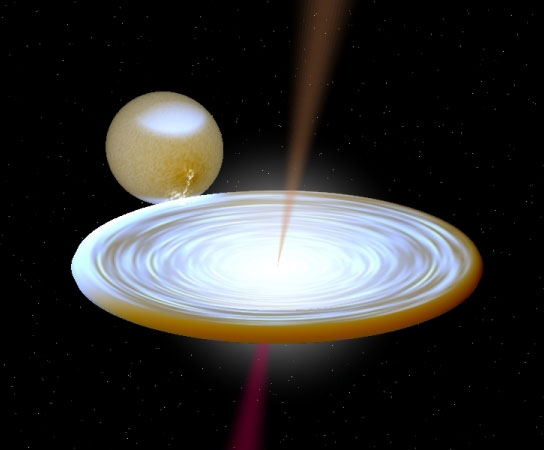
Black hole jets — lighthouse-like beams of material that race outwards at close to the speed of light — can have a major impact on the evolution of their environment. For example, jets from the super-massive black holes found at the center of galaxies can blow huge bubbles in and heat the gas found in clusters of galaxies.
Another stunning example of what black hole jets can do is known as Hanny’s Voorwerp, a cloud of gas where stars started forming after it was hit by the jet-beam of a black hole in a neighboring galaxy. These phenomena demonstrate the importance of research into the way black holes produce and distribute energy, but until recently, much of this has remained uncertain.
In 2003 it became clear from astronomical observations that there is a connection between the X-ray emission from a black hole and its jet outflow. This connection needs to be explained if we want to understand how the black hole engine works. In the first years after this connection was discovered, it seemed that it was the same for all feeding black holes, but soon oddballs were found. These unusual examples still have a clear connection between the energy released in the X-ray emission and that put in the jet ejection. But the proportion differs from that in the “standard” black holes. As the number of oddballs grew, it started to appear that there were two groups of black hole engines working in a slightly different way, as if one were running on petrol and the other on diesel.
For years astronomers struggled to justify this difference based on the properties of the two groups of black holes, but to no avail. Recently a step forward was made: a team of astronomers led by Michael Coriat (now at University of Southampton) found a black hole that seemed to switch between the two flavors of X-ray/jet connection, depending on its brightness changed. This suggested that black holes do not necessarily come with two different engines, but that each black hole can run in two different regimes, like two gears of the same engine.
Now Peter Jonker and PhD-student Eva Ratti, two researchers from the SRON Netherlands Institute for Space Research — have taken an important step forward in the attempts to solve this puzzle. Using X-ray observations from the Chandra X-ray Observatory and radio observations from the Expanded Very Large Array in New Mexico they watched two black hole systems until their feeding frenzies ended.
Eva Ratti comments: “We found that these two black holes could also ‘change gear’, demonstrating that this is not an exceptional property of one peculiar black hole. Our work suggests that changing gear might be common among black holes. We also found that the switch between gears happens at a similar X-ray luminosity for all the three black holes.”
These discoveries provide a new and important input to theoretical models that aim to explain both the functioning of the black hole engine itself and its impact on the surrounding environment.
The results appear in the following two papers in the journal Monthly Notices of the Royal Astronomical Society.
References:
“The black hole candidate MAXI J1659–152 in and towards quiescence in X-ray and radio” by P. G. Jonker, J. C. A. Miller-Jones, J. Homan, J. Tomsick, R. P. Fender, P. Kaaret, S. Markoff and E. Gallo, 18 May 2012, Monthly Notices of the Royal Astronomical Society.
DOI: 10.1111/j.1365-2966.2012.21116.x
“The black hole candidate XTE J1752−223 towards and in quiescence: optical and simultaneous X-ray–radio observations” by E. M. Ratti, P. G. Jonker, J. C. A. Miller-Jones, M. A. P. Torres, J. Homan, S. Markoff, J. A. Tomsick, P. Kaaret, R. Wijnands, E. Gallo, F. Özel, D. T. H. Steeghs and R. P. Fender, 16 May 2012, Monthly Notices of the Royal Astronomical Society.
DOI: 10.1111/j.1365-2966.2012.21071.x
Never miss a breakthrough: Join the SciTechDaily newsletter.
Follow us on Google and Google News.
2 Comments
I find it difficult to accept that a hole could produce such effects.
So, if we know the energy being ’emitted’ from the area of a Black Hole, and if we know how/why this X-ray energy is being released, then we know the amount of ‘energy’ be4ing swallowed by the BH.
Surely there comes a time when the BH is so large that it must either expand its event horizon or …
now there’s a thought.
At some point the event horizon is going to be so large it will spin at a velocity > light. Not possible, oh yes it is.
We know that energy, even here on Earth, can travel > SoL, so why deny it.. Work with what you have instead of looking for alternatives.
Q: What is the relation between neutrinos and velocity of spin of a BH? My thought is that not only are X-ray emitted by BHs but neutrinos are also a bye product. (y/n).