
Technique for editing bacterial genomes can record interactions between cells, may offer a way to edit genes in the human microbiome.
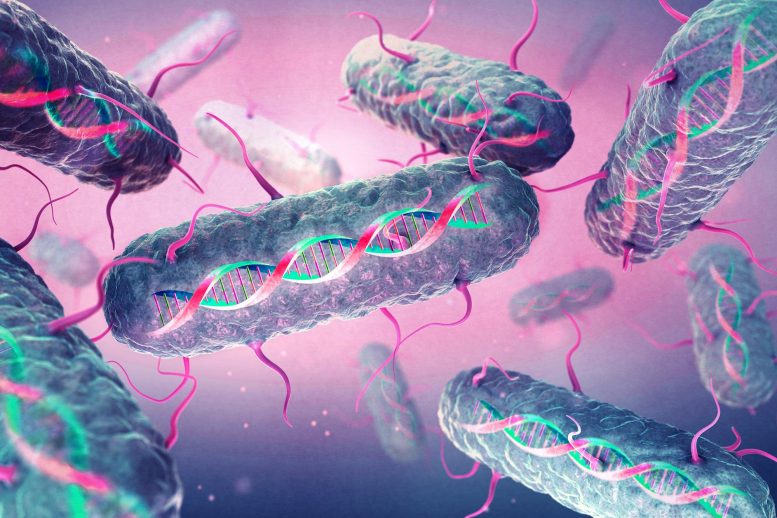
Biological engineers at MIT have devised a new way to efficiently edit bacterial genomes and program memories into bacterial cells by rewriting their DNA. Using this approach, various forms of spatial and temporal information can be permanently stored for generations and retrieved by sequencing the cells’ DNA.
The new DNA writing technique, which the researchers call HiSCRIBE, is much more efficient than previously developed systems for editing DNA in bacteria, which had a success rate of only about 1 in 10,000 cells per generation. In a new study, the researchers demonstrated that this approach could be used for storing memory of cellular interactions or spatial location.
This technique could also make it possible to selectively edit, activate, or silence genes in certain species of bacteria living in a natural community such as the human microbiome, the researchers say.
“With this new DNA writing system, we can precisely and efficiently edit bacterial genomes without the need for any form of selection, within complex bacterial ecosystems,” says Fahim Farzadfard, a former MIT postdoc and the lead author of the paper. “This enables us to perform genome editing and DNA writing outside of laboratory settings, whether to engineer bacteria, optimize traits of interest in situ, or study evolutionary dynamics and interactions in the bacterial populations.”
Timothy Lu, an MIT associate professor of electrical engineering and computer science and of biological engineering, is the senior author of the study, which was published on August 5, 2021, in Cell Systems. Nava Gharaei, a former graduate student at Harvard University, and Robert Citorik, a former MIT graduate student, are also authors of the study.
Genome Writing and Recording Memories
For several years, Lu’s lab has been working on ways to use DNA to store information such as memory of cellular events. In 2014, he and Farzadfard developed a way to employ bacteria as a “genomic tape recorder,” engineering E. coli to store long-term memories of events such as a chemical exposure.
To achieve that, the researchers engineered the cells to produce a reverse transcriptase enzyme called retron, which produces a single-stranded DNA (ssDNA) when expressed in the cells, and a recombinase enzyme, which can insert (“write”) a specific sequence of single-stranded DNA into a targeted site in the genome. This DNA is produced only when activated by the presence of a predetermined molecule or another type of input, such as light. After the DNA is produced, the recombinase inserts the DNA into a preprogrammed site, which can be anywhere in the genome.
That technique, which the researchers called SCRIBE, had a relatively low writing efficiency. In each generation, out of 10,000 E. coli cells, only one would acquire the new DNA that the researchers tried to incorporate into the cells. This is in part because the E. coli have cellular mechanisms that prevent single-stranded DNA from being accumulated and integrated into their genomes.
In the new study, the researchers tried to boost the efficiency of the process by eliminating some of E. coli’s defense mechanisms against single-stranded DNA. First, they disabled enzymes called exonucleases, which break down single-stranded DNA. They also knocked out genes involved in a system called mismatch repair, which normally prevents integration of single-stranded DNA into the genome.
With those modifications, the researchers were able to achieve near-universal incorporation of the genetic changes that they tried to introduce, creating an unparalleled and efficient way for editing bacterial genomes without the need for selection.
“Because of that improvement, we were able to do some applications that we were not able to do with the previous generation of SCRIBE or with other DNA writing technologies,” Farzadfard says.
Cellular Interactions
In their 2014 study, the researchers showed that they could use SCRIBE to record the duration and intensity of exposure to a specific molecule. With their new HiSCRIBE system, they can trace those kinds of exposures as well as additional types of events, such as interactions between cells.
As one example, the researchers showed that they could track a process called bacterial conjugation, during which bacteria exchange pieces of DNA. By integrating a DNA “barcode” into each cell’s genome, which can then be exchanged with other cells, the researchers can determine which cells have interacted with each other by sequencing their DNA to see which barcodes they carry.
This kind of mapping could help researchers study how bacteria communicate with each other within aggregates such as biofilms. If a similar approach could be deployed in mammalian cells, it could someday be used to map interactions between other types of cells such as neurons, Farzadfard says. Viruses that can cross neural synapses could be programmed to carry DNA barcodes that researchers could use to trace connections between neurons, offering a new way to help map the brain’s connectome.
“We are using DNA as the mechanism to record spatial information about the interaction of bacterial cells, and maybe in the future, neurons that have been tagged,” Farzadfard says.
The researchers also showed that they could use this technique to specifically edit the genome of one species of bacteria within a community of many species. In this case, they introduced the gene for an enzyme that breaks down galactose into E. coli cells growing in culture with several other species of bacteria.
This kind of species-selective editing could offer a novel way to make antibiotic-resistant bacteria more susceptible to existing drugs by silencing their resistance genes, the researchers say. However, such treatments would likely require several years more years of research to develop, they say.
The researchers also showed that they could use this technique to engineer a synthetic ecosystem made of bacteria and bacteriophages that can continuously rewrite certain segments of their genome and evolve autonomously with a rate higher than would be possible by natural evolution. In this case, they were able to optimize the cells’ ability to consume lactose consumption.
“This approach could be used for evolutionary engineering of cellular traits, or in experimental evolution studies by allowing you to replay the tape of evolution over and over,” Farzadfard says.
Reference: “Efficient retroelement-mediated DNA writing in bacteria” by Fahim Farzadfard, Nava Gharaei, Robert J. Citorik and Timothy K. Lu, 5 August 2021, Cell Systems.
DOI: 10.1016/j.cels.2021.07.001
The research was funded by the National Institutes of Health, the Office of Naval Research, the National Science Foundation, the Defense Advanced Research Projects Agency, the MIT Center for Microbiome Informatics and Therapeutics, the NSF Expeditions in Computing Program Award, and the Schmidt Science Fellows Program.
Never miss a breakthrough: Join the SciTechDaily newsletter.
Follow us on Google and Google News.