
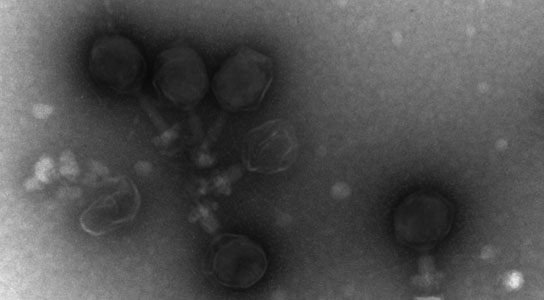
MIT researchers are studying how viruses use bacteria to support the replication of their own DNA. Viruses in phosphorus-starved regions of the ocean are able to take advantage of bacteria that need phosphorus as a nutrient. The bacteria seek out these seemingly helpful viruses only to have the virus inject its own DNA into a bacterium, which results in the host bacterium exploding after about 10 hours.
MIT researchers have discovered that certain photosynthetic ocean bacteria should beware of viruses bearing gifts: These viruses are carrying genetic material taken from their previous bacterial hosts that tricks the new host into using its own machinery to activate the genes, a process never before documented in any virus-bacteria relationship.
The con occurs when a virus injects its DNA into a bacterium living in a phosphorus-starved region of the ocean. Such bacteria, stressed by the lack of phosphorus — which they use as a nutrient — have their phosphorus-gathering machinery in high gear. The virus senses the host’s stress and offers what seems like a helping hand: bacterial genes nearly identical to the host’s own that enable the host to gather more phosphorus. The host uses those genes — but the additional phosphorus goes primarily toward supporting the virus’s replication of its own DNA.
Once that process is complete, about 10 hours after infection, the virus explodes its host, releasing progeny viruses back into the ocean where they can invade other bacteria and repeat this process. The additional phosphorus-gathering genes provided by the virus keep its reproduction cycle on schedule.
In essence, the virus, or phage, is co-opting a very sophisticated component of the host’s regulatory machinery to enhance its own reproduction — something never before documented in a virus-bacteria relationship.
“This is the first demonstration of a virus of any kind — even those heavily studied in biomedical research — exploiting this kind of regulatory machinery in a host cell, and it has evolved in response to the extreme selection pressures of phosphorus limitation in many parts of the global oceans,” says Sallie “Penny” W. Chisholm, a professor of civil and environmental engineering (CEE) and biology at MIT, who is principal investigator of the research and co-author of a paper published in the January 24 issue of Current Biology. “The phages have evolved the capability to sense the degree of phosphorus stress in the host they’re infecting and have captured, over evolutionary time, some components of the bacteria’s machinery to overcome the limitation.”
Chisholm and co-author Qinglu Zeng, a CEE postdoc, performed this research using the bacterium Prochlorococcus and its close relative, Synechococcus, which together produce about one-sixth of the oxygen in Earth’s atmosphere. Prochlorococcus is about one micron in diameter and can reach densities of up to 100 million per liter of seawater; Synechococcus is only slightly larger and a bit less abundant. The viruses that attack both bacteria, called cyanophages, are even more populous.
The bacterial mechanism in play is called a two-component regulatory system, which refers to the microbe’s ability to sense and respond to external environmental conditions. This system prompts the bacteria to produce extra proteins that bind to phosphorus and bring it into the cell. The gene carried by the virus encodes this same protein.
“Both the phage and bacterial host have the genes that produce the phosphorus-binding proteins, and we found they can both be up-regulated by the host’s two-component regulatory system,” Zeng says. “The positive side of infection for bacteria is that they will obtain more phosphorus binders from the phage and maybe more phosphorus, although the bacteria are dying and the phage is actually using the phosphorus for its own ends.”
In 2010, Chisholm and Maureen Coleman, now an assistant professor at the University of Chicago, demonstrated that the populations of Prochlorococcus living in the Atlantic Ocean had adapted to the phosphorus limitations of that environment by developing more genes specifically related to the scavenging of phosphorus. This proved to be the sole difference between those populations and their counterparts living in the Pacific Ocean, which is richer in phosphorus, indicating that the variation is the result of evolutionary adaptation to the environment.
The new research indicates that the phage that infect these bacteria have evolved right along with their hosts.
“These viruses … have acquired genes for a metabolic pathway from their host cells,” says David Shub, a professor of biological sciences at the State University of New York at Albany who was not involved in this research. “Now Zeng and Chisholm have shown that these particular viral genes are regulated by the amount of phosphate in their environment, and also that they use the regulatory proteins already present in their host cells at the time of infection. The significance of this paper is the revelation of a very close evolutionary interrelationship between this particular bacterium and the viruses that seek to destroy it.”
“We’ve come to think of this whole system as another bit of evidence for the incredible intimacy of the relationship of phage and host,” says Chisholm, whose next steps are to explore the functions of all the genes these marine phages have acquired from host cells to learn more about the selective pressures affecting the phage-host interactions in the open oceans. “Most of what we understand about phage and bacteria has come from model microorganisms used in biomedical research. The environment of the human body is dramatically different from that of the open oceans, and these oceanic phage have much to teach us about fundamental biological processes.”
Reference: “Marine Viruses Exploit Their Host’s Two-Component Regulatory System in Response to Resource Limitation” by Qinglu Zeng and Sallie W. Chisholm, 12 January 2012, Current Biology.
DOI: 10.1016/j.cub.2011.11.055
Never miss a breakthrough: Join the SciTechDaily newsletter.
Follow us on Google and Google News.