
Close Menu
    Facebook X (Twitter) Instagram
    SciTechDaily
    • Biology
    • Chemistry
    • Earth
    • Health
    • Physics
    • Science
    • Space
    • Technology
    Facebook X (Twitter) Pinterest YouTube RSS
    SciTechDaily
    Home»Physics»Innovative New Way To Generate Visible Light
    Physics

    Innovative New Way To Generate Visible Light

    By SciTechDailyNovember 5, 20211 Comment3 Mins Read
    Facebook Twitter Pinterest Telegram LinkedIn WhatsApp Email Reddit
    Share
    Facebook Twitter LinkedIn Pinterest Telegram Email Reddit
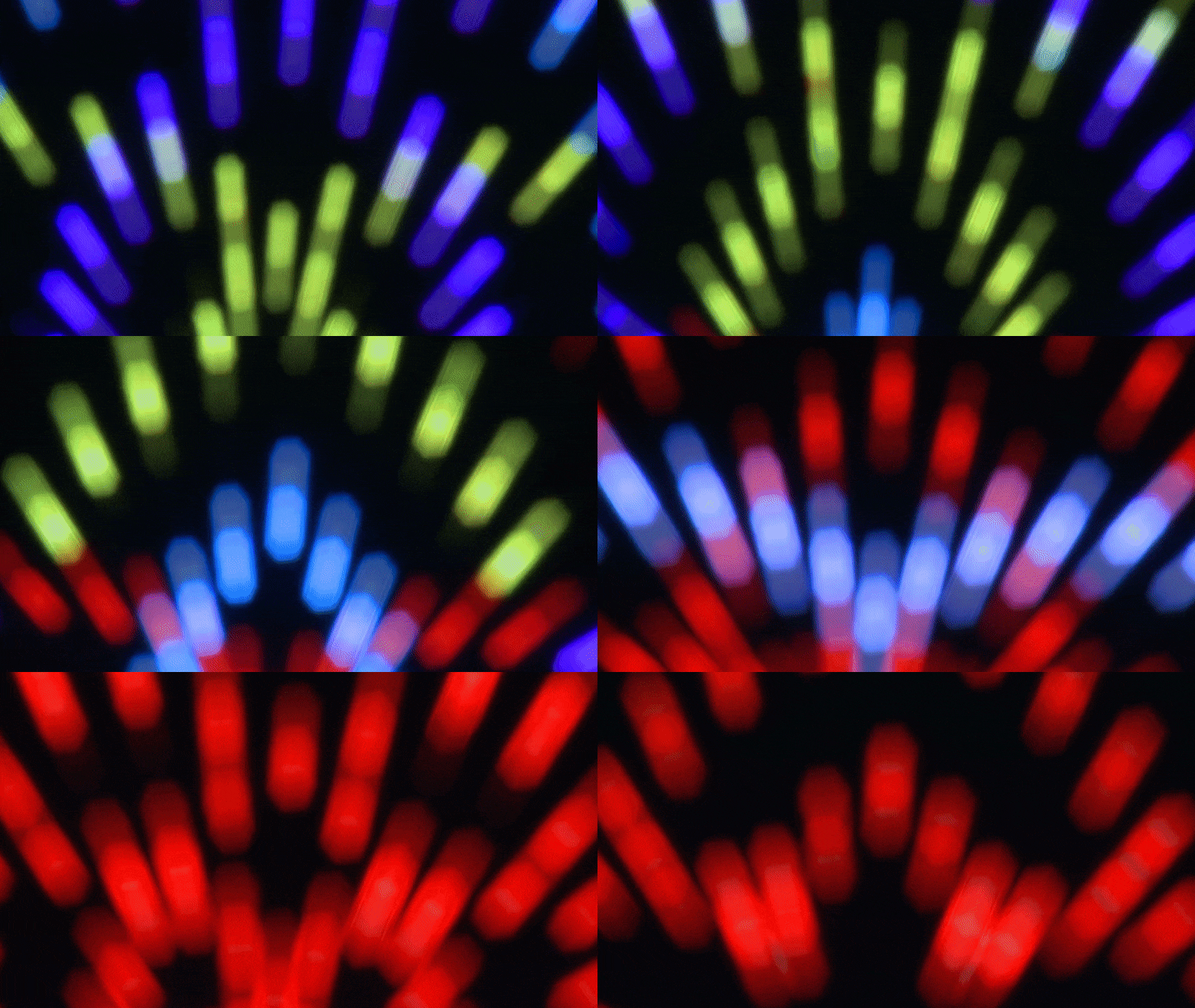
    Fast Light Pulses Art Concept
    It is difficult to generate coherent visible light, like the light of a laser, that is intense for a short amount of time.

    An international research team demonstrates how to generate extremely short pulses of visible light using an industrial-grade laser system.

    Visible light is extremely important in nature. Seen by the human eye, it is the most intense light emitted by the sun to reach the earth’s surface and is an essential element for fundamental biological processes underlying life. However, it is difficult to generate coherent visible light, like the light of a laser, that is intense for a short amount of time, in the order of the femtosecond (one millionth of one billionth of a second).

    A research team, directed by Professor Luca Razzari of the Institut national de la recherche scientifique (INRS), has successfully achieved this goal without using a complicated system. The results of their work were recently published in the prestigious journal Nature Photonics.

    An Accessible Setup

    To generate visible light of that timescale, the team used an industrial-grade laser system available for most laboratories. They discovered that by propagating an infrared laser pulse in a hollow-core fiber filled with argon gas, a nonlinear effect generated short pulses of visible light with high intensity. “We observe a mixing of the different ‘modes,’ i.e., the spatial shapes the light beam takes as it propagates through the fiber, that creates this effect. It occurs only with intense light,” explains Professor Razzari. He collaborated with Professors Roberto Morandotti and François Légaré at INRS for the experimental part of the work, as well as with a team of international researchers, from the French National Centre for Scientific Research (CNRS) (France), Louisiana State University (United States) and Heriot-Watt University (United Kingdom), for the theoretical modeling of the observed phenomenon.

    Luca Razzari
    Luca Razzari, Scientific head of the IR and THz Photonics Laboratory, is interested in investigating the fundamental aspects of radiation-matter interactions on unusual temporal and spatial scales, in view of creating novel tools for photonic applications. Credit: Christian Fleury

    This innovative approach, for the first time, does not rely on complex and expensive optical architectures to generate such ultrashort visible light pulses. As a result, it could be made widely available to explore a vast variety of phenomena in physics, chemistry, as well as biology, such as photosynthesis or even human vision. “With our pulses, we can study the dynamics of such processes and how they evolve on extremely short timescales,” says the postdoctoral researcher Riccardo Piccoli, first author of the paper.

    This collaborative research project greatly benefited from the expertise of the INRS startup few-cycle, which markets the special system to stretch and hold such hollow-core fibers.

    Reference: “Intense few-cycle visible pulses directly generated via nonlinear fibre mode mixing” by Riccardo Piccoli, Jeff M. Brown, Young-Gyun Jeong, Andrea Rovere, Luca Zanotto, Mette B. Gaarde, François Légaré, Arnaud Couairon, John Travers, Roberto Morandotti, Bruno E. Schmidt and Luca Razzari, 28 October 2021, Nature Photonics.
    DOI: 10.1038/s41566-021-00888-7

    The study received funding from the Natural Sciences and Engineering Research Council of Canada (NSERC), PROMPT, and the Air Force Office of Scientific Research.

    Never miss a breakthrough: Join the SciTechDaily newsletter.
    Follow us on Google and Google News.

    Lasers Photonics
    Share. Facebook Twitter Pinterest LinkedIn Email Reddit

    Related Articles

    Ultrafast Electronic Characterization of Proteins and Materials

    “Life-Like” Lasers Can Self-Organize, Adapt, and Cooperate Like Living Systems

    Advancing Optical Signal Processing: Using Magnets To Toggle Nanolasers Leads to Better Photonics

    Integrated Photonics Meets Electron Microscopy in Unconventional Collaboration

    The Nanophotonics Orchestra Presents: Twisting to the Light of Nanoparticles To Reveal “Forbidden” Colors

    Free Electron Laser Insight: Fundamental Process of Free Electron Lasing Revealed

    Nanostructures Enable Record High-Harmonic Generation From Ultra-Intense Laser Pulses

    Recycling Lost Energy: Quantum Laser Turns Energy Loss Into Gain?

    New Type of Silicon Laser Uses Sound Waves to Amplify Light

    1 Comment

    1. xABBAAA on November 13, 2021 11:51 am

      … could they create anti photon and why, that is an important thing…

      Reply
    Leave A Reply Cancel Reply

    • Facebook
    • Twitter
    • Pinterest
    • YouTube

    Don't Miss a Discovery

    Subscribe for the Latest in Science & Tech!

    Trending News

    A Star Near the Milky Way’s Black Hole Is Losing Mass at an Astonishing Rate

    Scientists Solve a Vitamin B12 Mystery With an Unexpected Culprit

    Has the Autism Spectrum Become Too Broad? Leading Scientist Warns of Hidden Consequences

    Rewriting History: Researchers Uncover a Forgotten Amazon Civilization That May Have Housed 3 Million People

    New Research May Change How We Think About Weight Loss Drugs Like Ozempic

    Coffee Drinkers Show Surprising Differences in Fat, Muscle, and Hormones

    New Treatment Targets Gum Disease Without Killing Good Bacteria

    Scientists Discover a 245-Million-Year-Old Reptile With Its Organs Still Preserved

    Follow SciTechDaily
    • Facebook
    • Twitter
    • YouTube
    • Pinterest
    • Newsletter
    • RSS
    SciTech News
    • Biology News
    • Chemistry News
    • Earth News
    • Health News
    • Physics News
    • Science News
    • Space News
    • Technology News
    Recent Posts
    • Quantum Fluctuations Break a Crystal’s Symmetry Rules
    • Researchers Discover a Mysterious New Frog Species in the Amazon
    • Scientists Spotted This Mysterious Congo Monkey 18 Years Ago – Now They Finally Know What It Is
    • Why Does an Irregular Heartbeat Strike 40 Years Early in Some People?
    • Scientists Reveal How ADHD Could Fuel Creative Thinking
    Copyright © 1998 - 2026 SciTechDaily. All Rights Reserved.
    • Science News
    • About
    • Contact
    • Editorial Board
    • Privacy Policy
    • Terms of Use

    Type above and press Enter to search. Press Esc to cancel.