
Close Menu
    Facebook X (Twitter) Instagram
    SciTechDaily
    • Biology
    • Chemistry
    • Earth
    • Health
    • Physics
    • Science
    • Space
    • Technology
    Facebook X (Twitter) Pinterest YouTube RSS
    SciTechDaily
    Home»Space»Astronomers Spot a Moon-Forming Disk Around a Super-Jupiter Exoplanet
    Space

    Astronomers Spot a Moon-Forming Disk Around a Super-Jupiter Exoplanet

    By Andy Tomaswick, Universe TodayNovember 5, 2021No Comments3 Mins Read
    Facebook Twitter Pinterest Telegram LinkedIn WhatsApp Email Reddit
    Share
    Facebook Twitter LinkedIn Pinterest Telegram Email Reddit
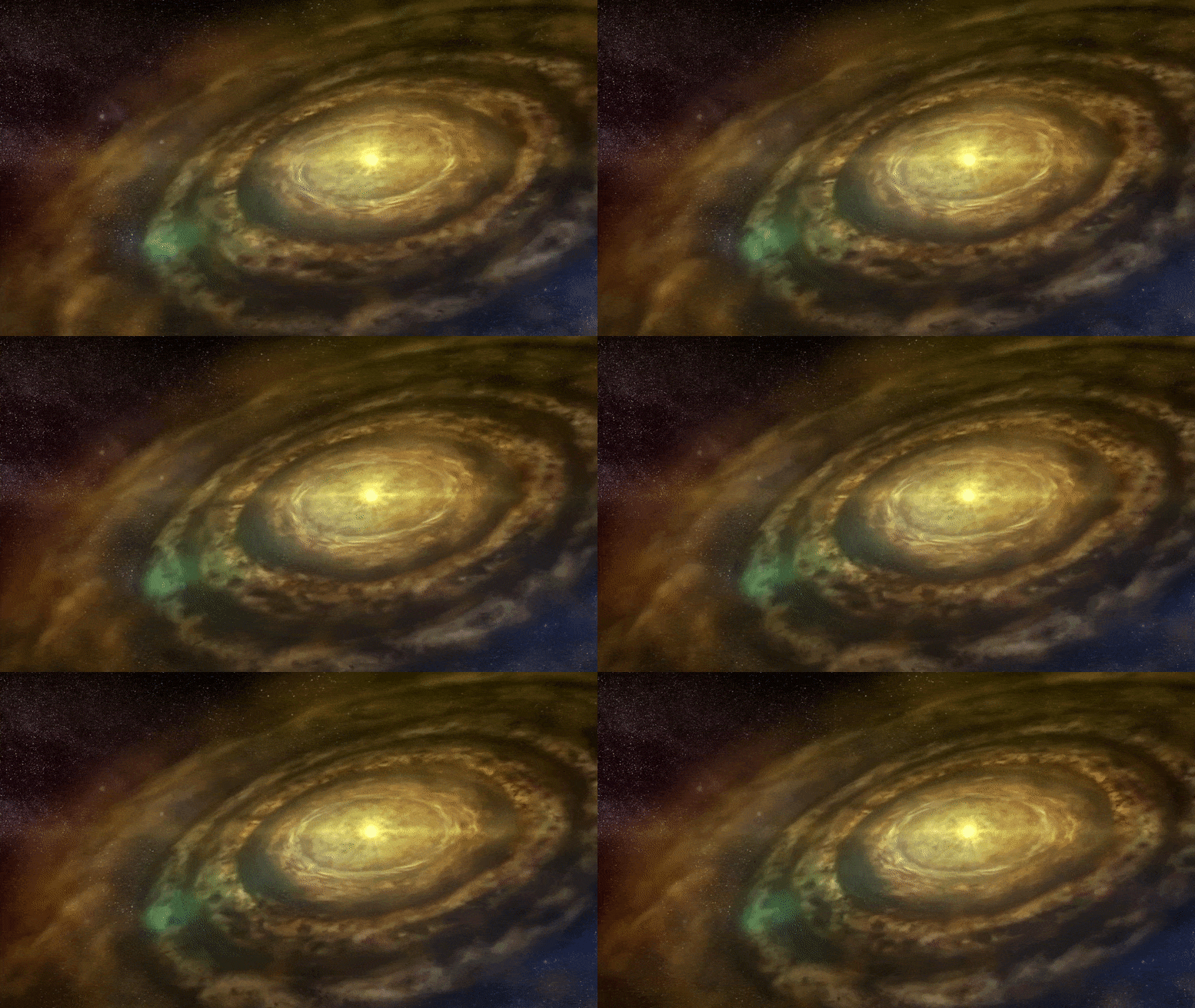
    Protoplanetary Disc Animation
    Protoplanetary Disc Animation

    GQ Lupi B, a massive “super Jupiter” about 500 light-years away, has a surrounding disc of material that could be forming moons.

    Recently, astronomers have been finding protoplanetary discs around certain stars.  Their discovery has helped kick off a new work in planetary formation theory.  But planets aren’t the objects that form from discs of material in space.  Moons do too.  Now, scientists led by Dr. Tomas Stolker of Leiden University and his team have delved deeper into the characteristics of a “protolunar” disc surrounding a “super Jupiter” exoplanet about 500 light-years away.

    The exoplanet, GQ Lupi B, orbits its parent star on a path about 20 times wider than Jupiter does from the Sun.  In addition, the planet is much heavier than our latest gas giant. Initially discovered in 2004, this exoplanet has been the center of lots of attention.  Scientists have been trying to determine whether it was formed via a typical planetary formation process, which would indeed create a giant planet.  Alternatively, it could have formed using a process similar to some star and wound up as an object known as a brown dwarf.

    This increased interest has led to more data on GQ Lupi B.  Dr. Stolker and his team collected some of that data using two instruments on the Very Large Telescope – NACO, a near-infrared imager, and MUSE, a visible light spectroscope.  Using NACO, the team took a look at the thermal profile of the disc surrounding GQ Lupi B.  The surrounding disc is a much lower temperature than the planet’s atmosphere, leading the researchers to theorize that there might be a “cavity” in the ring where a moon is starting to coalesce.  But it could also just be influenced by the magnetic field of the planet itself.

    Signs of Planetary Growth and Material Exchange

    MUSE provided a different picture.  With it, the researchers looked at H-alpha radiation, which allowed them to detect features in the planet’s atmosphere.  They noticed that the planet is still growing, using either a supply of material from its own protolunar disc or grabbing material from its star’s protoplanetary disc. 

    Despite all the attention it has garnered, the study of GQ Lupi B still lacks a key component – the mid-infrared range.  Those spectra would help astronomers understand the thermal properties of the disc and determine whether a moon indeed is forming there.  Luckily, that wavelength is exactly what the James Webb Space Telescope hopes to begin monitoring soon.  Unfortunately, the researchers will have to get in line to get time on the telescope, as it will be in extraordinarily high demand after numerous delays and cost overruns.  But once it is fully operational, it should collect some additional light from this interesting system – and maybe even capture an image of an exomoon or two.

    Adapted from an article originally published on Universe Today.

    Never miss a breakthrough: Join the SciTechDaily newsletter.
    Follow us on Google and Google News.

    Astronomy Astrophysics Planets Very Large Telescope
    Share. Facebook Twitter Pinterest LinkedIn Email Reddit

    Related Articles

    Rogue Planet Feasting Faster Than Any World Ever Seen

    Astronomers Just Caught a Giant Baby Planet Sculpting Spirals in Space

    Perpendicular Planet: A 90° Orbit Over Twin Suns Leaves Scientists Stunned

    Four Tiny Planets Discovered Near Earth, After Century-Long Search

    Unlocking Cosmic Secrets: Groundbreaking Insights Into Planetary Genesis

    The Genesis of Jupiters: Incredible New Image Reveals Secrets of Planet Birth

    Surprise Planet Discovered Around Extreme Star Pair

    AB Aur: A Rosetta Stone for Planet Formation

    Astronomers Discover Pair of Lonely Exotic Planet-Like Objects Born Like Stars

    Leave A Reply Cancel Reply

    • Facebook
    • Twitter
    • Pinterest
    • YouTube

    Don't Miss a Discovery

    Subscribe for the Latest in Science & Tech!

    Trending News

    Popular Sugar-Free Sweetener Linked to Liver Disease, Study Warns

    What Is Hantavirus? The Deadly Disease Raising Alarm Worldwide

    Scientists Just Discovered How the Universe Builds Monster Black Holes

    Scientists Unveil New Treatment Strategy That Could Outsmart Cancer

    A Simple Vitamin May Hold the Key to Treating Rare Genetic Diseases

    Scientists Think the Real Fountain of Youth May Be Hiding in Your Gut

    Ravens Don’t Follow Wolves, They Predict Them

    This Common Knee Surgery May Be Doing More Harm Than Good

    Follow SciTechDaily
    • Facebook
    • Twitter
    • YouTube
    • Pinterest
    • Newsletter
    • RSS
    SciTech News
    • Biology News
    • Chemistry News
    • Earth News
    • Health News
    • Physics News
    • Science News
    • Space News
    • Technology News
    Recent Posts
    • This Mars Rock Refused To Let Go of NASA’s Curiosity Rover
    • James Webb Telescope Reveals the Universe’s Hidden Cosmic Web in Stunning Detail
    • Scientists Build a Living AI Device Using Real Brain Cells
    • Why Are So Many New Fathers Dying? Scientists Say the U.S. Has a Dangerous Blind Spot
    • Scientists Identify Simple Supplement That Greatly Reduces Alzheimer’s Damage
    Copyright © 1998 - 2026 SciTechDaily. All Rights Reserved.
    • Science News
    • About
    • Contact
    • Editorial Board
    • Privacy Policy
    • Terms of Use

    Type above and press Enter to search. Press Esc to cancel.