
Close Menu
    Facebook X (Twitter) Instagram
    SciTechDaily
    • Biology
    • Chemistry
    • Earth
    • Health
    • Physics
    • Science
    • Space
    • Technology
    Facebook X (Twitter) Pinterest YouTube RSS
    SciTechDaily
    Home»Physics»A Triple Treat From Large Hadron Collider: Three J/ψ Particles Emerging From a Single Collision Between Two Protons
    Physics

    A Triple Treat From Large Hadron Collider: Three J/ψ Particles Emerging From a Single Collision Between Two Protons

    By Ana Lopes, CERNNovember 9, 20219 Comments2 Mins Read
    Facebook Twitter Pinterest Telegram LinkedIn WhatsApp Email Reddit
    Share
    Facebook Twitter LinkedIn Pinterest Telegram Email Reddit
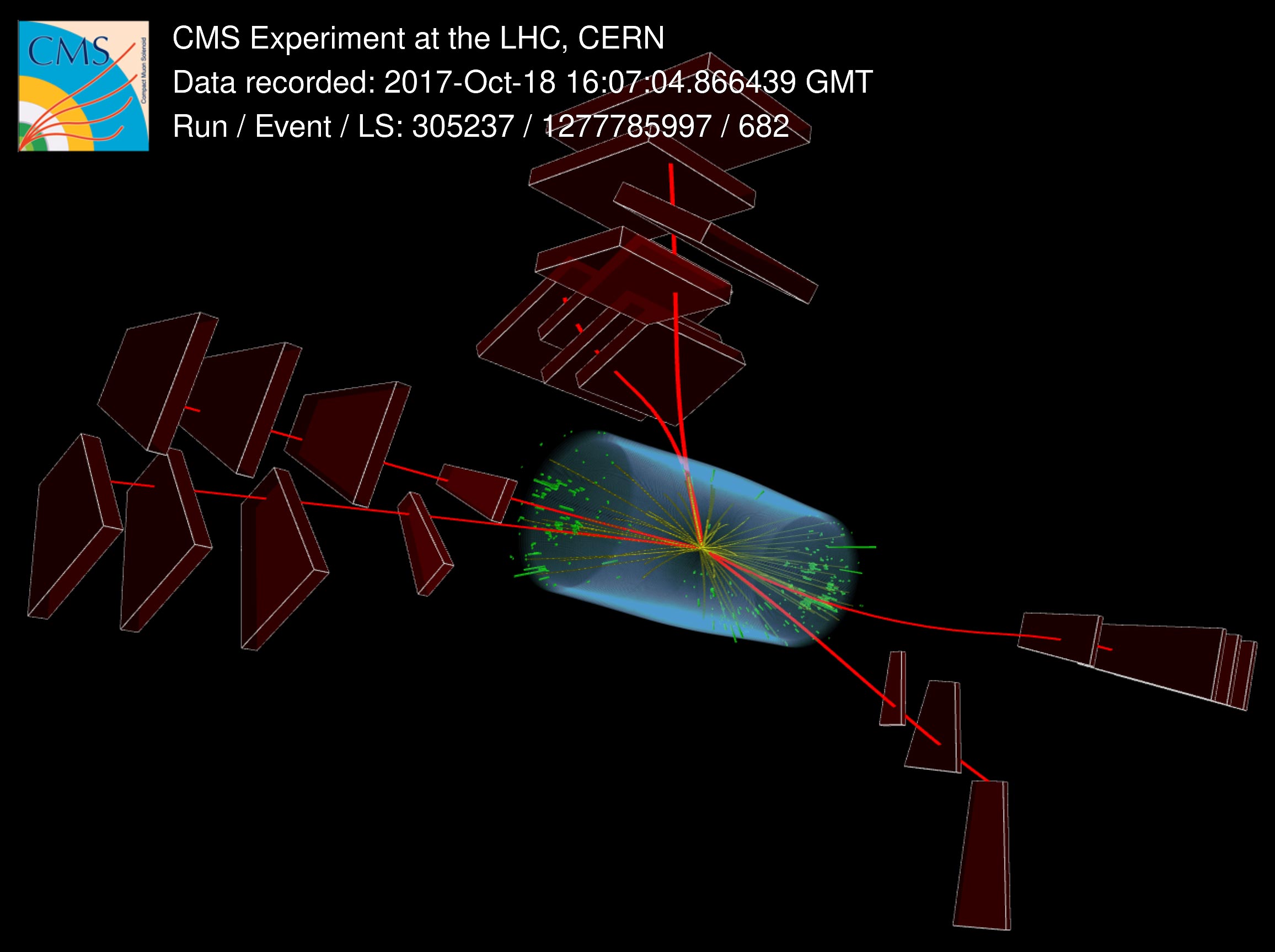
    Proton–Proton Collision Event With Six Muons
    A proton-proton collision event with six muons (red lines) produced in the decays of three J/ψ particles. Credit: CMS/CERN

    In a first for particle physics, the CMS collaboration has observed three J/ψ particles emerging from a single collision between two protons.

    It’s a triple treat. By sifting through data from particle collisions at the Large Hadron Collider (LHC), the CMS collaboration has seen not one, not two but three J/ψ particles emerging from a single collision between two protons. In addition to being a first for particle physics, the observation opens a new window into how quarks and gluons are distributed inside the proton.

    The J/ψ particle is a special particle. It was the first particle containing a charm quark to be discovered, winning Burton Richter and Samuel Ting a Nobel prize in physics and helping to establish the quark model of composite particles called hadrons.

    Experiments including ATLAS, CMS, and LHCb at the LHC have previously seen one or two J/ψ particles coming out of a single particle collision, but never before have they seen the simultaneous production of three J/ψ particles – until the new CMS analysis.

    Detecting Triple J/ψ Through Muon Pairs

    The trick? Analyzing the vast amount of high-energy proton-proton collisions collected by the CMS detector during the second run of the LHC, and looking for the transformation of the J/ψ particles into pairs of muons, the heavier cousins of the electrons.

    From this analysis, the CMS team identified five instances of single proton-proton collision events in which three J/ψ particles were produced simultaneously. The result has a statistical significance of more than five standard deviations – the threshold used to claim the observation of a particle or process in particle physics.

    These three-J/ψ events are very rare. To get an idea, one-J/ψ events and two-J/ψ events are about 3.7 million and 1800 times more common, respectively. “But they are well worth investigating,” says CMS physicist Stefanos Leontsinis, “A larger sample of three-J/ψ events, which the LHC should be able to collect in the future, should allow us to improve our understanding of the internal structure of protons at small scales.”

    Never miss a breakthrough: Join the SciTechDaily newsletter.
    Follow us on Google and Google News.

    CERN Large Hadron Collider Particle Physics Popular
    Share. Facebook Twitter Pinterest LinkedIn Email Reddit

    Related Articles

    Jetting Into the Dark Side: ATLAS’ Precision Search for Dark Matter

    Large Hadron Collider Detects Evidence of a Rare Higgs Boson Process: God Particle Decaying Into a Pair of Muons

    Exotic Never Before Seen Four-Quark Particle Discovered Using Large Hadron Collider

    Intriguing New Result From the Large Hadron Collider May Signal a Crack in the Standard Model

    New CERN Study Suggests Subatomic Particles Could Defy the Standard Model

    New Results Indicate That Particle Discovered at LHC Is a Higgs Boson

    CERN to Announce the Latest Results from ATLAS and CMS

    More Data of Elusive Higgs Boson from Defunct US Tevatron Collider

    Higgs Boson Signals Gain Strength at Large Hadron Collider

    9 Comments

    1. George on November 10, 2021 7:03 pm

      Great Article!!! Now…. how about defining what the heck a J/Psi is so we have a better idea what you are actually discussing and the importance thereof.

      Reply
    2. Frosted Flake on November 11, 2021 6:14 am

      If I get it, what is being said is, some of the energy imparted to those protons by the accellerator was transformed, briefly, into matter. Which then promptly disintegrated into oppositely charged particles of a simpler nature.

      If so, then there is more story to tell.

      Reply
    3. Moonmaid on November 11, 2021 7:20 am

      Could it be the Jesus/Pitchfork of evil symbol? I’d like to know myself.

      Reply
    4. Syed Mahedi Hasan on November 11, 2021 10:17 am

      J/Psi is a meson(a combination of a quark and antiquark), in this case it is a meson containing charm and anticharm quark.

      Reply
    5. mullach abu on November 12, 2021 11:13 am

      and a proton is
      a proton proton collision event
      proton radius 0.833 fm three valence quarks
      two up quarks of charge + 2/3 e x 2
      one down quark of charge -1/3 e x 2
      kinetic energy of two up quarks x 2
      kinetic energy of one down quark x 2
      energy of the gluon fields that bind the three quarks together x 2 = xi xii
      wheres the charm in that

      Reply
    6. mullach abu on November 12, 2021 11:15 am

      a proton proton collision event
      proton radius 0.833 fm three valence quarks
      two up quarks of charge + 2/3 e x 2
      one down quark of charge -1/3 e x 2
      kinetic energy of two up quarks x 2
      kinetic energy of one down quark x 2
      energy of the gluon fields that bind the three quarks together x 2 = xi xii
      and wheres the charm in that
      did not print last time

      Reply
    7. Chad on November 12, 2021 8:43 pm

      Some about Harry Potter maybe? I don’t understand incantations and stuff

      Reply
    8. Paul on November 14, 2021 11:04 am

      Cern messing with earths shields. Expect havoc when they crank it up

      Reply
    9. Daniel Nittmann on November 17, 2021 1:04 am

      By winding two paticles at 11,11 the impact of two of these creates three particles, at 6,6,. Voldemort’s gringots vault…

      Reply
    Leave A Reply Cancel Reply

    • Facebook
    • Twitter
    • Pinterest
    • YouTube

    Don't Miss a Discovery

    Subscribe for the Latest in Science & Tech!

    Trending News

    Largest-Ever Study Finds Medicinal Cannabis Ineffective for Anxiety, Depression, PTSD

    250-Million-Year-Old Egg Solves One of Evolution’s Biggest Mysteries

    Living With Roommates Might Be Changing Your Gut Microbiome Without You Knowing

    Century-Old Cleaning Chemical Linked to 500% Increased Risk of Parkinson’s Disease

    What if Your Memories Never Happened? Physicists Take a New Look at the Boltzmann Brain Paradox

    One of the Universe’s Largest Stars May Be Getting Ready To Explode

    Scientists Discover Enzyme That Could Supercharge Ozempic-Like Weight Loss Drugs

    Popular Sweetener Linked to DNA Damage – “It’s Something You Should Not Be Eating”

    Follow SciTechDaily
    • Facebook
    • Twitter
    • YouTube
    • Pinterest
    • Newsletter
    • RSS
    SciTech News
    • Biology News
    • Chemistry News
    • Earth News
    • Health News
    • Physics News
    • Science News
    • Space News
    • Technology News
    Recent Posts
    • Scientists Prove There Are Just Six Degrees of Separation in a Social Network
    • Bee Bacteria Could Fix a Major Flaw in Plant-Based Milk
    • Scientists Discover a Surprising Way To Make Bread Healthier and More Nutritious
    • Natural Compounds Boost Bone Implant Success While Killing Bacteria and Cancer Cells
    • After 60 Years, Scientists Uncover Unexpected Brain Effects of Popular Diabetes Drug Metformin
    Copyright © 1998 - 2026 SciTechDaily. All Rights Reserved.
    • Science News
    • About
    • Contact
    • Editorial Board
    • Privacy Policy
    • Terms of Use

    Type above and press Enter to search. Press Esc to cancel.