
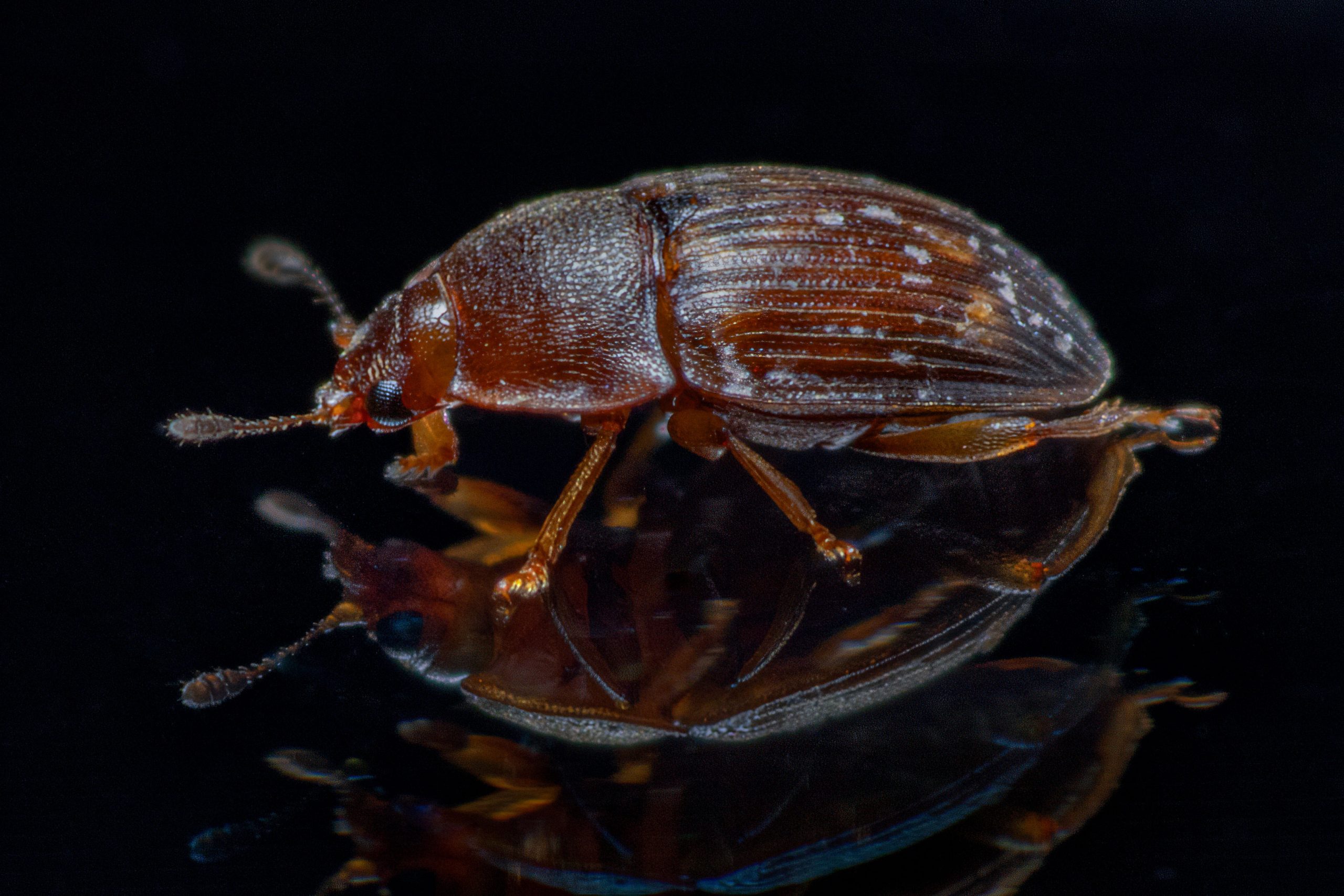
A newly identified nematode species may have entered Europe by hitchhiking on invasive beetles, revealing an unexpected ecological partnership hidden inside rotting fruit.
In 2025, researchers in Konstanz studying rotting fruit in local orchards spotted a behavior never before documented in nature. Hundreds of worms were seen stretching upward together into writhing structures called “towers.” Scientists had previously observed these formations only in laboratory experiments.
The team later recreated the behavior in the lab and found that the towers could cling to fruit flies. The finding supports the long-standing theory that the worms use other animals to travel to new environments.
Even so, researchers still did not know which animals were transporting the worms in the wild.
Beetles Identified as Likely Carriers
The scientists now believe two invasive sap-feeding beetles common in Europe may be carrying the worms between habitats. Although the researchers never directly witnessed towers attaching to the beetles, they examined hundreds of invertebrates collected from orchard fruit and found large groups of worms only on these two beetle species.
Genetic testing showed that the worms responsible for the towers belong to a previously unknown species named Caenorhabditis apta.
“It’s fascinating that C. apta prefers to attach to just these two beetles, out of the dozens of invertebrate species that we examined,” says first author Dr. Ryan Greenway, a research coordinator at the Max Planck Institute of Animal Behavior (MPI-AB). “Now we are looking at whether these worm clusters on beetles get there through towering, or if they can be formed after individual worms attach to the beetles instead.”
Caenorhabditis apta gathered in clusters on the underside of the wing cover of a strawberry sap beetle, Stelidota geminata. Credit: Ryan Greenway / Genes and Behavior Group
A Hidden World of Hitchhiking Worms
Nematodes are the most abundant animals on Earth, but scientists still know little about how many species spread from place to place. Because the worms are so small, many depend on larger animals called vectors to transport them to new habitats.
These relationships can have major environmental and agricultural effects. Some nematodes spread plant diseases through insect carriers. One example is the pinewood nematode, which is transported by longhorn beetles and has devastated forests on several continents.
Outside a few economically important cases, however, researchers know very little about which animals carry most nematodes in natural environments. That gap makes it harder to understand how these organisms spread, invade ecosystems, and shape ecological processes.
Did the Worms Arrive in Europe With Invasive Beetles?
After uncovering the link between C. apta and the beetles, the researchers began investigating whether the partnership extended beyond German orchards.
The newly identified nematode species has appeared in European collections only since 2010. Meanwhile, both beetle species arrived in Europe in the early 2000s, with one originating from North America and the other from the western Pacific. That timing led the researchers to consider a possible connection.
“What if C. apta hitched a ride into Europe on the wings of the beetles?” asks Greenway.
To test the idea, the team compared worldwide records of the beetles with known collections of C. apta and related species. They found overlapping distributions in North America involving the strawberry sap beetle, suggesting a possible route by which the nematode entered Europe.
Ecological Consequences and Future Research
If C. apta recently arrived in Europe, the species could already be affecting local ecosystems. Researchers say the nematode may influence food webs and the breakdown of fruit in orchard environments.
“The introduction of a new nematode species in Europe might not seem like a big issue,” says Greenway, “but we know that nematodes can play an important role in helping their vectors spread, and vice versa.”
The team is now studying whether C. apta benefits the beetles or harms them.
“We might even find ways to use C. apta to limit the spread of these sap beetles, which has implications for managing these well-known crop pests,” he says.
The researchers say the study offers rare insight into how nematodes evolve and interact with the world around them.
“We know surprisingly little about the natural history of nematodes, despite their abundance and despite C. elegans being one of the best-studied organisms in biology,” says senior author Dr. Serena Ding, who leads the Genes and Behavior Group at MPI-AB. “This study shows what we can learn when we move beyond the lab and observe them in their natural habitats together with the other organisms they interact with.”
Reference: “Differential Phoretic Vector Use Among Sympatric Caenorhabditis Nematodes and an Association With Invasive Nitidulid Beetles in Southwestern Germany” by Ryan Greenway, Loel Dalan, Christian Braendle, Marie-Anne Félix and Siyu Serena Ding, 4 May 2026, Ecology and Evolution.
DOI: 10.1002/ece3.73510
Never miss a breakthrough: Join the SciTechDaily newsletter.
Follow us on Google and Google News.