
Close Menu
    Facebook X (Twitter) Instagram
    SciTechDaily
    • Biology
    • Chemistry
    • Earth
    • Health
    • Physics
    • Science
    • Space
    • Technology
    Facebook X (Twitter) Pinterest YouTube RSS
    SciTechDaily
    Home»Biology»Ancient DNA Reveals Link between Early Humans & Present-Day Asians and Native Americans
    Biology

    Ancient DNA Reveals Link between Early Humans & Present-Day Asians and Native Americans

    By Max Planck InstituteJanuary 22, 20131 Comment3 Mins Read
    Facebook Twitter Pinterest Telegram LinkedIn WhatsApp Email Reddit
    Share
    Facebook Twitter LinkedIn Pinterest Telegram Email Reddit
    leg-of-the-early-modern-human-from-Tianyuan-Cave
    The leg of the early modern human from Tianyuan Cave was used for the genetic analysis as well as for carbon dating. Credit: MPI for Evolutionary Anthropology

    Analyses of ancient DNA, which had been extracted from the leg bone of an early modern human living some 40,000 years ago near Beijing, revealed that this early modern human was related to the ancestors of many present-day Asians and Native Americans.

    An international team of researchers including Svante Pääbo and Qiaomei Fu of the Max Planck Institute for Evolutionary Anthropology in Leipzig, Germany, sequenced nuclear and mitochondrial DNA that had been extracted from the leg of an early modern human from Tianyuan Cave near Beijing, China. Analyses of this individual’s DNA showed that the Tianyuan human shared a common origin with the ancestors of many present-day Asians and Native Americans. In addition, the researchers found that the proportion of Neanderthal and Denisovan-DNA in this early modern human is not higher than in people living in this region nowadays.

    Humans with morphology similar to present-day humans appear in the fossil record across Eurasia between 40,000 and 50,000 years ago. The genetic relationships between these early modern humans and present-day human populations had not yet been established. Qiaomei Fu, Matthias Meyer, and colleagues of the Max Planck Institute for Evolutionary Anthropology in Leipzig, Germany, extracted nuclear and mitochondrial DNA from a 40,000-year-old leg bone found in 2003 at the Tianyuan Cave site located outside Beijing. For their study the researchers were using new techniques that can identify ancient genetic material from an archaeological find even when large quantities of DNA from soil bacteria are present.
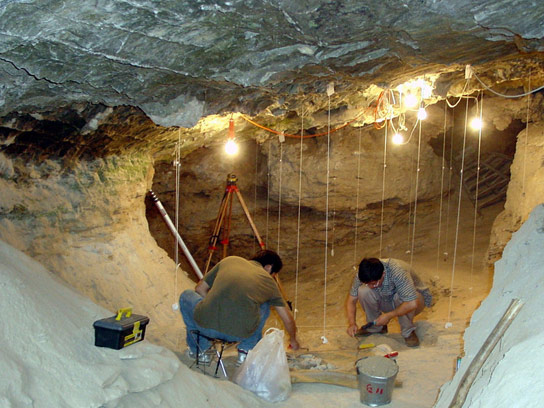
    humans-living-40,000-years-ago-in-Beijing-related-to-many-present-day-Asians-and-Native-Americans
    Researchers carrying out excavation works at the Tianyuan Cave from which the leg bones had been excavated in 2003. Credit: Institute of Vertebrate Paleontology and Paleoanthropology (IVPP), Beijing

    The researchers then reconstructed a genetic profile of the leg’s owner. “This individual lived during an important evolutionary transition when early modern humans, who shared certain features with earlier forms such as Neanderthals, were replacing Neanderthals and Denisovans, who later became extinct,” says Svante Pääbo of the Max Planck Institute for Evolutionary Anthropology, who led the study.

    The genetic profile reveals that this early modern human was related to the ancestors of many present-day Asians and Native Americans but had already diverged genetically from the ancestors of present-day Europeans. In addition, the Tianyuan individual did not carry a larger proportion of Neanderthal or Denisovan DNA than present-day people in the region. “More analyses of additional early modern humans across Eurasia will further refine our understanding of when and how modern humans spread across Europe and Asia,” says Svante Pääbo.

    Reference: “DNA analysis of an early modern human from Tianyuan Cave, China” by Qiaomei Fu, Matthias Meyer, Xing Gao, Udo Stenzel, Hernán A. Burbano, Janet Kelso, Svante Pääbo, 21 January 2013, Proceedings of the National Academy of Sciences.
    DOI: 10.1073/pnas.1221359110

    Parts of the work were carried out in a new laboratory jointly run by the Max Planck Society and the Chinese Academy of Sciences in Beijing.

    Never miss a breakthrough: Join the SciTechDaily newsletter.
    Follow us on Google and Google News.

    Anthropology DNA Evolutionary Biology Genetics Max Planck Institute
    Share. Facebook Twitter Pinterest LinkedIn Email Reddit

    Related Articles

    Time-Traveling Genes: Ancient DNA Reveals Down Syndrome in Past Human Societies

    23,000 Years Old: The Oldest Human Genome From Southern Spain

    Biologists Sequence a New Neanderthal Genome from Vindija Cave in Croatia

    DNA Study Reveals Clues about Primate Evolution

    Gene Flow Between Indian Populations and Australia Occurred 4,000 Years Ago

    DNA Jumps Directly From the Cell’s Chloroplasts Into Its Nucleus

    Rare Example of Bacterial Gene Transfer Providing Evolutionary Benefit

    Human Y-Chromosome Has Enough Genes to Stay for Millions of Years

    Researchers Complete Genome Sequence of a Denisovan Human Finger Bone

    1 Comment

    1. Liz on November 13, 2023 2:20 am

      Unfortunately, it doesn’t tell us who ate the rest of the bones of this former individual.

      Reply
    Leave A Reply Cancel Reply

    • Facebook
    • Twitter
    • Pinterest
    • YouTube

    Don't Miss a Discovery

    Subscribe for the Latest in Science & Tech!

    Trending News

    Scientists Say This Natural Hormone Reverses Obesity by Targeting the Brain

    35-Million-Year-Old Mystery: Strange Arachnid Discovered Preserved in Amber

    Is AI Really Just a Tool? It Could Be Altering How You See Reality

    JWST Reveals a “Forbidden” Planet With a Baffling Composition

    The Protein “Sabotaging” Aging Muscle Recovery Could Be Key to Surviving Aging

    This Diet–Gut Interaction Could Transform Fat Into a Calorie-Burning Machine

    Scientists Discover Hidden Virus Linked to Colorectal Cancer

    Scientists Discover 132-Million-Year-Old Dinosaur Tracks on South Africa’s Coast

    Follow SciTechDaily
    • Facebook
    • Twitter
    • YouTube
    • Pinterest
    • Newsletter
    • RSS
    SciTech News
    • Biology News
    • Chemistry News
    • Earth News
    • Health News
    • Physics News
    • Science News
    • Space News
    • Technology News
    Recent Posts
    • Surprise RNA Discovery Challenges Long-Held Beliefs About How Genes Work
    • Your IQ at 23 Could Predict Your Wealth at 27, Study Finds
    • 320 Light-Years Away, a Planet Confirms a Fundamental Cosmic Assumption
    • Astronomers Solve Decades-Long Mystery About Saturn’s Spin – “Something Strange Was Happening”
    • Scientists Uncover Strange New State of Matter Inside Uranus and Neptune
    Copyright © 1998 - 2026 SciTechDaily. All Rights Reserved.
    • Science News
    • About
    • Contact
    • Editorial Board
    • Privacy Policy
    • Terms of Use

    Type above and press Enter to search. Press Esc to cancel.