
Close Menu
    Facebook X (Twitter) Instagram
    SciTechDaily
    • Biology
    • Chemistry
    • Earth
    • Health
    • Physics
    • Science
    • Space
    • Technology
    Facebook X (Twitter) Pinterest YouTube RSS
    SciTechDaily
    Home»Biology»Rare Example of Bacterial Gene Transfer Providing Evolutionary Benefit
    Biology

    Rare Example of Bacterial Gene Transfer Providing Evolutionary Benefit

    By SciTechDailyFebruary 28, 2012No Comments2 Mins Read
    Facebook Twitter Pinterest Telegram LinkedIn WhatsApp Email Reddit
    Share
    Facebook Twitter LinkedIn Pinterest Telegram Email Reddit
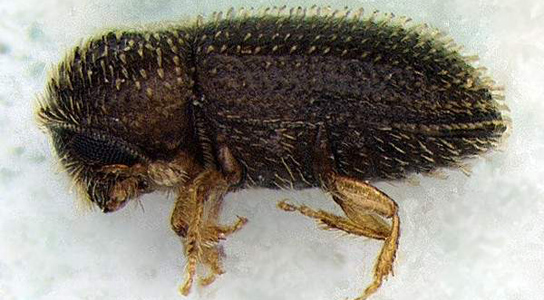
    Hypothenemus-hampei
     Coffee berry borer beetle (Hypothenemus hampei).

    A bacterial gene that has been discovered in the genome of the coffee berry borer beetle (Hypothenemus hampei) allows it to occupy a unique ecological niche and feed exclusively on coffee beans.

    The findings that were published in the Proceedings of the National Academy of Sciences are a rare example of a bacteria-to-animal gene transfer that has had an obvious benefit.

    Jocelyn Rose, a plant biologist at Cornell University, in Ithaca, New York, and his colleagues think that the transferred genes, which let the beetle break down complex sugars that are found in the coffee bean, came from the beetle’s intestinal flora.

    This kind of nonsexual horizontal gene transfer (HGT) has been widely documented in prokaryotes, but there are relatively few examples of this in more complex organisms, including higher animals.
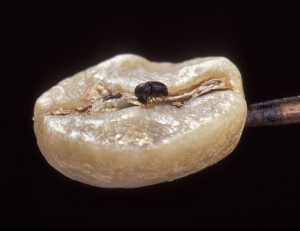
    coffee-berry-borer-beetleHypothenemus hampei is a small beetle native to Africa that has spread worldwide during the 20th century. Rose and his colleagues examined its genome. They identified a beetle gene, HhMAN1, that codes for a protein called mannanase, which breaks down polysaccharide galactomannan that is found in coffee beans. The gene closely resembles the sequence of bacterial mannanase and it’s the first kind of this type that has been discovered in an insect.

    The gene lies between two transposable elements, indicating that these transposons may have enabled mannanase to jump from bacteria to the beetle genome, although the exact process is completely unknown.

    It’s possible that the adjacent transposons are coincidental.

    Reference: “Adaptive horizontal transfer of a bacterial gene to an invasive insect pest of coffee” by Ricardo Acuña, Beatriz E. Padilla, Claudia P. Flórez-Ramos, José D. Rubio, Juan C. Herrera, Pablo Benavides, Sang-Jik Lee, Trevor H. Yeats, Ashley N. Egan, Jeffrey J. Doyle and Jocelyn K. C. Rose, 27 February 2012, Proceedings of the National Academy of Sciences.
    DOI: 10.1073/pnas.1121190109

    Never miss a breakthrough: Join the SciTechDaily newsletter.
    Follow us on Google and Google News.

    Bacteria DNA Evolutionary Biology Genetics
    Share. Facebook Twitter Pinterest LinkedIn Email Reddit

    Related Articles

    Engineered Bacteria Store Memories of Chemical Exposure

    DNA Study Reveals Clues about Primate Evolution

    Ancient DNA Reveals Link between Early Humans & Present-Day Asians and Native Americans

    Bactrian Camel Genome Might Help Survival in Harsh Environments

    Researchers Calculate That DNA Has a 521 Year Half-Life

    Genetic Variability Helps Sea Urchins Cope with Environmental Changes

    DNA Could Predate Existence of Life As We Know It

    Human Y-Chromosome Has Enough Genes to Stay for Millions of Years

    Researchers Complete Genome Sequence of a Denisovan Human Finger Bone

    Leave A Reply Cancel Reply

    • Facebook
    • Twitter
    • Pinterest
    • YouTube

    Don't Miss a Discovery

    Subscribe for the Latest in Science & Tech!

    Trending News

    Hair Loss May Be an Overlooked Side Effect of Ozempic and Mounjaro

    Scientists Develop a Groundbreaking Chip That Operates at Brain-Like Speed

    Viagra May Block a Hidden Pathway Cancer Cells Need To Spread

    How Brown Tree Snakes Became an Unstoppable Invasive Species

    Earth’s First Complex Organisms May Hold Clues to Life Beyond Our Planet

    A 25,000-Year-Old Ritual Tradition Was Hidden Beneath This Cave Floor

    Plant Compounds in Berries, Tea, and Cocoa May Support Healthy Brain Aging

    Scientists Turn an Old Antibiotic Back Into a Superbug Killer

    Follow SciTechDaily
    • Facebook
    • Twitter
    • YouTube
    • Pinterest
    • Newsletter
    • RSS
    SciTech News
    • Biology News
    • Chemistry News
    • Earth News
    • Health News
    • Physics News
    • Science News
    • Space News
    • Technology News
    Recent Posts
    • Scientists Discover an Odd Genetic Trait in an Ancient Aboriginal Food Plant
    • Marine Heatwaves Are Hiding Far More Heat Than Scientists Realized
    • 1.4-Million-Year-Old Footprints Reveal a Giant Human Relative
    • Rocks From the Moon’s Far Side Are Rewriting Lunar History
    • NASA’s Curiosity Finds a Vast Sea of Mysterious Polygons on Mars
    Copyright © 1998 - 2026 SciTechDaily. All Rights Reserved.
    • Science News
    • About
    • Contact
    • Editorial Board
    • Privacy Policy
    • Terms of Use

    Type above and press Enter to search. Press Esc to cancel.