
The nature of dark matter remains one of the great unsolved puzzles of fundamental physics. Unexplained by the Standard Model, dark matter has led scientists to probe new physics models to understand its existence. Many such theoretical scenarios postulate that dark matter particles could be produced in the intense high-energy proton–proton collisions of the LHC. While the dark matter would escape the ATLAS detector unseen, it could occasionally be accompanied by a visible jet of particles radiated from the interaction point, thus providing a detectable signal.
The ATLAS Collaboration set out to find just that. Today, at the International Conference in High-Energy Physics (ICHEP 2020), ATLAS presented a new search for novel phenomena in collision events with jets and high missing transverse momentum (MET). The search was designed to uncover events that could indicate the existence of physics processes that lie outside the Standard Model and, in doing so, open a window to the cosmos.
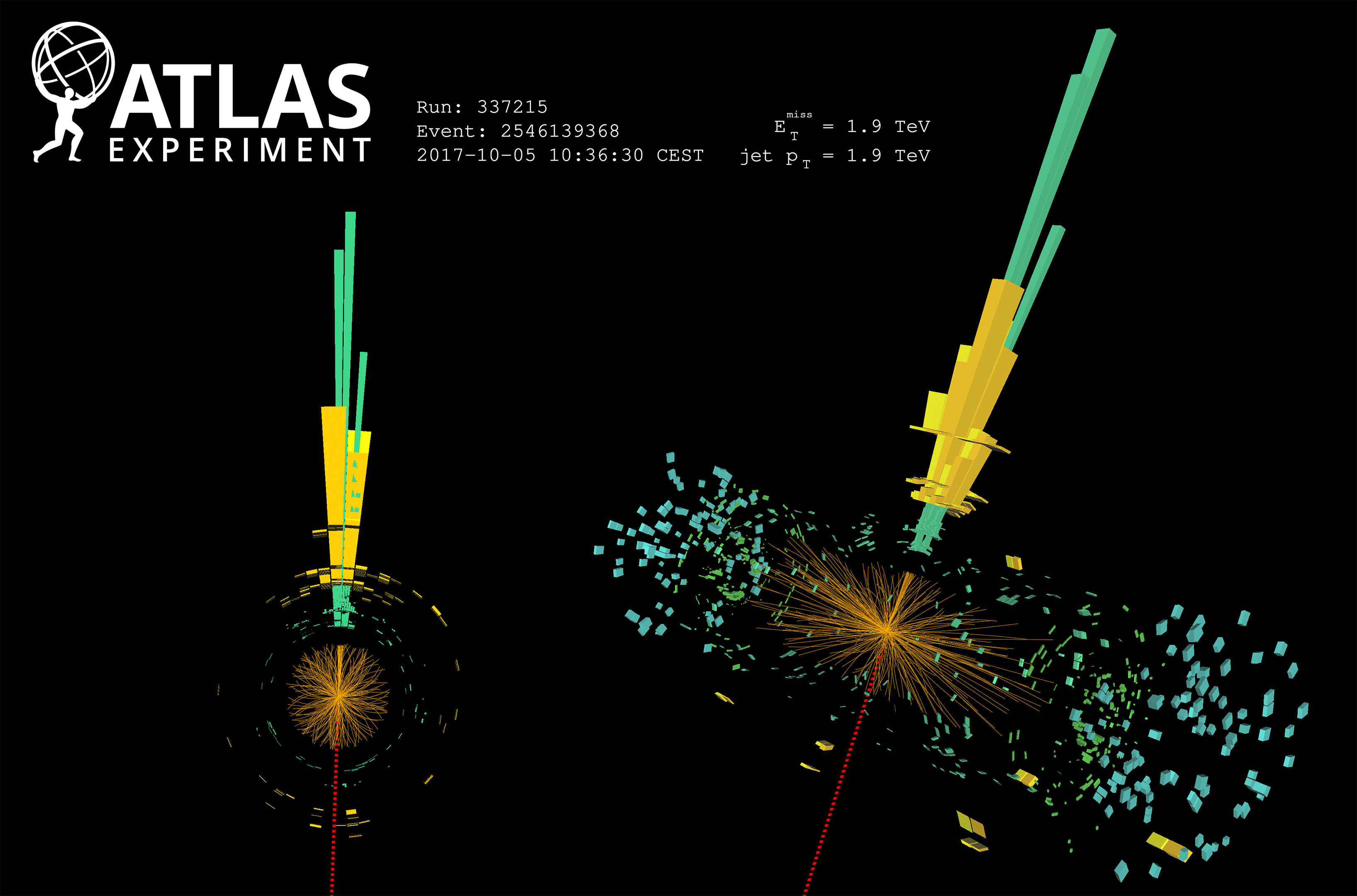
To identify such events, physicists exploited the principle of momentum conservation in the transverse detector plane – that is, perpendicular to the beam direction – looking for visible jets recoiling from something invisible. As events with jets are common at the LHC, physicists further refined their parameters: the events had to have at least one highly energetic jet and significant MET, generated by the momentum imbalance of the “invisible” particles. This is known as a monojet event – a spectacular example of which can be seen in Figure 1, a 2017 event display featuring the highest-momentum (1.9 TeV) monojet recorded so far by ATLAS.
A plethora of exotic phenomena, not directly detectable by collider experiments, could also have yielded this characteristic monojet signature. ATLAS physicists thus set out to make their study inclusive of several new physics models, including those featuring supersymmetry, dark energy, large extra spatial dimensions, or axion-like particles.
Today’s new result sets the most stringent limit on dark matter of any collider experiment so far – a milestone for the ATLAS Collaboration’s search programme.
Evidence of new phenomena would be seen in an excess of collision events with large MET when compared to the Standard Model expectation. Accurately predicting the different background contributions was a key challenge, as several abundant Standard Model processes could exactly mimic the signal topology – such as the production of a jet plus a Z boson, which then decays to two neutrinos that also leave ATLAS without being directly detected.
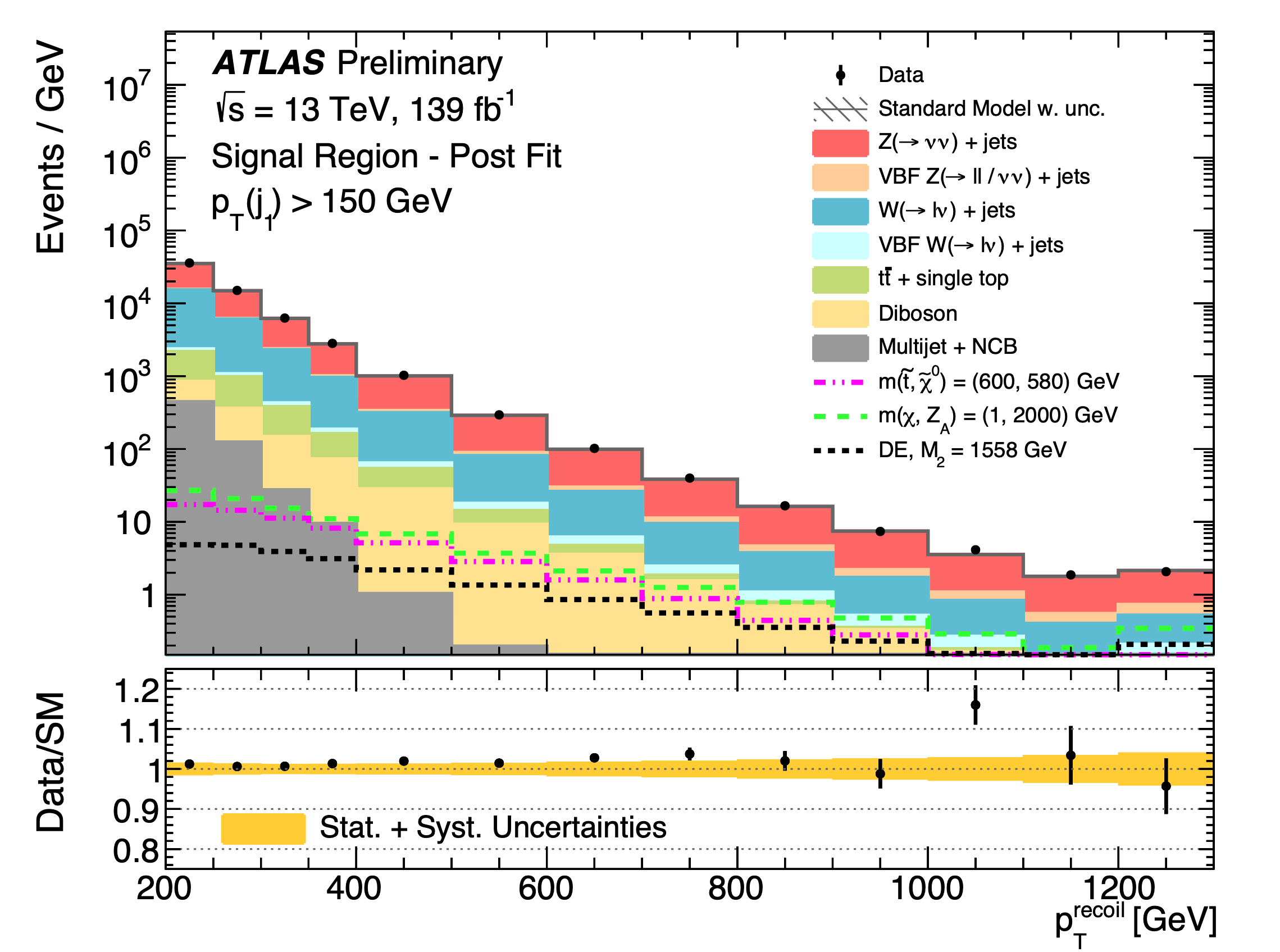
Physicists used a combination of data-driven techniques and high-precision theoretical calculations to estimate the Standard Model background. The total background uncertainty in the signal region ranges from about 1% to 4% in the range of MET between 200 GeV and 1.2 TeV. The shape of the MET spectrum was used to enhance the discrimination power between signals and backgrounds, thus increasing the discovery potential. Figure 2 shows a comparison of the MET spectrum observed in the entire dataset collected from the ATLAS experiment during Run 2 (2015–2018), and the Standard Model expectation.
As no significant excess was observed, physicists used the level of agreement between data and the prediction to set limits on the parameters of new physics models. In the context of weakly-interacting massive particles (a popular dark matter candidate), ATLAS physicists were able to exclude dark matter particle masses up to about 500 GeV and interaction axial-vector mediators up to 2 TeV, both at the 95% confidence level. These results provide the most stringent dark matter limits in collider experiments so far, and a milestone of the ATLAS search program.
Never miss a breakthrough: Join the SciTechDaily newsletter.
Follow us on Google and Google News.
8 Comments
So, have read the article and the linked page of graphs/descriptions. Unless I’m missing something, it’s seems the big takeaway is that they can now more precisely not detect dark matter?
Another possibility, from a view of String Theory, is that Dark Matter appears to us as an effect of string/anti-string annihilations. As you may know, quantum mechanics requires that strings must be formed as pairs in the quantum foam – a string and an anti-string – that immediately annihilate each other. Quantum mechanics also requires both the string and anti-string to be surrounded by “jitters” that reduce their monstrous vibrating energies. What if this jitter remains for a fraction of an instant after their string/anti-string annihilations? This temporary jitter would be seen by us as matter for that instant before it too returns to the foam. That’s why we never see it – the “mass” lasts only for that instant but is repeated over and over and over, all over. Specifics on this can be found in my YouTube at https://www.youtube.com/watch?v=xdI0wyIiYdk
… Now I wonder, is the morphing 1 dimensional entity on small scale into 3, 4 … what ever dimensional entity there it is,…
and could that be the reason why there is Uncertainty principle as a fundamental property of the space time on the small scale?
Could dark matter be just unaccessible to us and that is the reason why we can’t see it.
There might be different types of the dark matter too…
@BBC, not particularly ‘more precisely not detect dark matter’, but not detect anything non-standard Model, one of the main points of the monojet search is it’s very model-independent. The takeaway here is that the ATLAS monojet search is now pretty precise and agrees well with the Standard Model
Did you know that the aether field is made in three energy levels ? You can’t remove the aether field from your particle collider experiments at #CERN so you’re going to be getting different results in at least three different energy levels and that gives you different particles. Same particle three or more results depending upon time and position in the field.
Super string Theory supports this!
#energy #physics #plasma #science
#mantledynamics
Distinguished Colleagues,
The answer to the mystery of Dark Matter is obvious, and it requires the immediate attention of our space exploration community – allow me to explain:
Our astronomical observation instruments rely on reflectors to gather light and produce discernible observations. Reflectors have one weakness in this application, and that is that in simple terms – they are mirrors.
As everyone knows, the one thing mirrors cannot detect is a vampire. It is in light of this fact that – considering the calculated certainty of the existence of Dark Matter, and our inability to observe it – we must conclude that outer space is full of vampires.
The reason for my urgent concern in this matter is that vampires are known to be hostile towards humans, and exceptionally cunning. They possess a versatile and highly effective set of abilities which are not fully understood by Science, and they enjoy manipulating circumstances so that they may dominate their environments.
Vampires are aggressive entities, highly dangerous to non-vampiric creatures when encountered, and potentially disruptive not only to space exploration operations but also our way of life in general as human beings.
Therefore I submit that we must accept and plan for the fact that outer space is full of vampires, and ensure our future explorers are equipped to defend themselves from vampiric attacks.
Now, at the dawn of our remote outer space exploration, we must prepare ourselves to face the onset of Earth’s War on Vampires.
Thank you, and may God bless our Space Corps!
Sincerely,
Your humble servant
The beginning of the ultimate explanation for Dark Matter will soon be explained in the author’s second book to be published in December 2020: Theory of Everything and the Ultimate Origin of the Universe.
thank you for this