
Probing Dark Matter With the Higgs Boson
Visible matter – everything from pollen to stars and galaxies – accounts for roughly 15% of the total mass of the Universe. The remaining 85% is made of something entirely different from things we can touch and see: dark matter. Despite overwhelming evidence from the observation of gravitational effects, the nature of dark matter and its composition remain unknown.
How can physicists study dark matter beyond gravitational effects if it is practically invisible? Three different approaches are pursued: indirect detection with astronomical observatories, searching for the decay products of dark-matter annihilation in galactic centers; direct detection with highly sensitive low-background experiments, looking for dark matter scattering off nuclei; and by creating dark matter in the controlled laboratory environment of the Large Hadron Collider (LHC) at CERN.
Although successful at describing elementary particles and their interactions at low energies, the Standard Model of particle physics does not include a viable dark-matter particle. The only possible candidates, neutrinos, do not have the right properties to explain the observed dark matter. To remedy this problem, a simple theoretical extension of the Standard Model posits that existing particles, such as the Higgs boson, act as a “portal” between known particles and dark-matter particles. Since the Higgs boson couples to mass, massive dark-matter particles should interact with it. The Higgs boson still has large uncertainties associated with the strength of its interaction with Standard Model particles; up to 30% of the Higgs-boson decays can potentially be invisible, according to the latest ATLAS combined Higgs-boson measurements.
Could some of the Higgs bosons decay into dark matter? As dark matter does not interact directly with the ATLAS detector, physicists look for signs of “invisible particles”, inferred through momentum conservation of the proton–proton collision products. According to the Standard Model, the fraction of Higgs bosons decaying to an invisible final state (four neutrinos!) accounts for just 0.1% and is thus negligible. Should such events be observed, it would be a direct indication of new physics and potential evidence of Higgs bosons decaying into dark-matter particles.
Could the Higgs boson decay into dark matter? The ATLAS Collaboration searched the full LHC Run 2 dataset to set the strongest limits on the Higgs boson decaying to invisible dark-matter particles to date.
At the LHC, the most sensitive channel to search for direct decays of the Higgs boson to invisible particles is via the so-called vector boson fusion (VBF) production of the Higgs boson. VBF Higgs-boson production results in two sprays of particles (called “jets”) that point in a more forward direction in the ATLAS detector. This, combined with a large missing momentum in perpendicular direction (“transverse”) to the beam axis from the invisible dark-matter particles, creates a unique signature that ATLAS physicists can search for.

In results presented recently, the ATLAS Collaboration studied the full LHC Run 2 dataset, collected by the ATLAS detector in 2015–2018 to search for Higgs-boson decays to dark-matter particles in VBF events. No significant excess of events over the expected background from known Standard Model processes was found in the analysis. ATLAS derived, at a 95% confidence level, an exclusion bound of the Higgs-boson decay to invisible particles of 13%. This analysis included roughly 75% more data than the previous ATLAS search, and the team implemented several improvements including:
- Faster filtering algorithms to generate more simulated collisions with equivalent computing power. Lack of simulated events was the leading uncertainty in the first 13 TeV version of this analysis.
- Optimized collision selection to accept ~50% more Higgs-boson events on the same dataset.
- Refined event categorization to result in a higher signal-to-background ratio in the search regions. This can be seen in Figure 1 as the red curve in the lower panel increases with higher invariant mass of the two leading jets (mjj).
- Improved acceptance for collisions enriched in background processes, allowing the analysts to improve the background-process modeling.
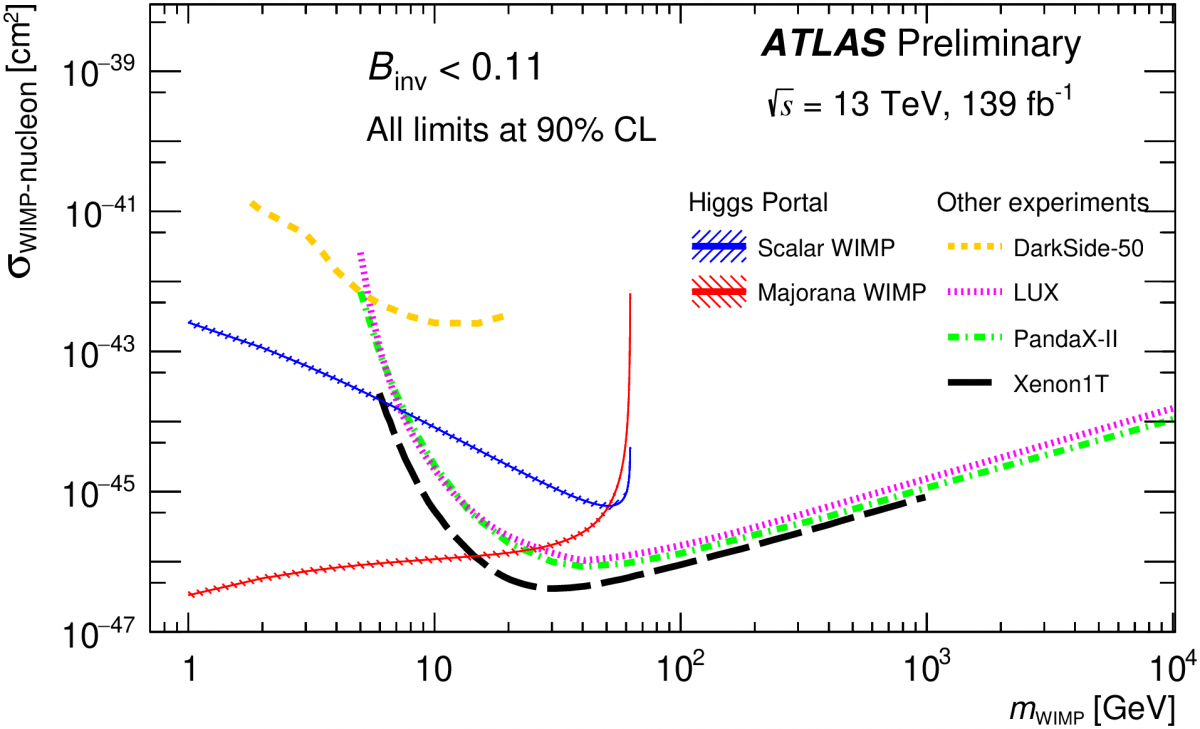
This observed exclusion is consistent with no signs of the Higgs boson decaying to dark matter. The new results advance the search for weakly interacting massive particles (WIMPs), a popular candidate for dark matter. ATLAS set additional exclusion limits for lower WIMP masses, which are compared to other direct-detection experiments in Figure 2. These limits are competitive with the best direct-detection experiments for WIMP masses up to half of the Higgs-boson mass, assuming the Higgs boson interacts directly with dark matter.
This new analysis places the strongest existing limits on the Higgs boson decaying to invisible particles to date. As the search goes on, physicists will continue to increase the sensitivity to this fundamental probe of dark matter.
Never miss a breakthrough: Join the SciTechDaily newsletter.
Follow us on Google and Google News.
5 Comments
Linking the Higgs boson to Dark Matter is a stretch, to say the least! Another possibility, from a view of String Theory, is that Dark Matter appears to us as an effect of string/anti-string annihilations. As you may know, quantum mechanics requires that strings must be formed as pairs in the quantum foam – a string and an anti-string – that immediately annihilate each other. Quantum mechanics also requires both the string and anti-string to be surrounded by “jitters” that reduce their monstrous vibrating energies. What if this jitter remains for a fraction of an instant after their string/anti-string annihilations? This temporary jitter would be seen by us as matter for that instant before it too returns to the foam. That’s why we never see it – the “mass” lasts only for that instant but is repeated over and over and over, all over. Specifics on this can be found in my YouTube at https://www.youtube.com/watch?v=xdI0wyIiYdk
No SUSY, No WIMP, No AXION, No HIGGS, No BIG BANG…
Please, read it:
https://vixra.org/pdf/2003.0448v1.pdf
and
Time-Space, Probability abd Physics
Regards,
Dr. Gunn
https://www.youtube.com/watch?v=uvHalv2f5oM
… could there be Higgs Boson as intersection between dark matter and ordinary matter. So, the rest of the fun spins around, like some type of strings…
And since the other string are in some different dimensions, there is no way to influence each other beside the gravity…
,,, if it is not like that, I have great doubts that dark matter is ever going to be detected,…
… if Higgs field could be intersection between matter and different flavours of dark matter then it might be a chance that we not see it, but feel its presence, it is like strange wind breeze that one can’t touch, but one can feel its presence…
… One interesting thing from the past! How do you see invisible man? Well, you find the way to see it. (proton)…