
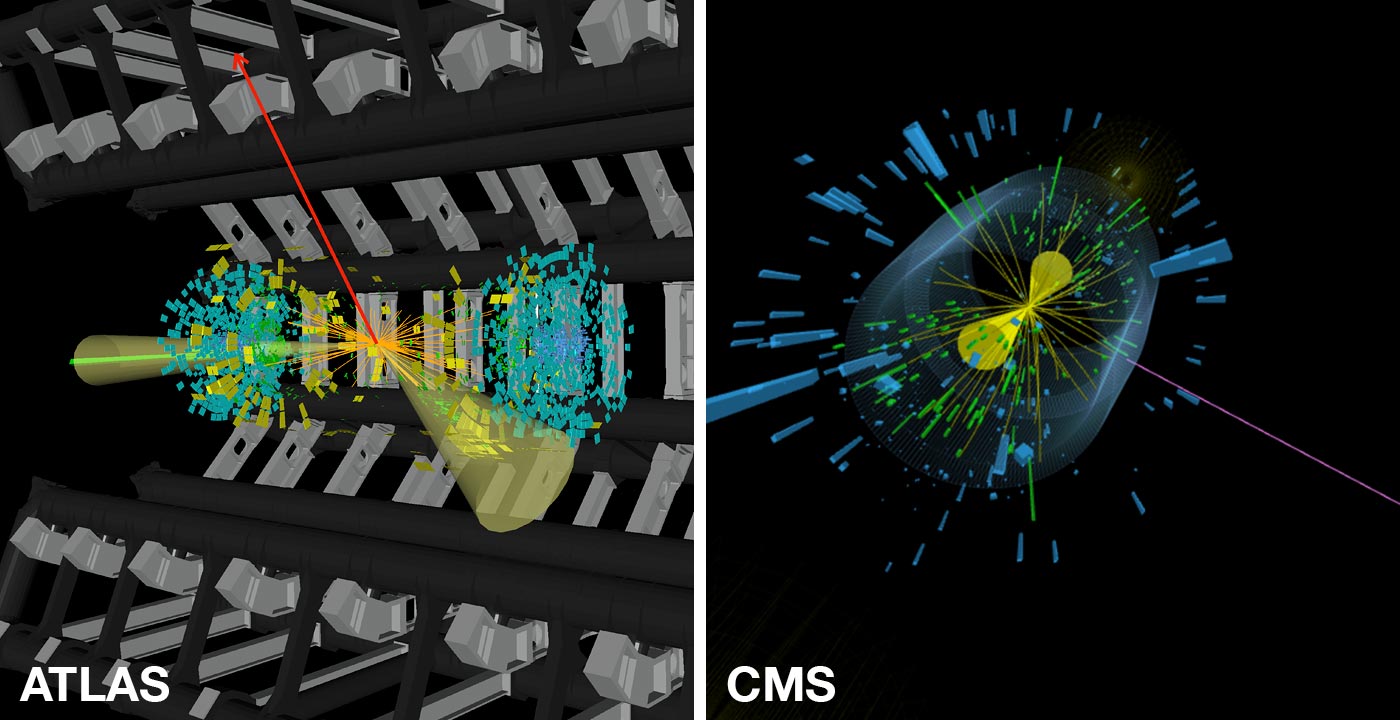
The collaborations have set stringent new bounds on the fraction of Higgs bosons transforming into invisible particles.
The Higgs boson lives for an extremely short time before it transforms, or “decays,” into other particles. It is through the detection of some of these decay products that the unique particle has first been – and continues to be – spotted in particle collisions at the Large Hadron Collider (LHC).
But what if the Higgs boson also decayed into unexpected, new particles that were invisible to the LHC detectors, such as the particles that may constitute the dark matter permeating the universe? The ATLAS and CMS collaborations at the LHC have explored this possibility in two recent studies, setting stringent new upper bounds on the fraction of Higgs bosons decaying into invisible particles.
According to the Standard Model of particle physics, the Higgs boson decays indirectly into known invisible particles – almost massless particles called neutrinos – only 0.1% of the time. However, if dark matter is made up of particles interacting too weakly to be detected, as suspected by many physicists, the dark-matter particle could interact with the Higgs boson and, if not too massive, allow the Higgs boson to decay into it, increasing the fraction of invisible Higgs-boson decays.
Investigating Invisible Higgs Decays
In their latest independent investigations, the ATLAS and CMS collaborations searched for invisible Higgs-boson decays in proton–proton collision data collected during the second run of the LHC. Both teams looked for a particular type of collision event, in which a Higgs boson is produced by a process known as vector-boson fusion and then decays into invisible particles.
These vector-boson-fusion events contain additional sprays, or “jets”, of particles emitted towards either end of the particle detectors, making this mode of Higgs-boson production easier to spot than the other modes. Together with the “missing energy” in the collision products that the invisible particles would carry away, these jets and their properties provide distinctive signatures of such invisible Higgs-boson events.
No Evidence of Invisible Decays Yet
The ATLAS and CMS searches revealed no instances of these invisible Higgs-boson events that would exceed the expected number of background events mimicking the desired events. However, they showed that the Higgs boson cannot decay into invisible particles more often than a certain percentage of time: 15% for ATLAS and 18% for CMS, compared to an expected percentage, based on Standard Model computer simulations, of 10% for both ATLAS and CMS.
These bounds align well with one another and, when interpreted in the context of dark-matter models, they translate into bounds on the interaction strength of dark-matter particles with atomic nuclei that complement those obtained from non-collider experiments searching for dark matter.
With the LHC set to restart later this year and deliver more data, ATLAS and CMS will no doubt continue to chase the invisible with the Higgs boson.
Never miss a breakthrough: Join the SciTechDaily newsletter.
Follow us on Google and Google News.
5 Comments
This is a timely taken step to confirm dark matter.Thanks to CERN.
This is a timely taken step to confirm dark matter.Thanks to CERN.
The intermediate steps equivalent to amount of Higgs boson transformed to dark matter is important.The converse phenomena is also possible,that is in nature dark matter increases super massive black hole.
This is a timely taken step to confirm dark matter.Thanks to CERN.
The intermediate steps equivalent to amount of Higgs boson transformed to dark matter is important.The converse phenomena is also possible,that is in nature dark matter increases super massive black hole.
Though this increasing effect can not be detected directly in specific galaxy,but knon from red shift compared with the same calculated from Hubble’s Law.
This is a timely taken step to confirm dark matter.Thanks to CERN.
The intermediate steps equivalent to amount of Higgs boson transformed to dark matter is important.The converse phenomena is also possible,that is in nature dark matter increases super massive black hole.
Though this increasing effect can not be detected directly in specific galaxy,but knon from red shift compared with the same calculated from Hubble’s Law.
Star Dynamics is modified thus though invisible,so this can produce change in original line of path of a galaxy with respect to others.
This is a timely taken step to confirm dark matter.Thanks to CERN.
The intermediate steps equivalent to amount of Higgs boson transformed to dark matter is important.The converse phenomena is also possible,that is in nature dark matter increases super massive black hole.
Though this increasing effect can not be detected directly in specific galaxy,but knon from red shift compared with the same calculated from Hubble’s Law.
Star Dynamics is modified thus though invisible,so this can produce change in original line of path of a galaxy with respect to others.
Due complex nature of calculation this change is not predictable at once ,though dark matter is noted at the vicinity of galaxy center adjacent to super massive black hole.