
What is the Higgs Boson (God Particle)?
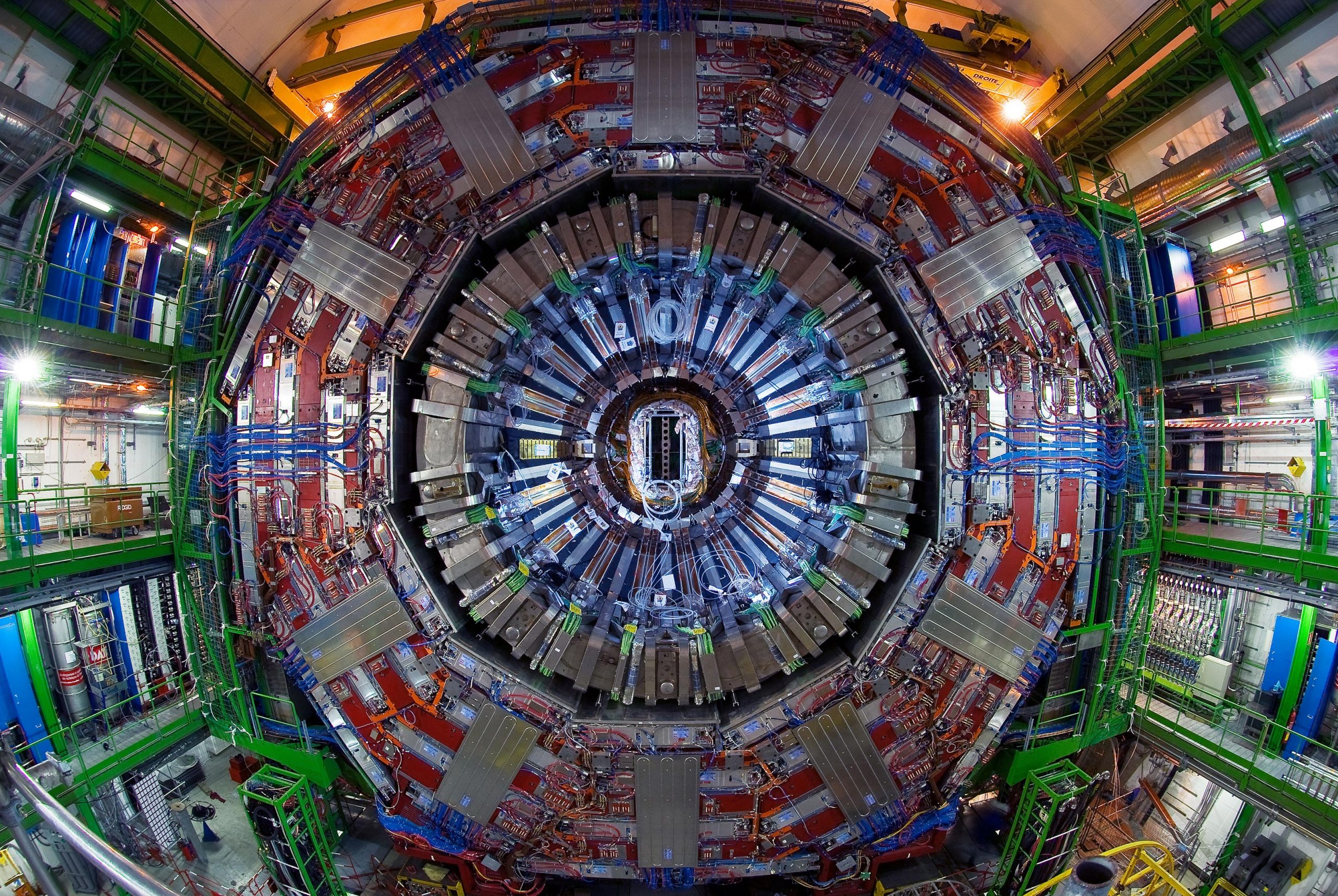
The Higgs boson is a subatomic particle that was discovered in 2012 at the Large Hadron Collider (LHC) located at CERN, the European Organization for Nuclear Research. It is named after physicist Peter Higgs, who, along with several other scientists, proposed its existence in the 1960s.
The Higgs boson is the fundamental particle associated with the Higgs field, a field that permeates the entire universe and gives mass to other fundamental particles such as electrons and quarks. A particle’s mass determines how much it resists changing its speed or position when it encounters a force. Not all fundamental particles have mass. For example, the photon, which is the particle of light and carries the electromagnetic force, has no mass at all.
The Higgs boson was proposed in 1964 by Peter Higgs, François Englert, and four other theorists to explain why certain particles have mass. Scientists confirmed its existence in 2012 through the ATLAS and CMS experiments at the Large Hadron Collider (LHC) at CERN in Switzerland. This discovery led to the 2013 Nobel Prize in Physics being awarded to Higgs and Englert. The discovery of the Higgs boson was significant because it confirmed the existence of the Higgs field and provided experimental evidence for the mechanism by which particles acquire mass. It also filled a gap in the Standard Model, which successfully describes the behavior of most known particles but initially lacked experimental confirmation of the Higgs mechanism.
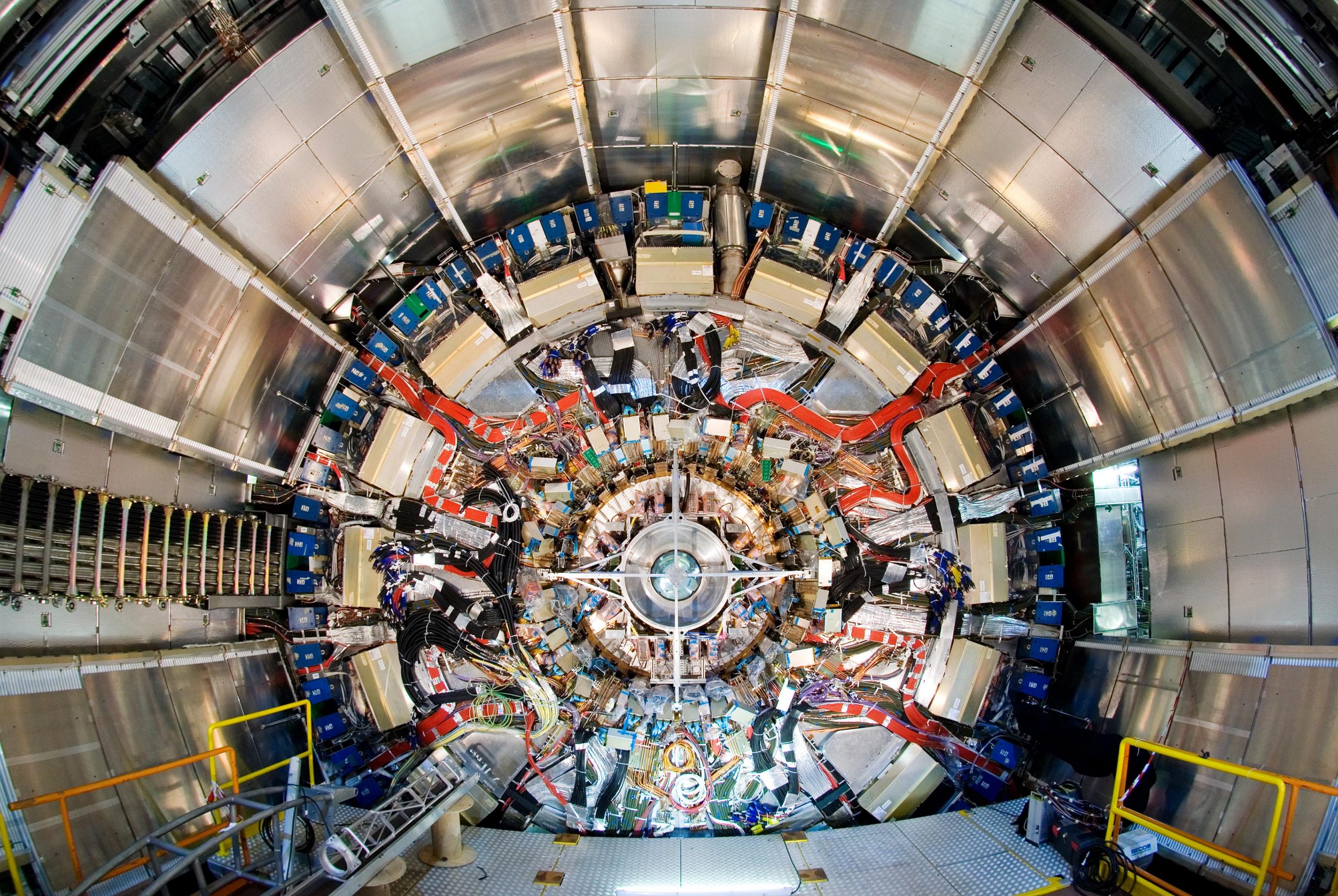
The Higgs boson is an extremely short-lived particle with a mass of around 125 gigaelectronvolts (GeV). It decays rapidly into other particles, making its direct detection challenging. Scientists at the LHC used high-energy particle collisions to produce the Higgs boson and observed its decay products to confirm its existence.
Scientists are now studying the characteristic properties of the Higgs boson to determine if it precisely matches the predictions of the Standard Model of particle physics. If the Higgs boson deviates from the model, it may provide clues to new particles that only interact with other Standard Model particles through the Higgs boson and thereby lead to new scientific discoveries.
Higgs Boson Facts
- The Higgs boson gets its mass just like other particles—from its own interactions with the Higgs field.
- There may be more than one Higgs boson. One theoretical model of new physics predicts five Higgs bosons.
- While the Higgs boson gives mass to the quarks that make up a proton, it is only responsible for giving a proton about 10% of its mass. The other 90% of a proton’s mass comes from the complex interactions of the quarks and the strong nuclear force.
- Since the Higgs boson has the role to generate the mass of other particles and the fact that dark matter can primarily be detected through its mass, the Higgs boson can be a unique portal to finding signs of dark matter.
DOE Office of Science: Contributions to Higgs Boson Research
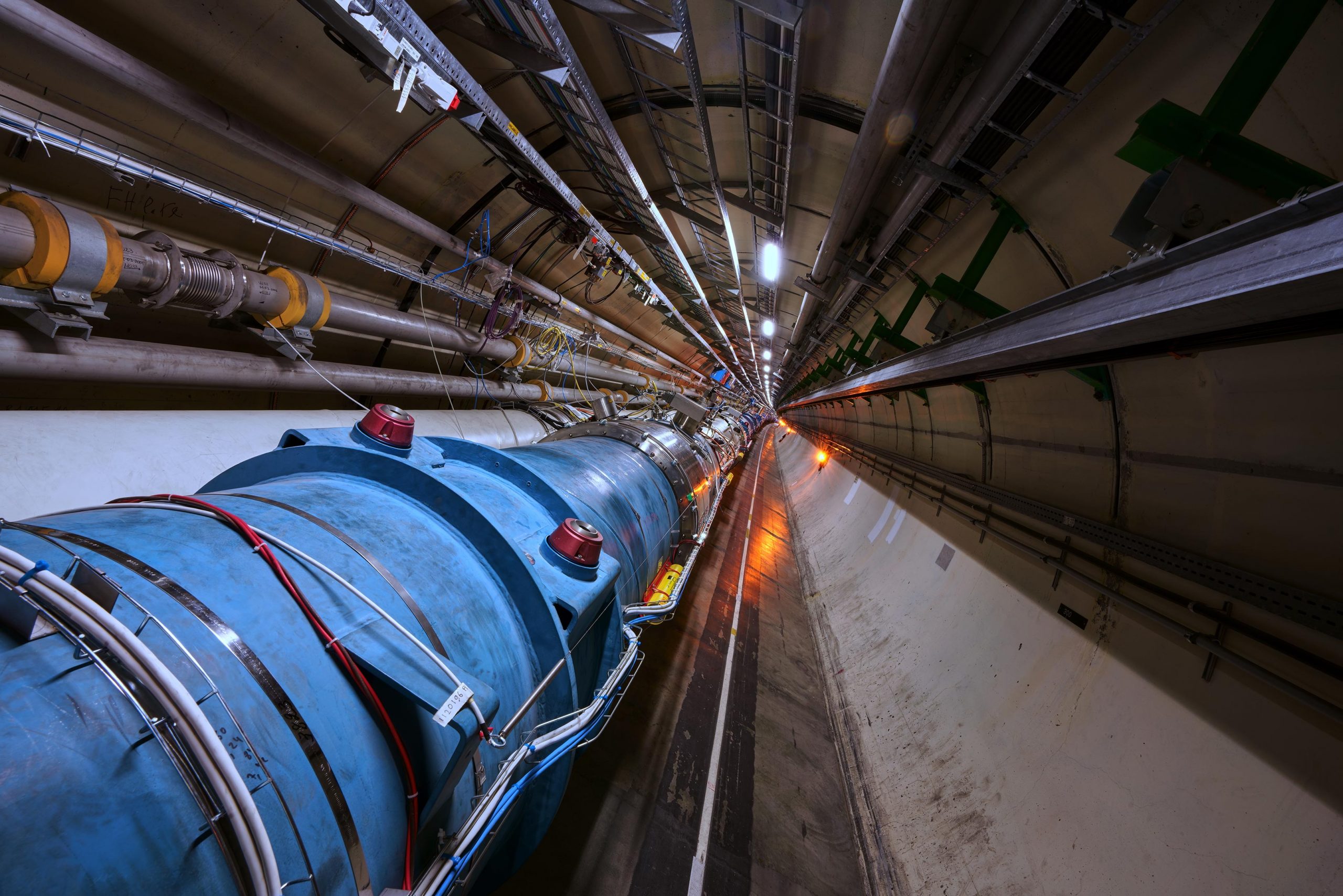
The LHC at CERN is the highest-energy particle collider in the world. It is currently the only place scientists can create and study Higgs bosons. The DOE Office of Science (SC) contributed important accelerator magnets to help construct the LHC. DOE also supports many scientists, engineers, and technicians in the LHC program. The LHC hosts four large experimental particle detectors, two of which are partially supported by SC’s Office of High Energy Physics: ATLAS and CMS. U.S. researchers account for approximately 20% and 25% of the ATLAS and CMS collaborations, respectively. They also play leadership roles in many aspects of each experiment. These experiments are making precise measurements of the Higgs boson’s properties to determine if it matches the Standard Model predictions or offers clues to new physics, exploring new particles and their interactions, and identifying the new physics of dark matter.
Never miss a breakthrough: Join the SciTechDaily newsletter.
Follow us on Google and Google News.
9 Comments
BACK IN THE OLDEN DAYS WE PROGRAMMED MUON DETECTOR STORAGE ALGORITHS VIA FPGA HARD CODING. FUN STUFF, GUESS NOW AI DOES THE LARGEST PART AND INCREASED STORAGE ALLOWS FOR MORE EVENTS TO BE STORED AND YOUR VIEW GETS WIDER. COOL, HUH?
I BET YOU MEANT ‘ALGORITHMS’.
What did he said ?🤣
This Machine will breakdown time into sections and help us split the Atom under some control. We would control a piece of time and space. “The Time Tunnel” idea.
The ‘Higgs mechanism’ like many other ‘foundations’ and measurements appropriated by high energy particle physics, has the original ideas and data deriving from work in condensed matter physics, in this case superconductivity. Responsible accounts of the Higgs should therefore always reference the name Phillip Anderson and maybe even include something about the Nambu-Goldstone bosons (also from condensed matter physics) that are part of the Higgs mechanism.
… oh, I have never heard of that Higgsy thingy, please more of this stuff..
Can dark matter be shaped,bent, or influenced in any way by magnetic fields like potters clay. ( molded ). I wonder if dark matter can be shaped by magnetic field ? And sound. Waves ?
Knowledge hunger in physics although I am different background in education Master Level , after
53 Years my mental attitude changing try to note down small diary for memorising ,now after
search engine Google engine available scenary totally changed handy for search latest inventionovery ,earlier my hobby was study about Ayurveda now hobby changed to study about
dark energy ,dark matter etc. time is very constrained due to profession for earning livelihood .Sometimes finding little space after 9 PM or holiday try to just satisfy my hunger in mystery of universe by studying latest astrophysics ,yes Iam human not robot . My intention after retirement 58 years major /maximum time investment in Physics related hurdle mystery discovered by the scientist very interesting , feel very relax investing time in such matter or particle physics ,
that setup literally looks like that machine in the spiderman movie that miles morales destroyed