
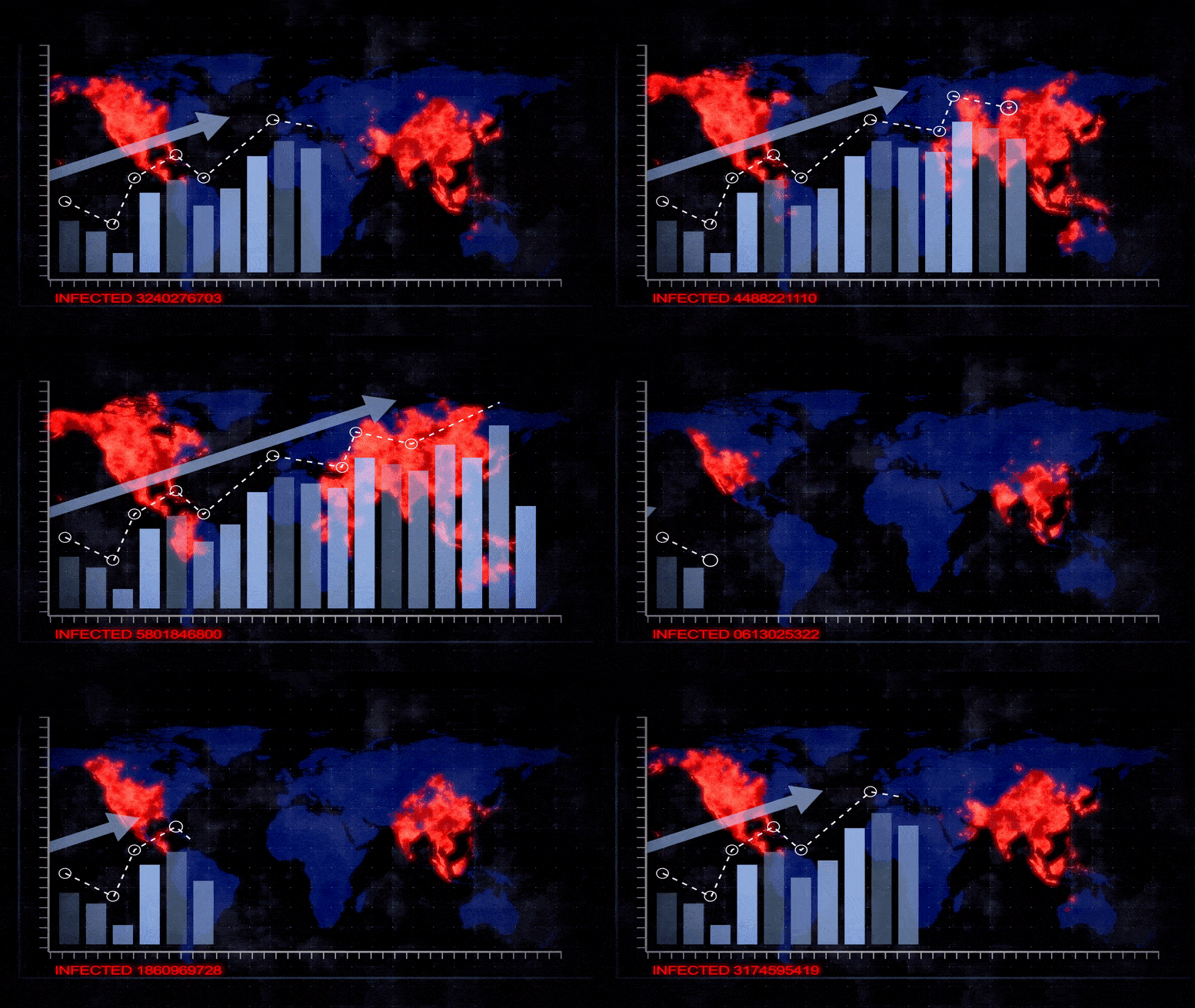
A mathematical model that can help project the contagiousness and spread of infectious diseases like the seasonal flu may not be the best way to predict the continuing spread of the novel coronavirus, especially during lockdowns that alter the normal mix of the population, researchers report.
Called the R-naught, or basic reproductive number, the model predicts the average number of susceptible people who will be infected by one infectious person. It’s calculated using three main factors — the infectious period of the disease, how the disease spreads and how many people an infected individual will likely come into contact with.
Historically, if the R-naught is larger than one, infections can become rampant and an epidemic or more widespread pandemic is likely. The COVID-19 pandemic had an early R-naught between two and three.
In a letter published in Infection Control and Hospital Epidemiology, corresponding author Dr. Arni S.R. Srinivasa Rao, a mathematical modeler at the Medical College of Georgia at Augusta University, argues that while it’s never possible to track down every single case of an infectious disease, the lockdowns that have become necessary to help mitigate the COVID-19 pandemic have complicated predicting the disease’s spread.

Rao and his co-authors instead suggest more of a dynamic, moment-in-time approach using a model called the geometric mean. That model uses today’s number to predict tomorrow’s numbers. Current number of infections — in Augusta today, for example — is divided by the number of predicted infections for tomorrow to develop a more accurate and current reproductive rate.
While this geometric method can’t predict long-term trends, it can more accurately predict likely numbers for the short term.
“The R-naught model can’t be changed to account for contact rates that can change from day to day when lockdowns are imposed,” Rao explains. “In the initial days of the pandemic, we depended on these traditional methods to predict the spread, but lockdowns change the way people have contact with each other.”
A uniform R-naught is also not possible since the COVID-19 pandemic has varied widely in different areas of the country and world. Places have different rates of infection, on different timelines — hotspots like New York and California would have higher R-naughts. The R-naught also did not predict the current third wave of the COVID-19 pandemic.
“Different factors continuously alter ground-level basic reproductive numbers, which is why we need a better model,” Rao says. Better models have implications for mitigating the spread of COVID-19 and for future planning, the authors say.
“Mathematical models must be used with care and their accuracy must be carefully monitored and quantified,” the authors write. “Any alternative course of action could lead to wrong interpretation and mismanagement of the disease with disastrous consequences.”
Reference: “How Relevant is the Basic Reproductive Number Computed During COVID-19, Especially During Lockdowns?” Arni S.R. Srinivasa Rao, Steven G. Krantz,
Michael B. Bonsall, Thomas Kurien, Siddappa N. Byrareddy, David A. Swanson, Ramesh Bhat and Kurapati Sudhakar, 14 December 2020, Infection Control and Hospital Epidemiology.
DOI: 10.1017/ice.2020.1376
Rao’s co-authors include Dr. Steven Krantz, a professor of mathematics and statistics at Washington University and Dr. Michael Bonsall, a professor in the Mathematical Ecology Research Group, at the University of Oxford.
Never miss a breakthrough: Join the SciTechDaily newsletter.
Follow us on Google and Google News.
4 Comments
… models are not accurate pictures, they are useful guidelines, and this one was not as one would guess in the very first place.
For an example, people didn’t take in account that some people will take masks, some will distance, some will wash their hands more carefully, some will isolate, etc…
That affects the calculation in some way, and in some cases it might be a significant contribution in a curvature of it…
This was a programmed release of a virus. You’ll never get a model unless you knew the plan. You guys are really naive sometimes.
… it is just obvious what it is…
… There are three ways it works:
– when it grows in the wild, without the control,
– when you take a control over it,
– or when it gets out of spread…
… YUM, GUM, RUM…
… past,
… now …
future…
Well, – when you take a control over it is just control depending on the measurements taken
https://en.wikipedia.org/wiki/PID_controller#/media/File:Change_with_Ki.png
hope you like it…