
New results from the LHCb experiment on CP asymmetry in charmless three-body charged B meson decays include the largest CP asymmetry ever observed.
CP asymmetry is the only non-trivial difference between matter and antimatter found so far. Its discovery in neutral kaon decays in 1964 came as a big surprise to the physics community, but today it is an essential component of the Standard Model of particle physics. Without CP asymmetry the Big Bang would have created equal amounts of matter and antimatter, which would all have then annihilated, leaving behind an empty Universe filled with radiation. To produce a matter-dominated Universe like the one we live in, an excess of matter must have formed and survived this annihilation. But to produce such an excess, some difference between matter and antimatter must be present: enter CP asymmetry. Unfortunately, the amount of CP asymmetry present in the Standard Model of particle physics is not enough to explain the observed composition of the Universe, driving extensive studies of this phenomenon and searches for other sources of CP asymmetry.
Last week, at the Rencontres de Moriond Electroweak conference and during a seminar held at CERN, the Large Hadron Collider beauty (LHCb) collaboration presented new results from studies of CP asymmetry in charmless three-body decays of charged B mesons. These decays involve a charged B meson, consisting of a beauty quark and an up quark, transforming into a combination of p and K mesons. The name “charmless” refers to the absence of charm quarks in the final state: π± mesons (pions) contain only up and down quarks, and K± mesons (kaons) contain a strange and an up quark. Charmless decays involve the transformation of a beauty quark into an up quark, which is an unlikely process, as the beauty quark predominantly decays into a charm quark. In this rare process the effects of CP violation are expected to be enhanced.
The new LHCb results focus on “direct” CP violation: a phenomenon where the same decay process has a different probability for a particle than for an antiparticle. The strongest global asymmetry was observed for the decay into two kaons and one pion, where the probability of a B+→π+K+K– decay is about 20% higher than for the B–→π–K+K– decay (corresponding to a measured CP asymmetry ACP of -0.114). A global CP asymmetry has also been observed with a significance of more than five standard deviations for the first time in decays into three pions and decays into three kaons. For the final state with two pions and one kaon, the CP violation is still not confirmed.
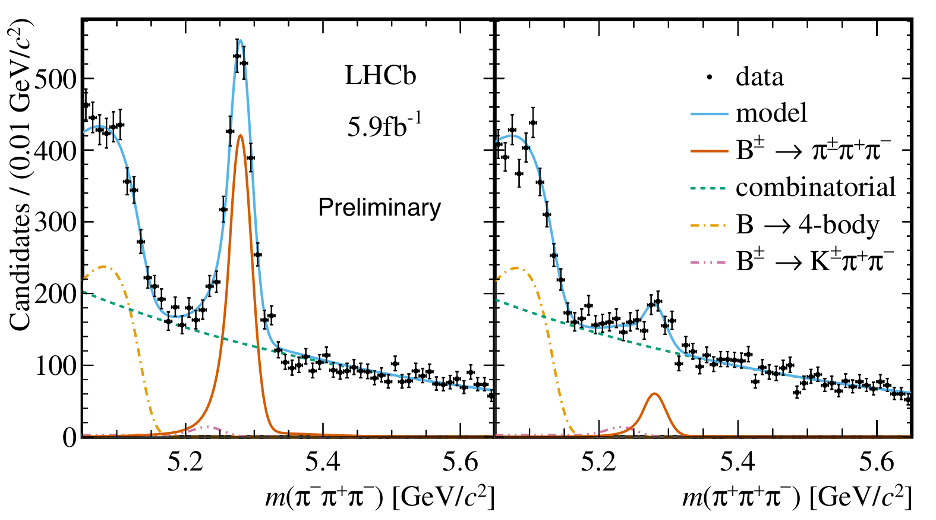
The three-particle final state can, however, be studied further in order to extract more information. The process of a B meson transforming into three particles can occur in several steps, with intermediate short-lived particles (“resonances”) forming and subsequently decaying into the pions and kaons seen in the final state. These processes can make different contributions to the CP asymmetry and can be disentangled by taking into account the momenta of the final state particles in what’s known as “phase space analysis”. One spectacular result of such an analysis is the indication of a χhc0 meson (containing a charm-anticharm quark pair) being formed during the B → πππ decay. The χhc0 was not expected to contribute to CP violation but the results show the presence of a significant asymmetry. In fact, the subset of data containing the χhc0 events features the highest CP asymmetry ever observed: the B– meson makes an almost 7 times greater contribution to this process than its B+counterpart, as can be seen in the plot below.
The results presented provide important clues about the mechanism of CP asymmetry generation in the Standard Model, which is not yet fully understood. Even more detailed studies will be performed in the upcoming LHC Run 3 with the newly upgraded LHCb detector.
Never miss a breakthrough: Join the SciTechDaily newsletter.
Follow us on Google and Google News.
1 Comment
… So! Where did that discrepancy go!