
Close Menu
    Facebook X (Twitter) Instagram
    SciTechDaily
    • Biology
    • Chemistry
    • Earth
    • Health
    • Physics
    • Science
    • Space
    • Technology
    Facebook X (Twitter) Pinterest YouTube RSS
    SciTechDaily
    Home»Space»Got it! Gaia Observatory Snaps Photo of James Webb Space Telescope at L2
    Space

    Got it! Gaia Observatory Snaps Photo of James Webb Space Telescope at L2

    By European Space Agency (ESA)March 24, 20222 Comments5 Mins Read
    Facebook Twitter Pinterest Telegram LinkedIn WhatsApp Email Reddit
    Share
    Facebook Twitter LinkedIn Pinterest Telegram Email Reddit
    Gaia Snaps Photo of Webb
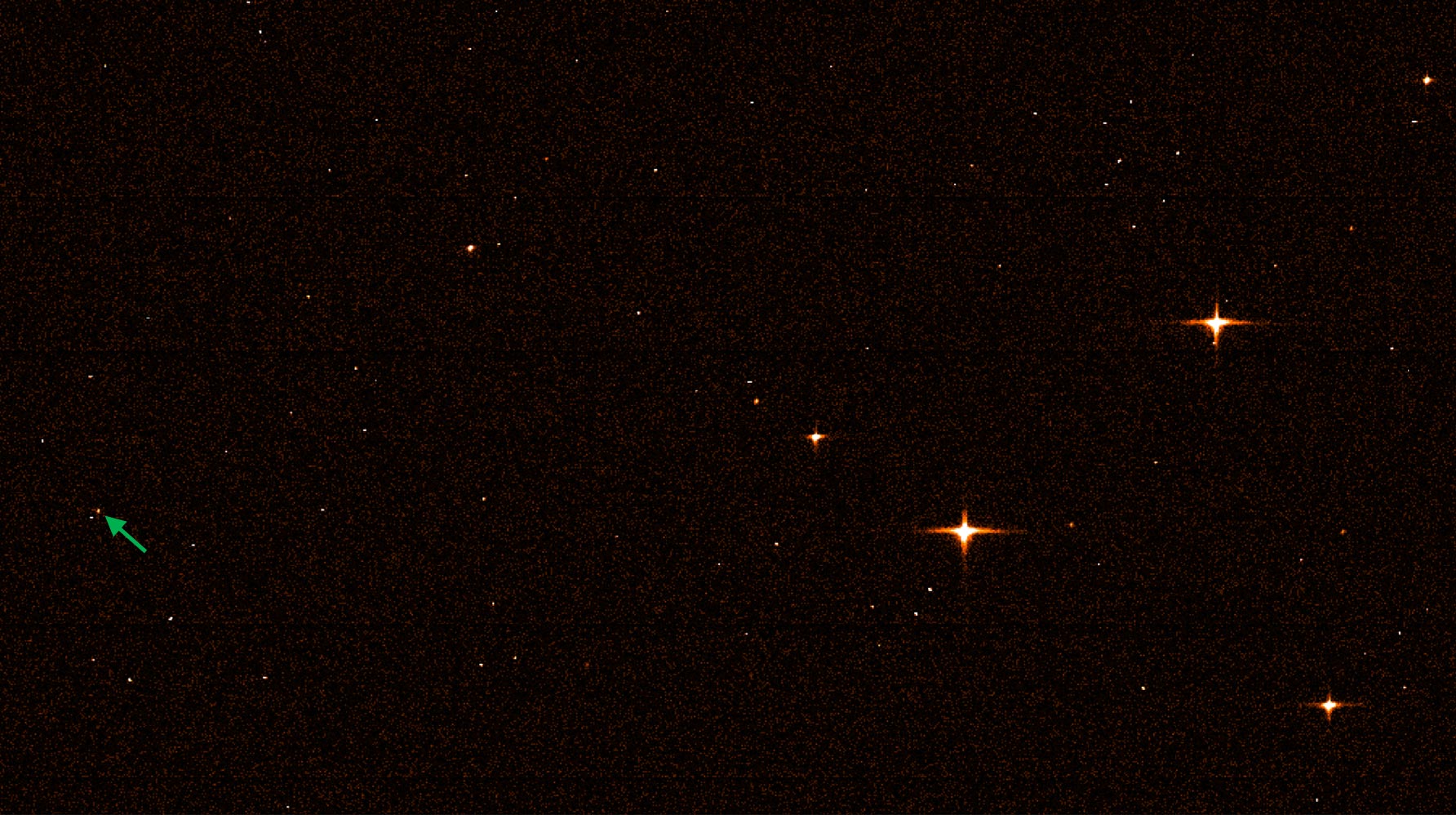
    Gaia’s sky mapper image showing the James Webb Space Telescope. The reddish color is artificial, chosen just for illustrative reasons. The frame shows a few relatively bright stars, several faint stars, a few disturbances – and a spacecraft. It is marked by the green arrow. Credit: ESA/Gaia/DPAC; CC BY-SA 3.0 IGO

    On February 18, 2022, the NASA/ESA/CSA James Webb Space Telescope was photographed by ESA’s Gaia observatory.

    Both spacecraft are located in orbits around the Lagrange point 2 (L2), 1.5 million km (930,000 mi) from Earth in the direction away from the Sun. Gaia arrived there in 2014, and Webb in January 2022.

    On February 18, 2022, the two spacecraft were 1 million km (620,000 mi) apart, with an edge-on view of Gaia towards Webb’s huge sunshield. Very little reflected sunlight came Gaia’s way, and Webb therefore appears as a tiny, faint spec of light in Gaia’s two telescopes without any details visible.

    Sky Mapper

    A few weeks before Webb’s arrival at L2, Gaia experts Uli Bastian of Heidelberg University (Germany) and Francois Mignard of Nice Observatory (France) realized that during Gaia’s continuous scanning of the entire sky, its new neighbor at L2 should occasionally cross Gaia’s fields of view.
    Gaia and Webb Orbits
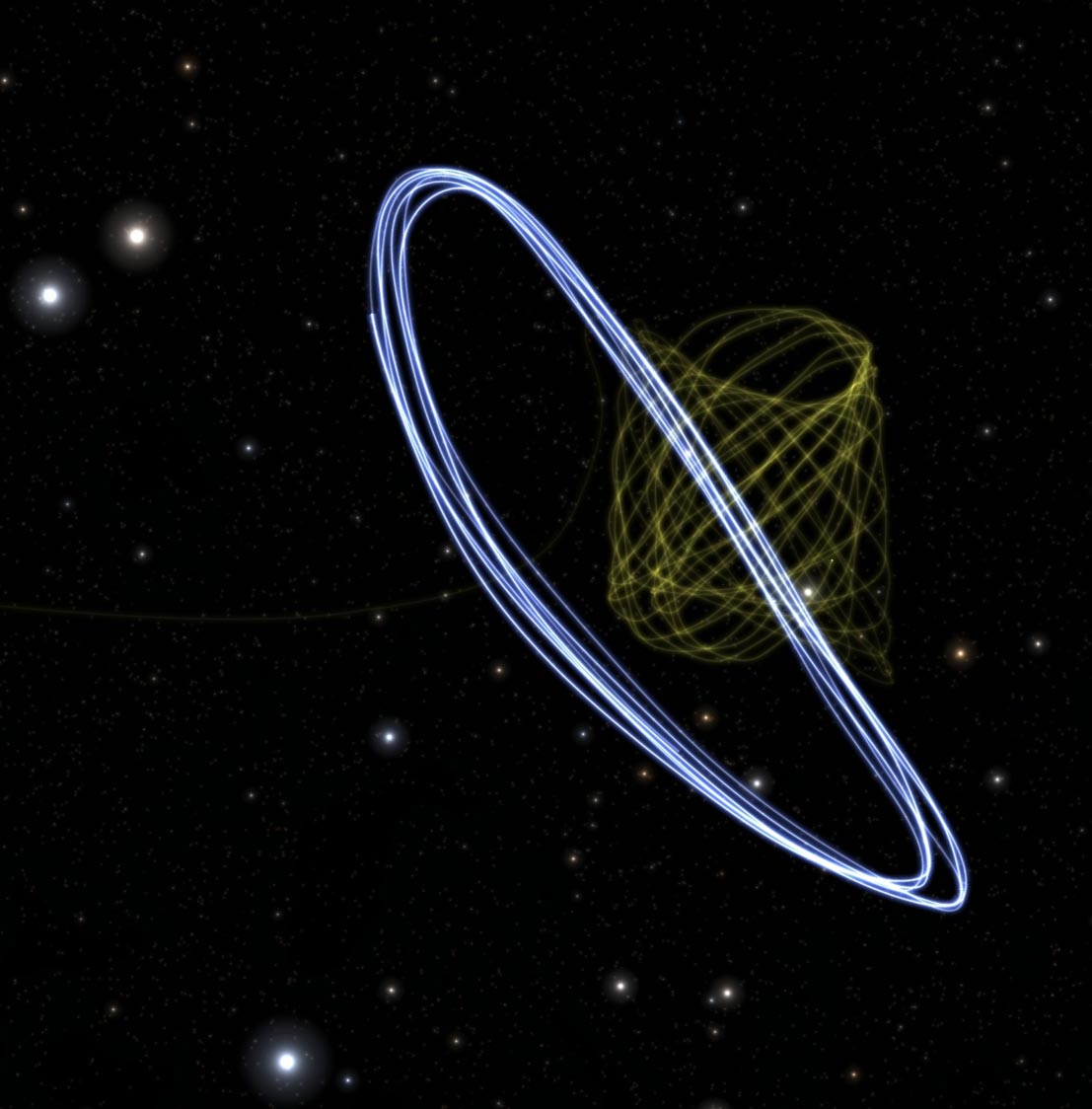
    Gaia orbits the second Lagrange Point (L2) in a Lissajous orbit. The James Webb Space Telescope orbits L2 in a halo orbit. The telescopes are between 400,000 and 1,100,000 km apart, depending on where they are in their respective orbits. This image shows the relative sizes and locations of the Gaia orbit (yellow) and the Webb orbit (white). In this view, Earth is located to the left, not far outside of the frame. Gaia’s Lissajous loops have L2 right in their center, while Webb’s halo orbit loops are closer to Earth by about 100,000 km on average. Credit: ESA/Gaia/DPAC; CC BY-SA 3.0 IGO

    Gaia is not designed to take real pictures of celestial objects. Instead, it collects very precise measurements of their positions, motions, distances, and colors. However, one part of the instruments on board takes a sort of sky images. It is the ‘finder scope’ of Gaia, also called the sky mapper.

    Every six hours, Gaia’s sky mapper scans a narrow 360-degree strip around the entire celestial sphere. The successive strips are slightly tilted with respect to each other, so that every few months the entire sky is covered – touching everything that’s there and that’s bright enough to be seen by Gaia. Within seconds, these slices are automatically scrutinized for star images, the positions of which are then used to predict when and where those stars could be recorded in Gaia’s main scientific instruments. Then they are routinely deleted.

    But the computer can be manually requested to exceptionally keep a stretch of the image data. The sky mapper was originally planned for technical servicing purposes, but during the mission it has also found some scientific uses. Why not use it for a snapshot of Webb?

    Got It!

    After Webb had reached its destination at L2, the Gaia scientists calculated when the first opportunity would arise for Gaia to spot Webb, which turned out to be 18 February 2022.

    After Gaia’s two telescopes had scanned the part of the sky where Webb would be visible, the raw data was downloaded to Earth. In the morning after, Francois sent an email to all people involved. The enthusiastic subject line of the email was “JWST: Got it!!”
    Gaia Snaps Photo of Webb Zoom
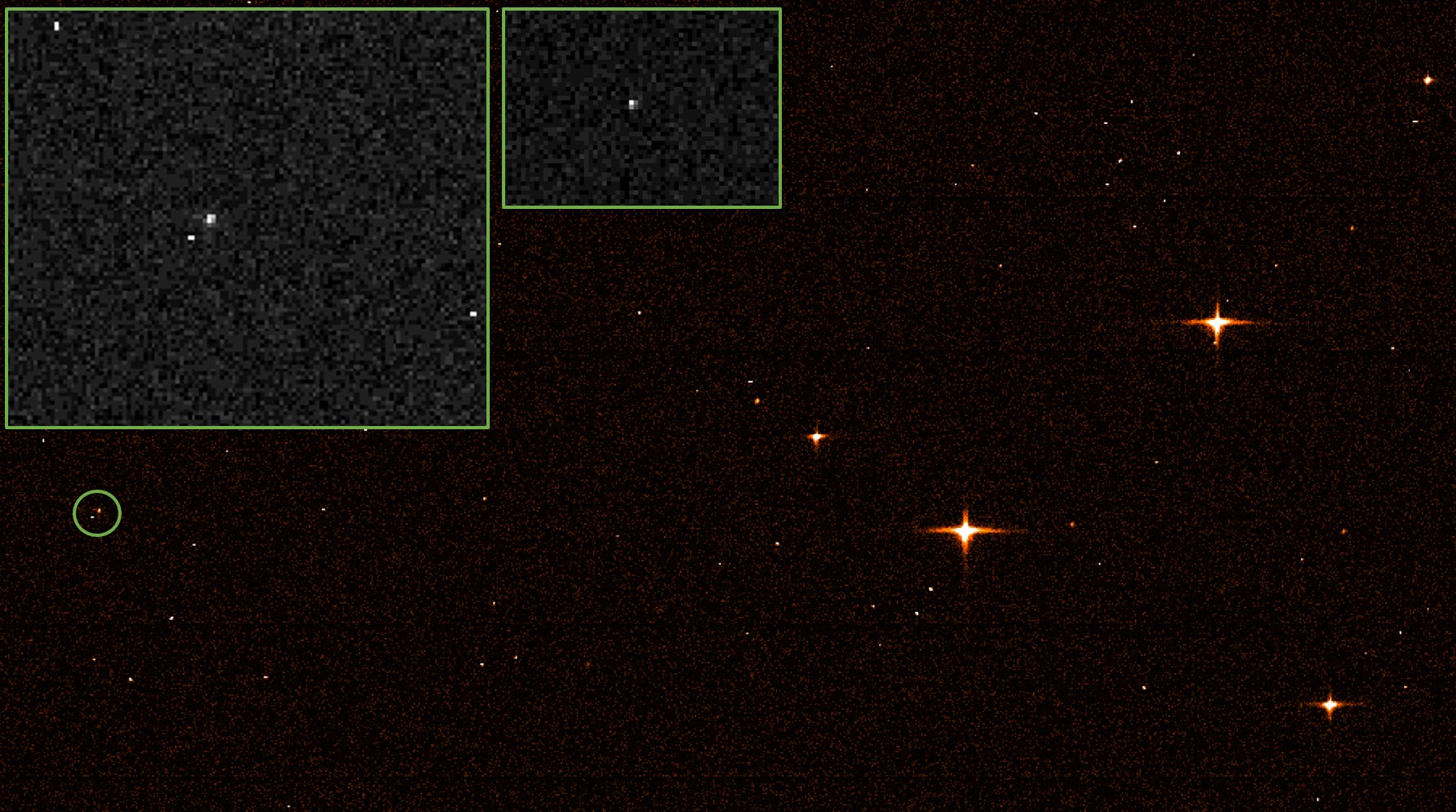
    Gaia snaps photo of Webb (zoom). Images of the James Webb Space Telescope taken by ESA’s Gaia observatory on February 18, 2022.
    Background frame: Cutout of the specially recorded image from Gaia’s sky mapper instrument at the first of the two observations from Gaia’s two telescopes. The reddish color is artificial, chosen just for illustrative reasons. The frame shows a few relatively bright stars, several faint stars, a few disturbances – and a spacecraft. It is marked by the green circle.
    Left grey inset: Zoom into the frame showing the Webb image at full resolution. It is the slightly extended speck of light in the center. The other three bright dots are traces of energetic cosmic-ray particles which hit the CCD chip during the 2.5 seconds of exposure. The on-board software is capable of autonomously and reliably distinguishing these from star images.
    Right grey inset: The second “photo” of Webb, taken in the second field of view of Gaia’s telescopes about 106.5 minutes after the first one. Each of the two images was created by just under 1000 sunlight photons arriving from the Webb spacecraft.
    Credit: ESA/Gaia/DPAC; CC BY-SA 3.0 IGO

    The astronomers had to wait a few more days for Juanma Martin-Fleitas, ESA’s Gaia calibration engineer, to identify Webb in the sky mapper images. “I’ve identified our target” was the message sent by him, with the images attached and the two tiny specks labeled as ‘Webb candidates’.

    After scrutinizing these carefully, Uli replied: “Your ‘candidates’ can be safely renamed ‘Webb’.”

    Gaia now has a spacecraft friend at L2, and together they will uncover our home galaxy, and the Universe beyond.


    Gaia snaps photo of Webb (animation).

    Never miss a breakthrough: Join the SciTechDaily newsletter.
    Follow us on Google and Google News.

    Astronomy ESA Gaia Spacecraft European Space Agency James Webb Space Telescope Popular
    Share. Facebook Twitter Pinterest LinkedIn Email Reddit

    Related Articles

    Webb Reveals What Happens When a Sun Like Ours Dies

    Webb Space Telescope Placed on Top of Ariane 5 Rocket in Preparation for Launch

    $10 Billion Webb Space Telescope Arrives at Europe’s Spaceport

    NASA’s $10 Billion New Observatory: James Webb Space Telescope Gets a Launch Date

    First James Webb Space Telescope General Observer Scientific Programs Selected

    Tantalizing Evidence: Is the Nearest Star Cluster to the Sun Being Destroyed?

    Unexpected Discovery: Hubble Space Telescope Uncovers Concentration of Small Black Holes

    To the Milky Way’s Anticenter and Beyond: Gaia’s New Detailed Data From More Than 1.8 Billion Stars

    Comparing the Hubble and James Webb Space Telescopes: From Ultraviolet to Infrared

    2 Comments

    1. Oscar Olszewski on March 25, 2022 6:39 am

      When one telescope takes a photo of another, it arouses self-awareness between explorers and discoverers of distant worlds. This must be what sailors felt when they tracked eachother on their joint voyages across the oceans to distant lands.

      Reply
    2. saylesh kumar Ramsurrun on March 28, 2022 2:34 am

      Awesome and ûńťhîñķâ;b)lê only a few years back.

      Reply
    Leave A Reply Cancel Reply

    • Facebook
    • Twitter
    • Pinterest
    • YouTube

    Don't Miss a Discovery

    Subscribe for the Latest in Science & Tech!

    Trending News

    Breakthrough Bowel Cancer Trial Leaves Patients Cancer-Free for Nearly 3 Years

    Natural Compound Shows Powerful Potential Against Rheumatoid Arthritis

    100,000-Year-Old Neanderthal Fossils in Poland Reveal Unexpected Genetic Connections

    Simple “Gut Reset” May Prevent Weight Gain After Ozempic or Wegovy

    2.8 Days to Disaster: Scientists Warn Low Earth Orbit Could Suddenly Collapse

    Common Food Compound Shows Surprising Power Against Superbugs

    5 Simple Ways To Remember More and Forget Less

    The Atomic Gap That Could Cost the Semiconductor Industry Billions

    Follow SciTechDaily
    • Facebook
    • Twitter
    • YouTube
    • Pinterest
    • Newsletter
    • RSS
    SciTech News
    • Biology News
    • Chemistry News
    • Earth News
    • Health News
    • Physics News
    • Science News
    • Space News
    • Technology News
    Recent Posts
    • Powerful Antioxidant Found To Play a Key Role in Proper Protein Folding
    • MIT Laser Breakthrough Lets Scientists Watch Drugs Enter the Brain in Real Time
    • Study Reveals Malaria’s Hidden Role in Human Evolution
    • Scientists Print Artificial Neurons That Can Talk to the Brain
    • Bowel and Ovarian Cancers Are Dramatically Rising in Young Adults and Scientists Aren’t Sure Why
    Copyright © 1998 - 2026 SciTechDaily. All Rights Reserved.
    • Science News
    • About
    • Contact
    • Editorial Board
    • Privacy Policy
    • Terms of Use

    Type above and press Enter to search. Press Esc to cancel.