
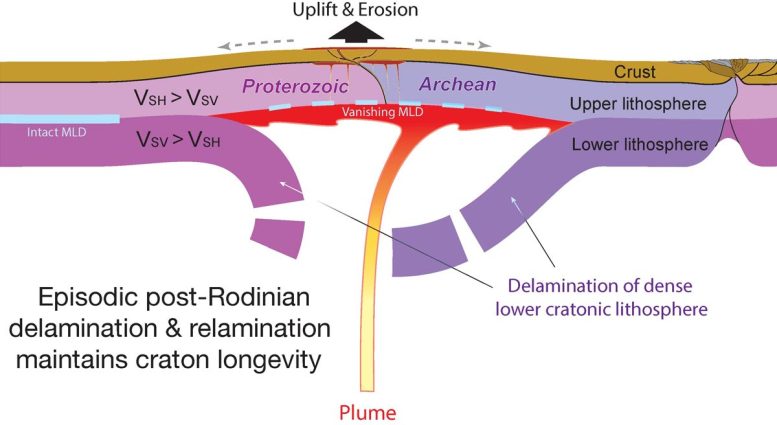
A new study challenges longstanding beliefs about Earth’s stable cratons, revealing that they have undergone repetitive deformation beneath their crust since formation. Contrary to previous theories, the study found that the mantle keels, once thought to be buoyant and stable, are dense and subject to significant change over time, altering our understanding of continental evolution and the operation of plate tectonics.
The seemingly stable regions of the Earth’s continental plates – the so-called stable cratons – have suffered repetitive deformation below their crust since their formation in the remote past, according to new research from the University of Illinois Urbana-Champaign. This hypothesis defies decades of conventional plate tectonics theory and begs to answer why most cratons have remained structurally stable while their underbellies have experienced significant change.
In a study led by Illinois geology professor Lijun Liu, researchers used previously collected density data from the Earth’s uppermost rigid layers of crust and mantle – known as the lithosphere – to examine the relationship between craton surface topography and the thickness of their underlying lithosphere layer.
The results of the study are published in the journal Nature Geosciences.
The lack of deformation within the cratons since their formation makes them the longest-lived tectonic units on Earth – surviving supercontinent cycles like the formation and breakup of the supercontinent Pangea, as well as the lesser-known and more ancient supercontinent Rodina, the study reports.
“It is generally accepted that the cratons are protected by their thick underlying mantle roots, or keels, which are believed to be buoyant and strong and thus stable over time,” Lui said.
New Insights into Craton Keel Density and Elevation
Several recent papers from Liu’s research group directly challenge this wisdom by showing that these mantle keels are actually quite dense.

In a 2022 study, the team demonstrated that the traditional view of buoyant craton keels implies that most of the Earth’s cratons would be sitting about 3 kilometers above the sea surface, while in reality, their elevation is only a few 100 meters. This requires the lithospheric mantle below the crust to be of high enough density to pull the surface down by about 2 kilometers, Liu said.
In another study, the team used gravity field measurements to pinpoint the density structure of the craton keels to find that the lower portion of the mantle keel is most likely where the high-density material resides, implying a depth-increasing density profile below the cratons.
Mantle Dynamics and Delamination: A Lava Lamp Effect
In the new paper, the team shows that the lower portion of the mantle keel that has a high density and tends to repeatedly peel away from the lithosphere above when mantle upwellings, called plumes, initiate supercontinent breakup. The peeled-off – or delaminated – keels could return to the base of the lithosphere after they warm up inside the hot mantle.
“The whole process is like what happens in a lava lamp, where the cool material near the surface sinks and the warm material near the bottom rises,” Liu said.
This deformation history is expressed in some of the more puzzling geophysical properties observed in the lithosphere, the study reports.
“For example, the repetitive vertical deformation of the lower half of the mantle keel allows the seismic waves that vibrate the rock vertically to travel faster, compared to the upper half of the keel, which experienced less vertical deformation,” Liu said.
Impact of Mantle Delamination on Surface Erosion and Uplift
The team also determined that mantle delamination will cause the craton surface to rise, leading to erosion.
“This is reflected in the strong dependence of crustal thickness on lithospheric thickness, an observation never made before this study,” Liu said. “In particular, there are two major uplift and erosion events in the past, when supercontinents Rodinia and Pangea each separated, the former causing what is known as the Great Unconformity – a feature in the Earth’s rock record shows no evidence of new deposition, only deep craton erosion. This is the reason why we see pieces of ancient lower crust exposed at the craton’s surface today.”
With the help of numerical simulations, the team said that this episodic deformation style of the lower craton keels is how the craton crusts survived the long geological history.
“We believe this newly hypothesized lifestyle of cratons will significantly change people’s view on how continents evolve and how plate tectonics operate on Earth,” Liu said.
Reference: “Secular craton evolution due to cyclic deformation of underlying dense mantle lithosphere” by Yaoyi Wang, Zebin Cao, Lihang Peng, Lijun Liu, Ling Chen, Craig Lundstrom, Diandian Peng and Xiaotao Yang, 12 June 2023, Nature Geoscience.
DOI: 10.1038/s41561-023-01203-5
Illinois geology professor Craig Lundstrom and Illinois graduate students Yaoyi Wang, Zebin Cao, Lihang Peng and Diandian Peng; and Chinese Academy of Sciences professor Ling Chen contributed to this study.
The National Science Foundation and the National Natural Science Foundation of China supported this research.
Never miss a breakthrough: Join the SciTechDaily newsletter.
Follow us on Google and Google News.
1 Comment
And on other planets…