
Close Menu
    Facebook X (Twitter) Instagram
    SciTechDaily
    • Biology
    • Chemistry
    • Earth
    • Health
    • Physics
    • Science
    • Space
    • Technology
    Facebook X (Twitter) Pinterest YouTube RSS
    SciTechDaily
    Home»Physics»Homing In on the Higgs Boson’s Interaction With the Charm Quark at the Large Hadron Collider
    Physics

    Homing In on the Higgs Boson’s Interaction With the Charm Quark at the Large Hadron Collider

    By Ana Lopes, CERNMarch 31, 20222 Comments4 Mins Read
    Facebook Twitter Pinterest Telegram LinkedIn WhatsApp Email Reddit
    Share
    Facebook Twitter LinkedIn Pinterest Telegram Email Reddit
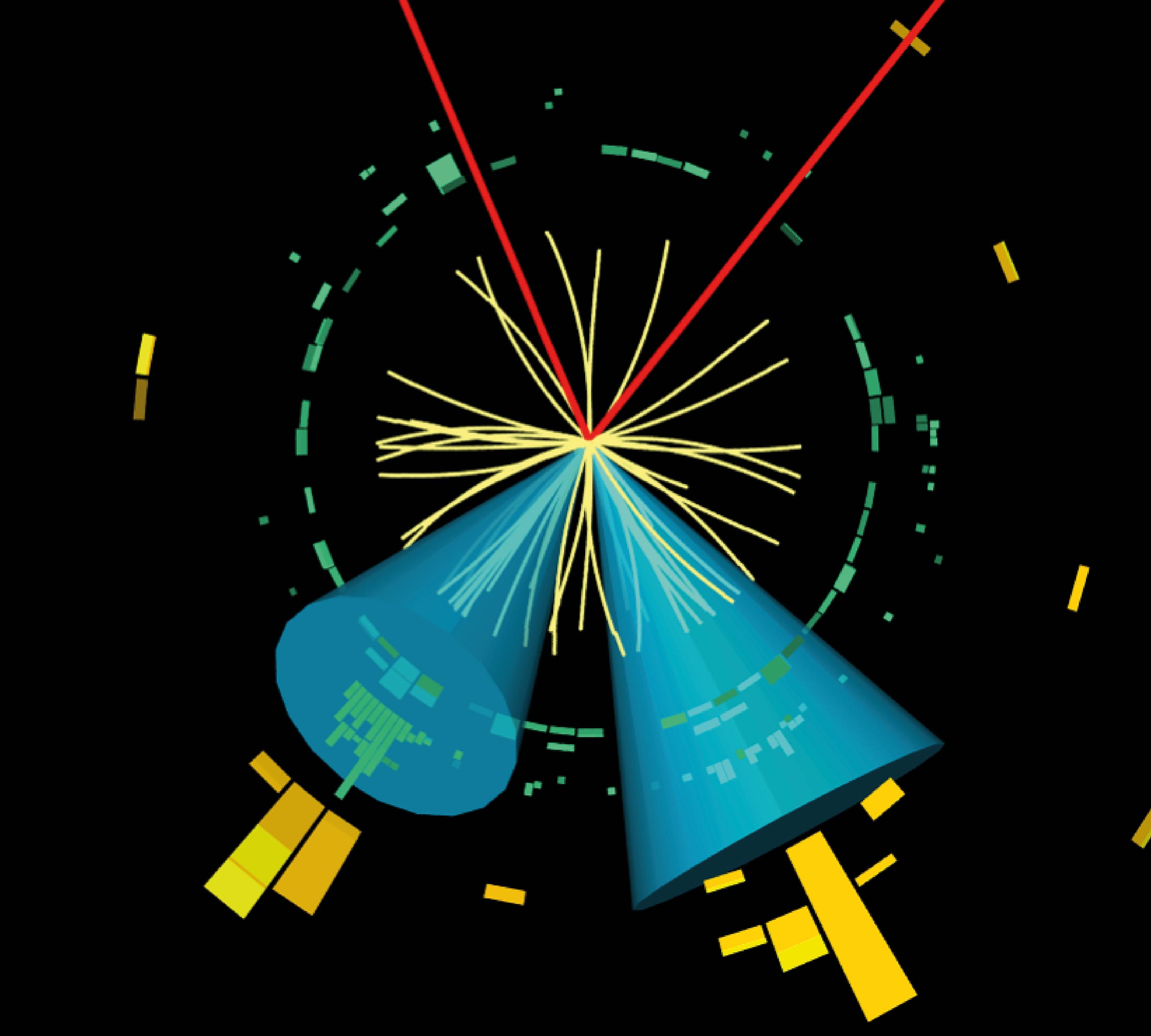
    Higgs Boson in Association With Z Boson
    The Higgs boson interacts more weakly with the charm quark than with the beauty quark, confirming that it interacts differently with quarks of the second and third generations as predicted by the Standard Model.

    New ATLAS and CMS analyses place tight limits on the strength of the Higgs boson’s interaction with the charm quark.

    Since the discovery of the Higgs boson a decade ago, the ATLAS and CMS collaborations at the Large Hadron Collider (LHC) have been hard at work trying to unlock the secrets of this special particle. In particular, they have been investigating in detail how the Higgs boson interacts with fundamental particles such as those that make up matter, that is, quarks and leptons. In the Standard Model of particle physics, these matter particles fall into three categories, or “generations”, of increasing mass, and the Higgs boson interacts with them with a strength that is proportional to their mass. Any deviation from this behavior would provide a clear indication of new phenomena.

    ATLAS and CMS have previously observed the interactions of the Higgs boson with the heaviest quarks and leptons, i.e. those of the third generation, which agree with the predictions from the Standard Model within the current measurement precision. They have also obtained the first indications that the Higgs boson interacts with a muon, a lepton of the second generation. However, they have yet to observe it interacting with second-generation quarks. In two recent publications, ATLAS and CMS report analyses that place tight limits on the strength of the Higgs boson’s interaction with a charm quark, a second-generation quark.
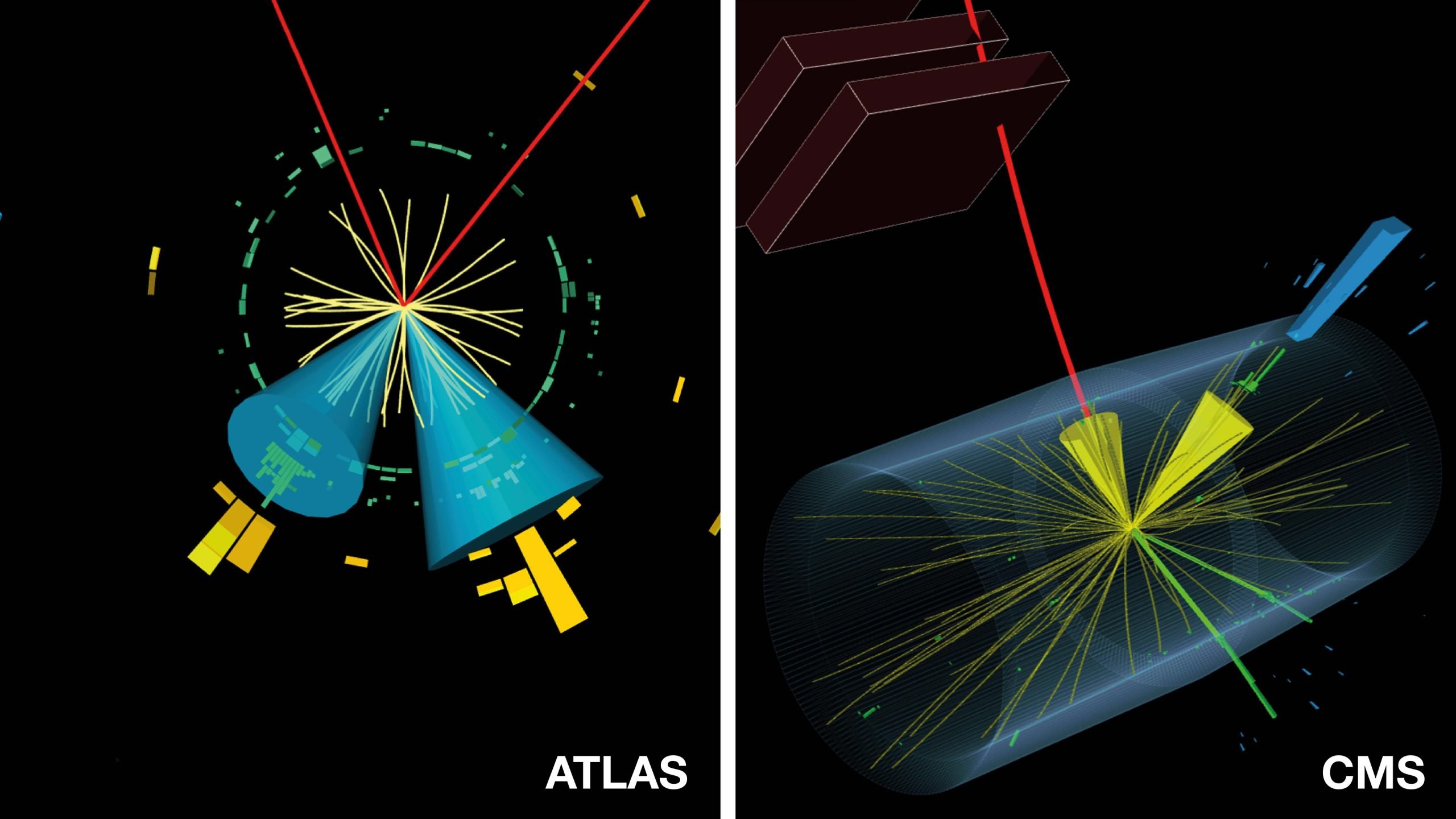
    Production of Higgs Boson in Association With Z Boson
    Candidate events for a Higgs boson produced in association with a Z boson, as recorded by ATLAS (left) and CMS (right). The Higgs boson decays into a pair of jets (cones) originating from charm quarks, and the Z boson decays into muons (red lines on the left) or electrons (green lines on the right). Credit: CERN

    ATLAS and CMS study the Higgs boson’s interactions by looking at how it transforms, or “decays”, into lighter particles or how it is produced together with other particles. In their latest studies, using data from the second run of the LHC, the two teams searched for the decay of the Higgs boson into a charm quark and its antimatter counterpart, the charm antiquark.

    In the Standard Model, this decay is relatively rare, occurring only 3% of the time. What’s more, the decay is extremely hard to spot because the two sprays, or “jets”, of particles that it generates can also be produced by other processes at far higher rates. To more easily identify this decay, ATLAS and CMS targeted their searches at Higgs bosons produced together with a W or a Z boson decaying to electrons, muons (W, Z) or neutrinos (Z), and they used sophisticated machine-learning techniques to identify jets originating from charm quarks. CMS also looked for high-momentum, or “boosted”, Higgs bosons that result in two charm jets collapsing into a wide jet.

    The teams found no significant indication of the decay of the Higgs boson into charm quarks in the data, but their analyses set bounds on the rate at which this decay should occur when the Higgs boson is produced along with a W and Z boson. These bounds correspond to upper limits on the interaction strength of the Higgs boson with a charm quark, of 8.5 and 5.5 times the Standard Model prediction in the case of ATLAS and CMS, respectively.

    The ATLAS team went on to combine their analysis with a measurement of the Higgs boson decay into beauty quarks, demonstrating that the Higgs boson interacts more weakly with the charm quark than it does with the beauty quark. In other words, they found that the Higgs boson interacts differently with quarks of the second and third generations, as predicted by the Standard Model.

    Interestingly, the CMS study allowed the CMS researchers to observe for the first time at a hadron collider the decay of the Z boson into charm quarks, a bonus observation that resulted from a validation step in their search for the decay of the Higgs boson into charm quarks.

    Never miss a breakthrough: Join the SciTechDaily newsletter.
    Follow us on Google and Google News.

    CERN Higgs Boson Large Hadron Collider Particle Physics
    Share. Facebook Twitter Pinterest LinkedIn Email Reddit

    Related Articles

    The Higgs Boson Mystery: When Nature Defies Expectations

    Large Hadron Collider: Could the Higgs Boson Decay Into Dark Matter?

    Large Hadron Collider Detects Evidence of a Rare Higgs Boson Process: God Particle Decaying Into a Pair of Muons

    ATLAS Experiment Observes the Decay Signature of the Higgs Boson

    New Results Indicate That Particle Discovered at LHC Is a Higgs Boson

    CERN to Announce the Latest Results from ATLAS and CMS

    Discussing the Search for the Higgs Particle

    More Data of Elusive Higgs Boson from Defunct US Tevatron Collider

    Higgs Boson Signals Gain Strength at Large Hadron Collider

    2 Comments

    1. xABBAAA on April 1, 2022 5:11 am

      …

      Reply
    2. Vytas Malcus on April 2, 2022 6:49 am

      Interest in new features.
      Develop new technology
      Microsoft Application Developer
      Vytas Malcus

      Reply
    Leave A Reply Cancel Reply

    • Facebook
    • Twitter
    • Pinterest
    • YouTube

    Don't Miss a Discovery

    Subscribe for the Latest in Science & Tech!

    Trending News

    Scientists Warn That This Common Pet Fish Can Wreck Entire Ecosystems

    Scientists Make Breakthrough in Turning Plastic Trash Into Clean Fuel Using Sunlight

    This Popular Supplement May Interfere With Cancer Treatment, Scientists Warn

    Scientists Finally Solved One of Water’s Biggest Mysteries

    Could This New Weight-Loss Pill Disrupt the Entire Market? Here’s What You Should Know About Orforglipron

    Earth’s Crust Is Tearing Open in Africa, and It Could Form a New Ocean

    Breakthrough Bowel Cancer Trial Leaves Patients Cancer-Free for Nearly 3 Years

    Natural Compound Shows Powerful Potential Against Rheumatoid Arthritis

    Follow SciTechDaily
    • Facebook
    • Twitter
    • YouTube
    • Pinterest
    • Newsletter
    • RSS
    SciTech News
    • Biology News
    • Chemistry News
    • Earth News
    • Health News
    • Physics News
    • Science News
    • Space News
    • Technology News
    Recent Posts
    • The Most Effective Knee Arthritis Treatments Aren’t What You Expect
    • Scientists Develop Bioengineered Chewing Gum That Could Help Fight Oral Cancer
    • Popular Weight-Loss Drugs Found To Cut Heart Attack and Stroke Risk
    • After 37 Years, the World’s Longest-Running Soil Warming Experiment Uncovers a Startling Climate Secret
    • NASA Satellite Captures First-Ever High-Res View of Massive Pacific Tsunami
    Copyright © 1998 - 2026 SciTechDaily. All Rights Reserved.
    • Science News
    • About
    • Contact
    • Editorial Board
    • Privacy Policy
    • Terms of Use

    Type above and press Enter to search. Press Esc to cancel.