
Close Menu
    Facebook X (Twitter) Instagram
    SciTechDaily
    • Biology
    • Chemistry
    • Earth
    • Health
    • Physics
    • Science
    • Space
    • Technology
    Facebook X (Twitter) Pinterest YouTube RSS
    SciTechDaily
    Home»Space»ESO’s VISTA Telescope Reveals the Interstellar Matter of the Carina Nebula
    Space

    ESO’s VISTA Telescope Reveals the Interstellar Matter of the Carina Nebula

    By SciTechDailyAugust 29, 2018No Comments4 Mins Read
    Facebook Twitter Pinterest Telegram LinkedIn WhatsApp Email Reddit
    Share
    Facebook Twitter LinkedIn Pinterest Telegram Email Reddit
    Stars vs Dust in the Carina Nebula
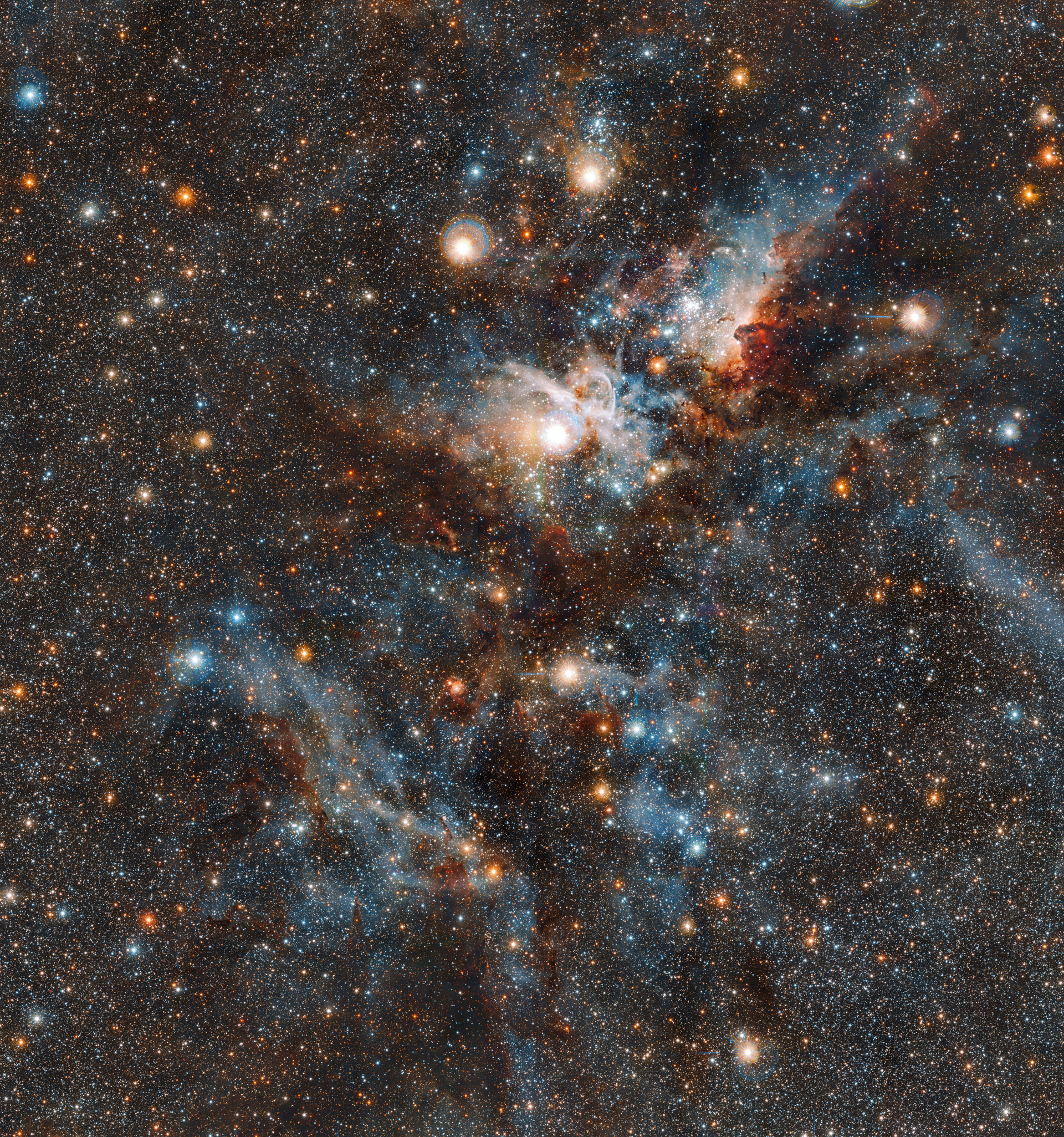
    This spectacular image of the Carina nebula reveals the dynamic cloud of interstellar matter and thinly spread gas and dust as never before. The massive stars in the interior of this cosmic bubble emit intense radiation that causes the surrounding gas to glow. By contrast, other regions of the nebula contain dark pillars of dust cloaking newborn stars. Credit: ESO/J. Emerson/M. Irwin/J. Lewis

    The Carina Nebula, one of the largest and brightest nebulae in the night sky, has been beautifully imaged by ESO’s VISTA telescope at the Paranal Observatory in Chile. By observing in infrared light, VISTA has peered through the hot gas and dark dust enshrouding the nebula to show us myriad stars, both newborn and in their death throes.

    About 7500 light-years away, in the constellation of Carina, lies a nebula within which stars form and perish side-by-side. Shaped by these dramatic events, the Carina Nebula is a dynamic, evolving cloud of thinly spread interstellar gas and dust.

    The massive stars in the interior of this cosmic bubble emit intense radiation that causes the surrounding gas to glow. By contrast, other regions of the nebula contain dark pillars of dust cloaking newborn stars. There’s a battle raging between stars and dust in the Carina Nebula, and the newly formed stars are winning — they produce high-energy radiation and stellar winds which evaporate and disperse the dusty stellar nurseries in which they formed.
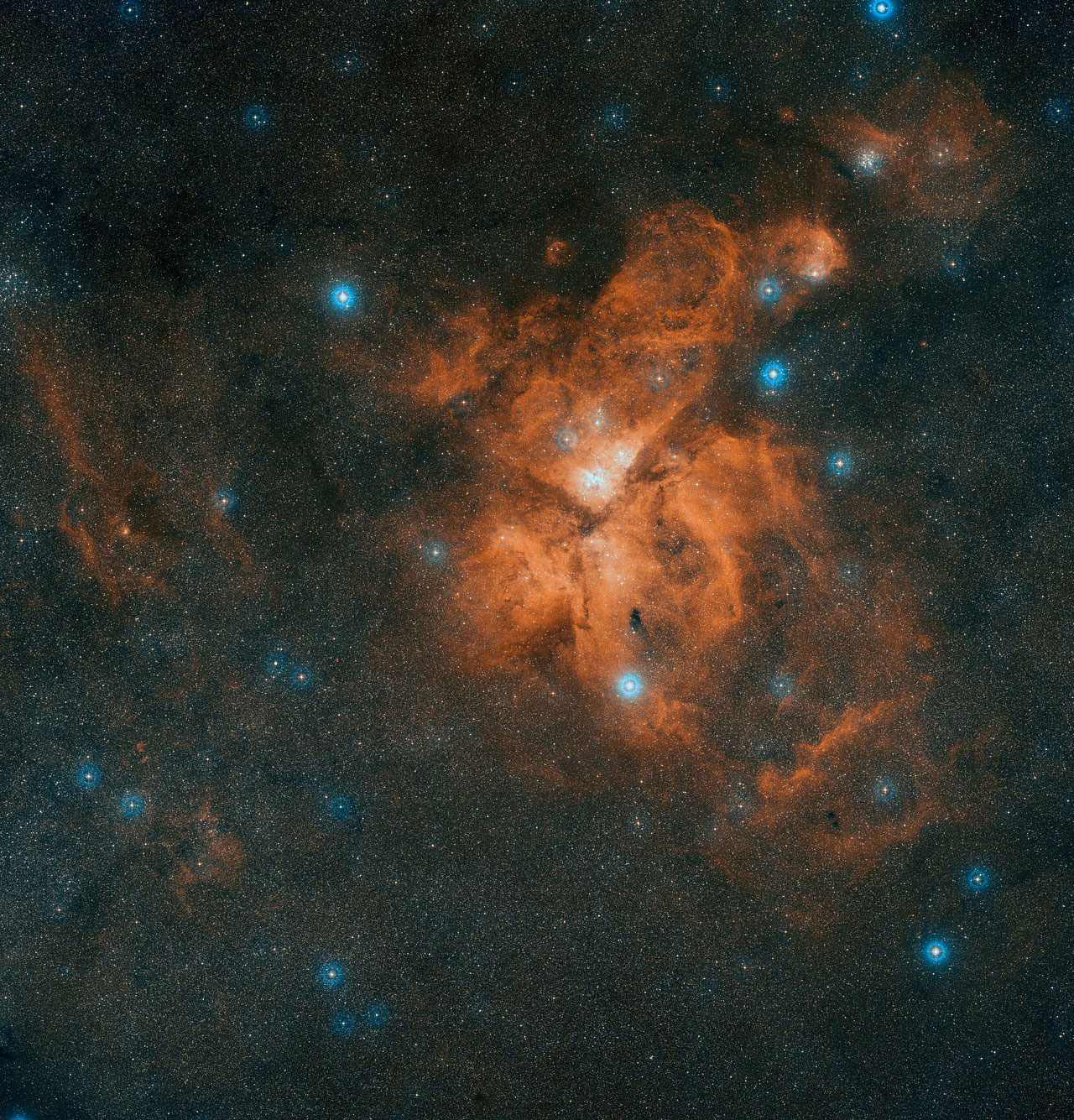
    Digitized Sky Survey image of Eta Carinae Nebula
    This image is a color composite made from exposures from the Digitized Sky Survey 2 (DSS2). The field of view is approximately 4.7 x 4.9 degrees. Credit: ESO/Digitized Sky Survey 2. Acknowledgment: Davide De Martin.

    Spanning over 300 light-years, the Carina Nebula is one of the Milky Way’s largest star-forming regions and is easily visible to the unaided eye under dark skies. Unfortunately for those of us living in the north, it lies 60 degrees below the celestial equator, so is visible only from the Southern Hemisphere.

    Within this intriguing nebula, Eta Carinae takes pride in place as the most peculiar star system. This stellar behemoth — a curious form of stellar binary— is the most energetic star system in this region and was one of the brightest objects in the sky in the 1830s. It has since faded dramatically and is reaching the end of its life, but remains one of the most massive and luminous star systems in the Milky Way.


    The VISTA telescope has allowed us to peer through the hot gas and dark dust shrouding the spectacular Carina nebula to show us myriad stars, both newborn and in their death throes.

    Eta Carinae can be seen in this image as part of the bright patch of light just above the point of the “V” shape made by the dust clouds. Directly to the right of Eta Carinae is the relatively small Keyhole Nebula — a small, dense cloud of cold molecules and gas within the Carina Nebula — which hosts several massive stars, and whose appearance has also changed drastically over recent centuries.


    This visualization shows a 3D conversion of images of the Carina Nebula.

    The Carina Nebula was discovered from the Cape of Good Hope by Nicolas Louis de Lacaille in the 1750s and a huge number of images have been taken of it since then. But VISTA — the Visible and Infrared Survey Telescope for Astronomy — adds an unprecedentedly detailed view over a large area; its infrared vision is perfect for revealing the agglomerations of young stars hidden within the dusty material snaking through the Carina Nebula. In 2014, VISTA was used to pinpoint nearly five million individual sources of infrared light within this nebula, revealing the vast extent of this stellar breeding ground. VISTA is the world’s largest infrared telescope dedicated to surveys and its large mirror, wide field of view and exquisitely sensitive detectors enable astronomers to unveil a completely new view of the southern sky.


    This pan video takes a closer look at the Carina Nebula. The VISTA telescope has allowed us to peer through the hot gas and dark dust shrouding the spectacular Carina nebula to show us myriad stars, both newborn and in their death throes.

    Never miss a breakthrough: Join the SciTechDaily newsletter.
    Follow us on Google and Google News.

    Astronomy Cosmology European Southern Observatory VISTA
    Share. Facebook Twitter Pinterest LinkedIn Email Reddit

    Related Articles

    VISTA Survey Reveals Hidden Secrets of Orion’s Clouds

    ESO VISTA Telescope Reveals Hidden Stars in Messier 78

    VISTA Telescope Discovers a New Component of Milky Way

    VLT Discovers the Brightest Distant Galaxy to Date and Signs of Population III Stars

    VLT/SPHERE Reveal a Star Giving Birth to a Butterfly-Like Planetary Nebula

    ESO Views Star Forming Cloud RCW 34

    The Possible First Signs of Self-interacting Dark Matter

    New VISTA Image of Stellar Nursery NGC 6357

    Popular VISTA Image of the Orion Nebula

    Leave A Reply Cancel Reply

    • Facebook
    • Twitter
    • Pinterest
    • YouTube

    Don't Miss a Discovery

    Subscribe for the Latest in Science & Tech!

    Trending News

    Monster Storms on Jupiter Unleash Lightning Beyond Anything on Earth

    Scientists Create “Liquid Gears” That Spin Without Touching

    The Simple Habit That Could Help Prevent Cancer

    Millions Take These IBS Drugs, But a New Study Finds Serious Risks

    Scientists Unlock Hidden Secrets of 2,300-Year-Old Mummies Using Cutting-Edge CT Scanner

    Bread Might Be Making You Gain Weight Even Without Eating More Calories

    Scientists Discover Massive Magma Reservoir Beneath Tuscany

    Europe’s Most Active Volcano Just Got Stranger – Here’s Why Scientists Are Rethinking It

    Follow SciTechDaily
    • Facebook
    • Twitter
    • YouTube
    • Pinterest
    • Newsletter
    • RSS
    SciTech News
    • Biology News
    • Chemistry News
    • Earth News
    • Health News
    • Physics News
    • Science News
    • Space News
    • Technology News
    Recent Posts
    • New Brain Discovery Challenges Long-Held Theory of Teenage Brain Development
    • Sharks Are Overheating as Warming Oceans Push Them to the Edge
    • Scientists Discover Plants “Scream” – We Just Couldn’t Hear Them Until Now
    • 25-Year Study Uncovers Hidden Paths and Early Warning Signs of Blood Cancer
    • Not Just Snoring – New Research Reveals Sleep Apnea May Be Damaging Your Muscles
    Copyright © 1998 - 2026 SciTechDaily. All Rights Reserved.
    • Science News
    • About
    • Contact
    • Editorial Board
    • Privacy Policy
    • Terms of Use

    Type above and press Enter to search. Press Esc to cancel.