
Close Menu
    Facebook X (Twitter) Instagram
    SciTechDaily
    • Biology
    • Chemistry
    • Earth
    • Health
    • Physics
    • Science
    • Space
    • Technology
    Facebook X (Twitter) Pinterest YouTube RSS
    SciTechDaily
    Home»Space»New Horizons Makes First Detection of Kuiper Belt Object Ultima Thule
    Space

    New Horizons Makes First Detection of Kuiper Belt Object Ultima Thule

    By Tricia Talbert, NASAAugust 29, 2018No Comments4 Mins Read
    Facebook Twitter Pinterest Telegram LinkedIn WhatsApp Email Reddit
    Share
    Facebook Twitter LinkedIn Pinterest Telegram Email Reddit
    New Horizons Makes First Detection of Kuiper Belt Flyby Target
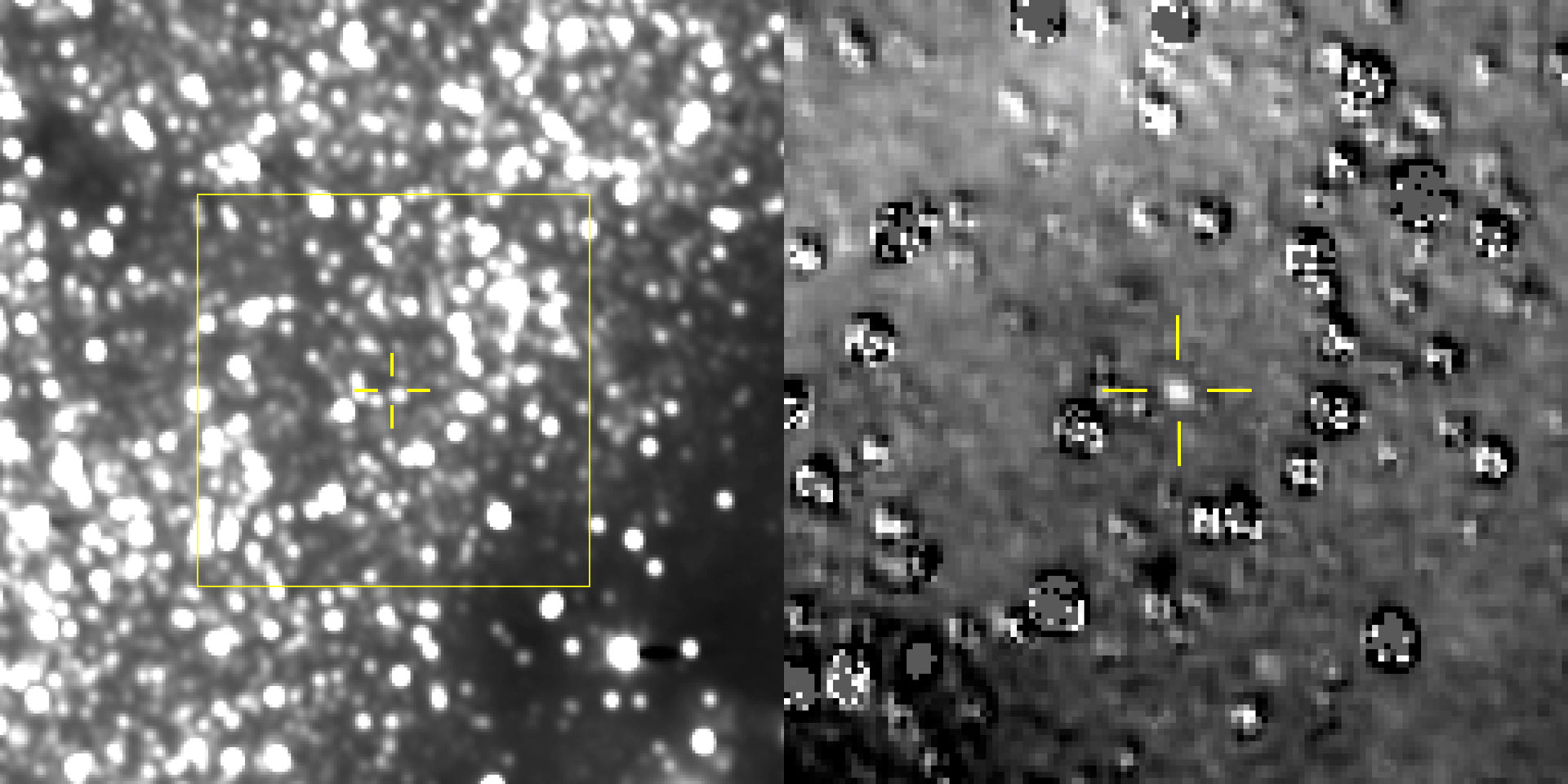
    The figure on the left is a composite image produced by adding 48 different exposures from the News Horizons Long Range Reconnaissance Imager (LORRI), each with an exposure time of 29.967 seconds, taken on August 16, 2018. The predicted position of the Kuiper Belt object nicknamed Ultima Thule is at the center of the yellow box, and is indicated by the red crosshairs, just above and left of a nearby star that is approximately 17 times brighter than Ultima. At right is a magnified view of the region in the yellow box, after subtraction of a background star field “template” taken by LORRI in September 2017 before it could detect the object itself. Ultima is clearly detected in this star-subtracted image and is very close to where scientists predicted, indicating to the team that New Horizons is being targeted in the right direction. The many artifacts in the star-subtracted image are caused either by small mis-registrations between the new LORRI images and the template, or by intrinsic brightness variations of the stars. At the time of these observations, Ultima Thule was 107 million miles (172 million kilometers) from the New Horizons spacecraft and 4 billion miles (6.5 billion kilometers) from the Sun. Credit: NASA/JHUAPL/SwRI

    NASA’s New Horizons spacecraft has made its first detection of its next flyby target, the Kuiper Belt object nicknamed Ultima Thule, more than four months ahead of its New Year’s 2019 close encounter.

    Mission team members were thrilled – if not a little surprised – that New Horizons’ telescopic Long Range Reconnaissance Imager (LORRI) was able to see the small, dim object while still more than 100 million miles away, and against a dense background of stars. Taken on August 16 and transmitted home through NASA’s Deep Space Network over the following days, the set of 48 images marked the team’s first attempt to find Ultima with the spacecraft’s own cameras.

    “The image field is extremely rich with background stars, which makes it difficult to detect faint objects,” said Hal Weaver, New Horizons project scientist and LORRI principal investigator from the Johns Hopkins Applied Physics Laboratory in Laurel, Maryland. “It really is like finding a needle in a haystack. In these first images, Ultima appears only as a bump on the side of a background star that’s roughly 17 times brighter, but Ultima will be getting brighter – and easier to see – as the spacecraft gets closer.”

    This first detection is important because the observations New Horizons makes of Ultima over the next four months will help the mission team refine the spacecraft’s course toward a closest approach to Ultima, at 12:33 a.m. EST on Jan. 1, 2019. That Ultima was where mission scientists expected it to be – in precisely the spot they predicted, using data gathered by the Hubble Space Telescope – indicates the team already has a good idea of Ultima’s orbit.

    The Ultima flyby will be the first-ever close-up exploration of a small Kuiper Belt object and the farthest exploration of any planetary body in history, shattering the record New Horizons itself set at Pluto in July 2015 by about 1 billion miles. These images are also the most distant from the Sun ever taken, breaking the record set by Voyager 1’s “Pale Blue Dot” image of Earth taken in 1990. (New Horizons set the record for the most distant image from Earth in December 2017.)

    “Our team worked hard to determine if Ultima was detected by LORRI at such a great distance, and the result is a clear yes,” said New Horizons Principal Investigator Alan Stern, of the Southwest Research Institute in Boulder, Colorado. “We now have Ultima in our sights from much farther out than once thought possible. We are on Ultima’s doorstep, and an amazing exploration awaits!”

    Never miss a breakthrough: Join the SciTechDaily newsletter.
    Follow us on Google and Google News.

    Astronomy Kuiper Belt New Horizons Popular
    Share. Facebook Twitter Pinterest LinkedIn Email Reddit

    Related Articles

    Meet the Icy World ‘Arrokoth’ From a Billion Miles Beyond Pluto in the Kuiper Belt

    Kuiper Belt Object 2014 MU69 Just Got a Lot More Interesting

    New Horizons Captures New Data on Kuiper Belt Object 2014 MU69

    New Horizons Reveals a Dense Region of Atmospheric Ions Behind Pluto

    Astrophysicist Scott Kenyon Shares His Thoughts and Reactions on New Horizons’ Flyby of Pluto

    NASA’s New Horizons Spacecraft Reaches Historic Encounter with Pluto

    New Horizons Reveals Signs of Pluto’s Geology

    Dwarf Planet Pluto: The ‘Other’ Red Planet

    NASA Scientists Identify Small-Scale Waves on Jupiter

    Leave A Reply Cancel Reply

    • Facebook
    • Twitter
    • Pinterest
    • YouTube

    Don't Miss a Discovery

    Subscribe for the Latest in Science & Tech!

    Trending News

    Breakthrough Bowel Cancer Trial Leaves Patients Cancer-Free for Nearly 3 Years

    Natural Compound Shows Powerful Potential Against Rheumatoid Arthritis

    100,000-Year-Old Neanderthal Fossils in Poland Reveal Unexpected Genetic Connections

    Simple “Gut Reset” May Prevent Weight Gain After Ozempic or Wegovy

    2.8 Days to Disaster: Scientists Warn Low Earth Orbit Could Suddenly Collapse

    Common Food Compound Shows Surprising Power Against Superbugs

    5 Simple Ways To Remember More and Forget Less

    The Atomic Gap That Could Cost the Semiconductor Industry Billions

    Follow SciTechDaily
    • Facebook
    • Twitter
    • YouTube
    • Pinterest
    • Newsletter
    • RSS
    SciTech News
    • Biology News
    • Chemistry News
    • Earth News
    • Health News
    • Physics News
    • Science News
    • Space News
    • Technology News
    Recent Posts
    • Scientists Print Artificial Neurons That Can Talk to the Brain
    • Bowel and Ovarian Cancers Are Dramatically Rising in Young Adults and Scientists Aren’t Sure Why
    • Alzheimer’s May Begin Decades Earlier Than You Think, New Mayo Clinic Study Finds
    • The Hidden Risk of Taking Breaks From Weight-Loss Drugs Like Ozempic
    • Total Solar Eclipse Made Cities Go Eerily Quiet Beneath the Surface
    Copyright © 1998 - 2026 SciTechDaily. All Rights Reserved.
    • Science News
    • About
    • Contact
    • Editorial Board
    • Privacy Policy
    • Terms of Use

    Type above and press Enter to search. Press Esc to cancel.