
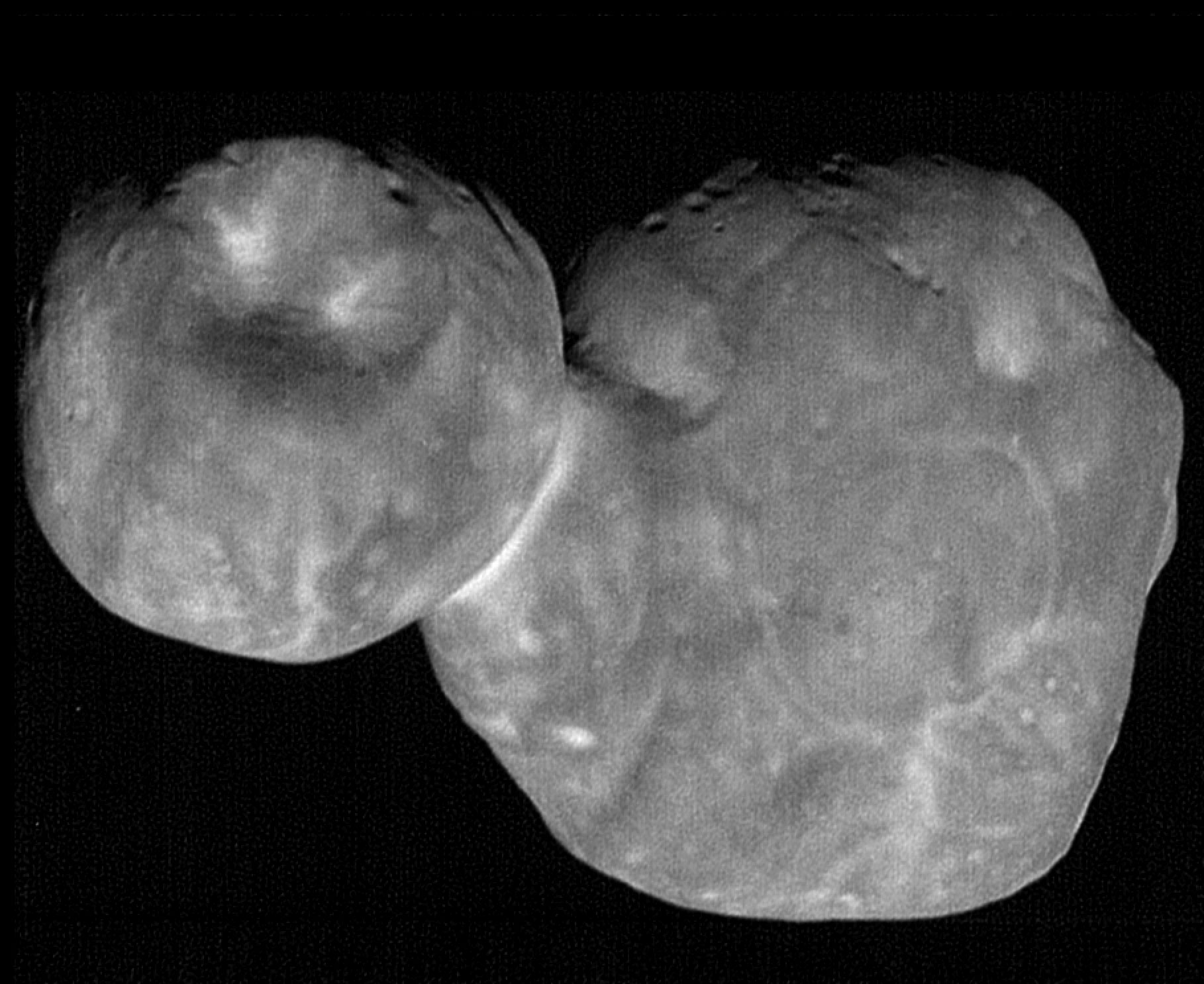
The mission team called it a “stretch goal” – just before closest approach, precisely pointing the cameras on NASA’s New Horizons spacecraft to snap the sharpest possible pictures of the Kuiper Belt object nicknamed Ultima Thule, its New Year’s flyby target and the farthest object ever explored.
Now that New Horizons has sent those stored flyby images back to Earth, the team can enthusiastically confirm that its ambitious goal was met.
These new images of Ultima Thule – obtained by the telephoto Long-Range Reconnaissance Imager (LORRI) just six-and-a-half minutes before New Horizons’ closest approach to the object (officially named 2014 MU69) at 12:33 a.m. EST on Jan. 1, 2019 – offer a resolution of about 110 feet (33 meters) per pixel. Their combination of high spatial resolution and a favorable viewing angle gives the team an unprecedented opportunity to investigate the surface, as well as the origin and evolution, of Ultima Thule, which is thought to be the most primitive object ever encountered by a spacecraft.
New Horizons scientists created this movie from 14 different images taken by the New Horizons Long Range Reconnaissance Imager (LORRI) shortly before the spacecraft flew past the Kuiper Belt object nicknamed Ultima Thule (officially named 2014 MU69) on Jan. 1, 2019. The central frame of this sequence was taken on Jan. 1 at 5:26:54 UT (12:26 a.m. EST), when New Horizons was 4,117 miles (6,640 kilometers) from Ultima Thule, some 4.1 billion miles (6.6 billion kilometers) from Earth. Ultima Thule nearly completely fills the LORRI image and is perfectly captured in the frames, an astounding technical feat given the uncertain location of Ultima Thule and the New Horizons spacecraft flying past it at over 32,000 miles per hour. Credit: NASA/Johns Hopkins Applied Physics Laboratory/Southwest Research Institute. Credit: NASA/Johns Hopkins Applied Physics Laboratory/Southwest Research Institute
“Bullseye!” said New Horizons Principal Investigator Alan Stern, of the Southwest Research Institute (SwRI). “Getting these images required us to know precisely where both tiny Ultima and New Horizons were — moment by moment – as they passed one another at over 32,000 miles per hour in the dim light of the Kuiper Belt, a billion miles beyond Pluto. This was a much tougher observation than anything we had attempted in our 2015 Pluto flyby.
“These ‘stretch goal’ observations were risky, because there was a real chance we’d only get part or even none of Ultima in the camera’s narrow field of view,” Stern continued. “But the science, operations and navigation teams nailed it, and the result is a field day for our science team! Some of the details we now see on Ultima Thule’s surface are unlike any object ever explored before.”
The higher resolution brings out a many surface features that weren’t readily apparent in earlier images. Among them are several bright, enigmatic, roughly circular patches of terrain. In addition, many small, dark pits near the terminator (the boundary between the sunlit and dark sides of the body) are better resolved. “Whether these features are craters produced by impactors, sublimation pits, collapse pits, or something entirely different, is being debated in our science team,” said John Spencer, deputy project scientist from SwRI.
Project Scientist Hal Weaver, of the Johns Hopkins Applied Physics Laboratory, noted that the latest images have the highest spatial resolution of any New Horizons has taken – or may ever take – during its entire mission. Swooping within just 2,200 miles (3,500 kilometers), New Horizons flew approximately three times closer to Ultima than it zipped past its primary mission target, Pluto, in July 2015.
Ultima is a smaller object than Pluto, but the Ultima flyby was done with the highest navigation precision ever achieved by any spacecraft before. This unprecedented precision was achieved thanks to the ground-based occultation campaigns from 2017 and 2018 conducted in Argentina, Senegal, South Africa and Colombia, as well as the European Space Agency’s Gaia mission, which provided the locations of the stars that were used during the occultation campaigns.
Look for these and other LORRI images on the New Horizons LORRI website this week. Raw images from the camera are posted to the site each Friday.
Mission operations manager Alice Bowman, of APL, reports that the spacecraft continues to operate flawlessly. New Horizons is nearly 4.13 billion miles (6.64 billion kilometers) from Earth; at that distance, radio signals, traveling at light speed, reach the large antennas of NASA’s Deep Space Network six hours and nine minutes after New Horizons sends them. Follow New Horizons on its trek through the Kuiper Belt.
Never miss a breakthrough: Join the SciTechDaily newsletter.
Follow us on Google and Google News.
1 Comment
These type of quality and scientific movies watch on https://thoptv-apk.com/