
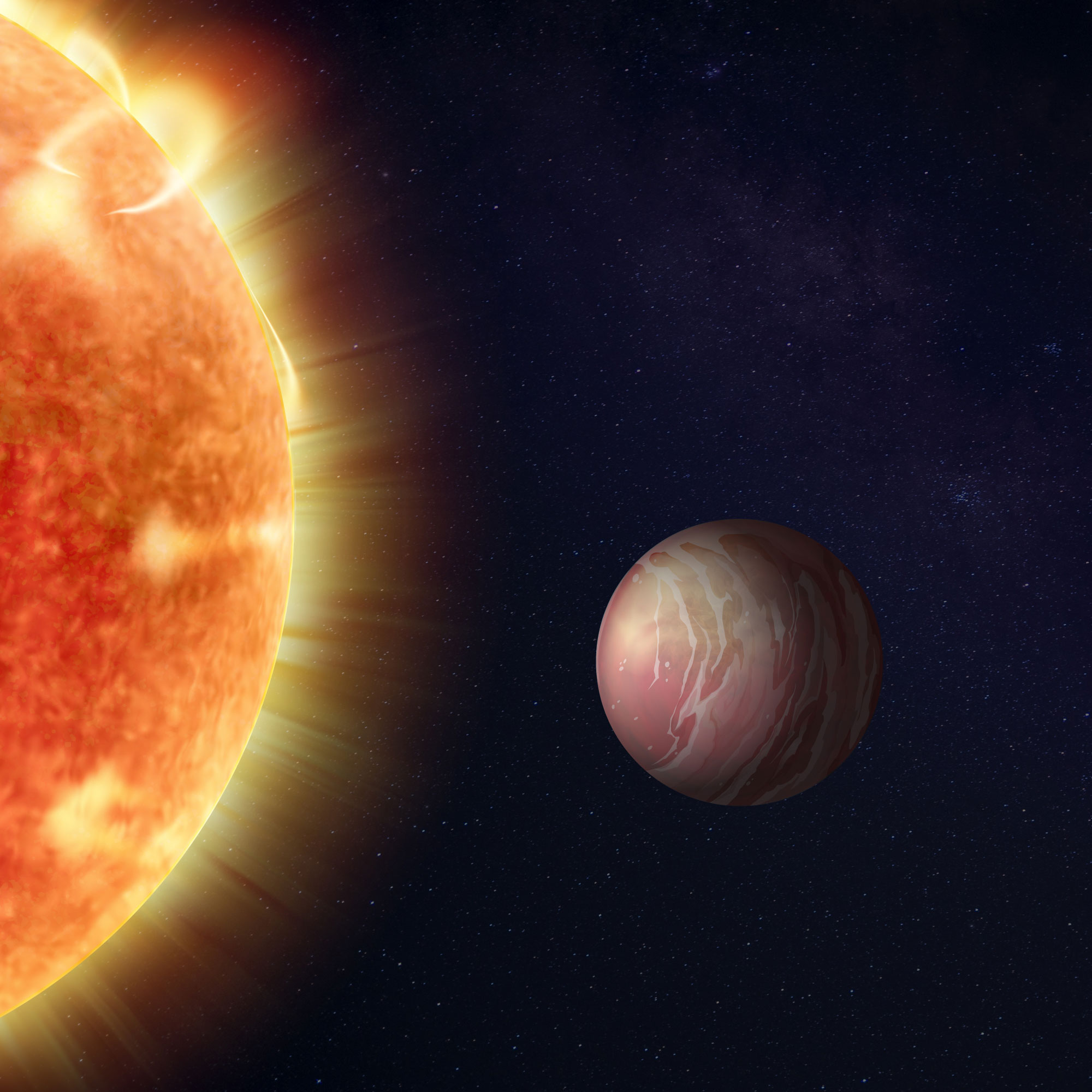
James Webb Space Telescope observations suggest that exotic mineral clouds may be shielding a distant lava planet from its star.
A rocky planet exposed to extreme heat from its star appears to reflect nearly three-quarters of the starlight that reaches it. Astronomers suspect silicate-mineral clouds could act as a protective sunscreen, helping the planet maintain temperatures far below those expected for an exposed surface of molten rock.
The planet, TOI-561 b, lies about 280 light-years from Earth and was previously considered too hot to retain a substantial atmosphere. New observations from the James Webb Space Telescope (JWST) suggest that it has a significant envelope of gas that reflects incoming radiation and redistributes heat around the planet. The findings, published in The Astronomical Journal, challenge existing theories about how atmospheres survive on intensely irradiated rocky worlds.
Webb Observations Reveal an Unusual Temperature Pattern
An international research team, including University of Birmingham astrophysicist Dr. Anjali Piette, monitored TOI-561 b for 37 hours, covering nearly four complete orbits around its star. By measuring changes in the planet’s brightness and thermal emission throughout its orbit, the researchers investigated how heat is distributed between its permanently illuminated dayside and its dark nightside.
Earlier observations had shown that the dayside was unexpectedly cool for a bare, dark rocky surface. Scientists considered whether winds might be transporting the missing heat to the nightside or whether the planet was reflecting much of the incoming starlight. Webb’s first measurements of the nightside showed that it was not warm enough to account for the difference. The results indicate that TOI-561 b reflects approximately 75% of the starlight it receives, a proportion comparable to Venus.
Professor Lisa Dang, the project’s lead researcher at the University of Waterloo in Ontario, Canada, explained: “We measured how the planet’s brightness and heat changed throughout its orbit. This technique, known as a phase curve, revealed that the planet reflects a significant amount of light from its star, and that heat is being redistributed around the planet instead of only on the sunlit side. Together, these point to the presence of an atmosphere.”
Could Clouds Made of Rock Protect the Planet?
To investigate the planet’s unusual reflectivity, the researchers compared their measurements with computer simulations of its climate. The models suggest that clouds containing silicate minerals, including silicon dioxide (SiO2) and magnesium silicate (MgSiO3), could form on the dayside. These clouds might reflect substantial amounts of stellar radiation before it can heat the surface, much as a sunscreen reduces the amount of sunlight absorbed by skin.
The atmosphere’s chemical composition remains unknown. One possibility is a dense layer of carbon dioxide, resembling the atmosphere of Venus but exposed to much more extreme conditions. Another is an atmosphere rich in sulfur dioxide, a volcanic gas also released by Jupiter’s moon Io. Neither scenario would produce habitable conditions.
Why Hasn’t the Atmosphere Disappeared?
The evidence for a substantial atmosphere raises questions about the planet’s history. Intense stellar radiation should have stripped much of the gas from a rocky world like TOI-561 b over billions of years. Yet the new measurements strengthen earlier findings suggesting that the planet still possesses a thick atmosphere, potentially replenished by gases escaping from its molten interior.
Dr. Piette, Assistant Professor in Astronomy at the University of Birmingham, said: “Our discovery challenges current theories. We would expect a heavily irradiated rocky planet like TOI-561 b to have lost its atmosphere billions of years ago.”
“Instead, the evidence suggests it still has a significant atmosphere today. This raises major questions such as whether the planet started with an unusually large supply of gases or if the ocean of molten rock covering its surface, acts as a planet-wide volcano that is constantly feeding its atmosphere.”
The Next Question: What Is the Atmosphere Made Of?
Determining which gases surround TOI-561 b could help researchers understand how its atmosphere has persisted under such extreme conditions. Additional Webb observations at longer wavelengths may provide the spectral information needed to distinguish between competing atmospheric models and investigate whether volcanic activity is continually replacing gases lost to space.
Professor Dang added: “The next big question we will seek to answer is whether TOI-561 b’s atmosphere resembles Venus or an extreme version of Io. Observing the planet at longer wavelengths with JWST could give us insights and help explain how a planet this hot has held on to an atmosphere for billions of years.”
Reference: “A Highly Reflective Atmosphere on the Lava World TOI-561b Revealed by JWST/NIRSpec Phase Curves” by Samuel Boucher, Lisa Dang, Alex McGinty, Johanna K. Teske, Raymond Pierrehumbert, Anjali A. A. Piette, Nicole L. Wallack, Angharad Weeks, Neil T. Lewis, Tim Lichtenberg, Mykhaylo Plotnykov, Emma Postolec, Daniel Huber, Timothy R. Bedding, Harrison Nicholls, Bo Peng, Mark Hammond and Diana Valencia, 29 September 2026, The Astronomical Journal.
DOI: 10.3847/1538-3881/ae9763
Never miss a breakthrough: Join the SciTechDaily newsletter.
Follow us on Google and Google News.
2 Comments
Merely …..Thank you.
Hey, I think current iformation from that planet are from it 280 years ago, because it is 280 lightyears away from Earth. So we can not confirm the information received today.