

First Image Ever Taken of Exoplanet in Extremely Misaligned System
NASA’s James Webb Space Telescope is not only changing how we understand the universe, it’s also dazzling the world with stunning images of space, from glowing star nurseries to planets in our own solar system.
But when Webb turns its gaze toward distant exoplanets, the images look quite different. These worlds orbit stars far beyond our own Sun, making them incredibly hard to capture. Their stars shine thousands of times brighter, and the planets themselves are often lost in the glare, appearing as faint dots of light.
Still, even those tiny dots can tell scientists a lot.
In its latest observation, Webb captured an image of 14 Herculis c, a frigid giant planet orbiting a star 60 light-years from Earth. From this single, cold speck in space, researchers are uncovering new details about the planet’s temperature, unusual orbit, and even how its atmosphere behaves, offering a rare glimpse into the strange dynamics of alien worlds.
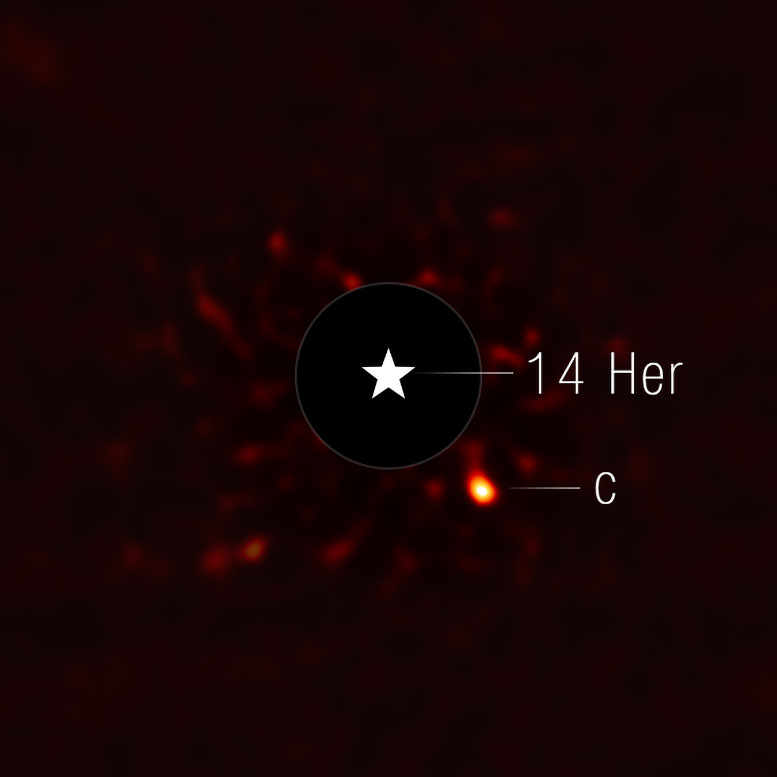
Webb Space Telescope Images Frigid Exoplanet in Strange Orbit
A distant star system that scientists described as abnormal, chaotic, and strange is finally coming into focus, thanks to NASA’s James Webb Space Telescope. Using its powerful Near-Infrared Camera (NIRCam), Webb has captured a rare image of one of two known planets orbiting the star 14 Herculis, located about 60 light-years from Earth in the Milky Way.
The planet, known as 14 Herculis c, stands out for how incredibly cold it is. While astronomers have discovered nearly 6,000 exoplanets, only a small handful have been directly imaged, and most of those are extremely hot, with temperatures soaring into the hundreds or thousands of degrees. But Webb’s data shows that 14 Herculis c, a massive planet about seven times the size of Jupiter, is chilling at just 26 degrees Fahrenheit, or minus 3 degrees Celsius.
This breakthrough has been accepted for publication in The Astrophysical Journal Letters and was recently presented at the American Astronomical Society’s meeting in Anchorage, Alaska.
Webb Unlocks a New Era of Cold Planet Imaging
“The colder an exoplanet, the harder it is to image, so this is a totally new regime of study that Webb has unlocked with its extreme sensitivity in the infrared,” said William Balmer, co-first author of the new paper and graduate student at Johns Hopkins University. “We are now able to add to the catalog of not just hot, young exoplanets imaged, but older exoplanets that are far colder than we’ve directly seen before Webb.”
Webb’s image of 14 Herculis c also provides insights into a planetary system unlike most others studied in detail with Webb and other ground- and space-based observatories. The central star, 14 Herculis, is almost Sun-like – it is similar in age and temperature to our own Sun, but a little less massive and cooler.
X-Shaped Orbits Break the Norm
There are two planets in this system – 14 Herculis b is closer to the star, and covered by the coronagraphic mask in the Webb image. These planets don’t orbit the host star on the same plane like our solar system. Instead, they cross each other like an ‘X’, with the star being at the center. That is, the orbital planes of the two planets are inclined relative to one another at an angle of about 40 degrees. The planets tug and pull at one another as they orbit the star.
This is the first time an image has ever been snapped of an exoplanet in such a misaligned system.
The Violent Past of a Planetary Crime Scene
Scientists are working on several theories for just how the planets in this system got so “off track.” One of the leading concepts is that the planets scattered after a third planet was violently ejected from the system early in its formation.
“The early evolution of our own solar system was dominated by the movement and pull of our own gas giants,” added Balmer. “They threw around asteroids and rearranged other planets. Here, we are seeing the aftermath of a more violent planetary crime scene. It reminds us that something similar could have happened to our own solar system, and that the outcomes for small planets like Earth are often dictated by much larger forces.”
Webb Sharpens the Picture of 14 Herculis c
Webb’s new data is giving researchers further insights into not just the temperature of 14 Herculis c, but other details about the planet’s orbit and atmosphere.
Findings indicate the planet orbits around 1.4 billion miles from the host star in a highly elliptical, or football-shaped orbit, closer in than previous estimates. This is around 15 times farther from the Sun than Earth. On average, this would put 14 Herculis c between Saturn and Uranus in our solar system.
Atmospheric Mysteries Revealed by Brightness
The planet’s brightness at 4.4 microns measured using Webb’s coronagraph, combined with the known mass of the planet and age of the system, hints at some complex atmospheric dynamics at play.
“If a planet of a certain mass formed 4 billion years ago, then cooled over time because it doesn’t have a source of energy keeping it warm, we can predict how hot it should be today,” said Daniella C. Bardalez Gagliuffi of Amherst College, co-first author on the paper with Balmer. “Added information, like the perceived brightness in direct imaging, would in theory support this estimate of the planet’s temperature.”
Chemistry That Defies Expectations
However, what researchers expect isn’t always reflected in the results. With 14 Herculis c, the brightness at this wavelength is fainter than expected for an object of this mass and age. The research team can explain this discrepancy, though. It’s called carbon disequilibrium chemistry, something often seen in brown dwarfs.
“This exoplanet is so cold, the best comparisons we have that are well-studied are the coldest brown dwarfs,” Bardalez Gagliuffi explained. “In those objects, like with 14 Herculis c, we see carbon dioxide and carbon monoxide existing at temperatures where we should see methane. This is explained by churning in the atmosphere. Molecules made at warmer temperatures in the lower atmosphere are brought to the cold, upper atmosphere very quickly.”
A New Chapter in Exoplanet Exploration
Researchers hope Webb’s image of 14 Herculis c is just the beginning of a new phase of investigation into this strange system.
While the small dot of light obtained by Webb contains a plethora of information, future spectroscopic studies of 14 Herculis could better constrain the atmospheric properties of this interesting planet and help researchers understand the dynamics and formation pathways of the system.
The James Webb Space Telescope (Webb) is the world’s most advanced space science observatory, designed to explore the deepest questions of the cosmos. As NASA’s flagship space telescope—and an international collaboration with the European Space Agency (ESA) and the Canadian Space Agency (CSA)—Webb is revolutionizing our understanding of the universe. It is uncovering mysteries within our own solar system, examining distant exoplanets, and probing the early universe to study the formation of galaxies, stars, and planets. With its powerful infrared vision, Webb is not only revealing how the universe evolved—but also helping us better understand our place in it.
Never miss a breakthrough: Join the SciTechDaily newsletter.
Follow us on Google and Google News.
2 Comments
“These planets don’t orbit the host star on the same plane like our solar system. Instead, they cross each other like an ‘X’, with the star being at the center. ”
Honestly, this article needs an animation. Or at least a diagram. The word-picture doesn’t make sense.
“Nasa discovers one of the coldest planets ever”… Proceeds to tell me about a planet that is 26°F.