
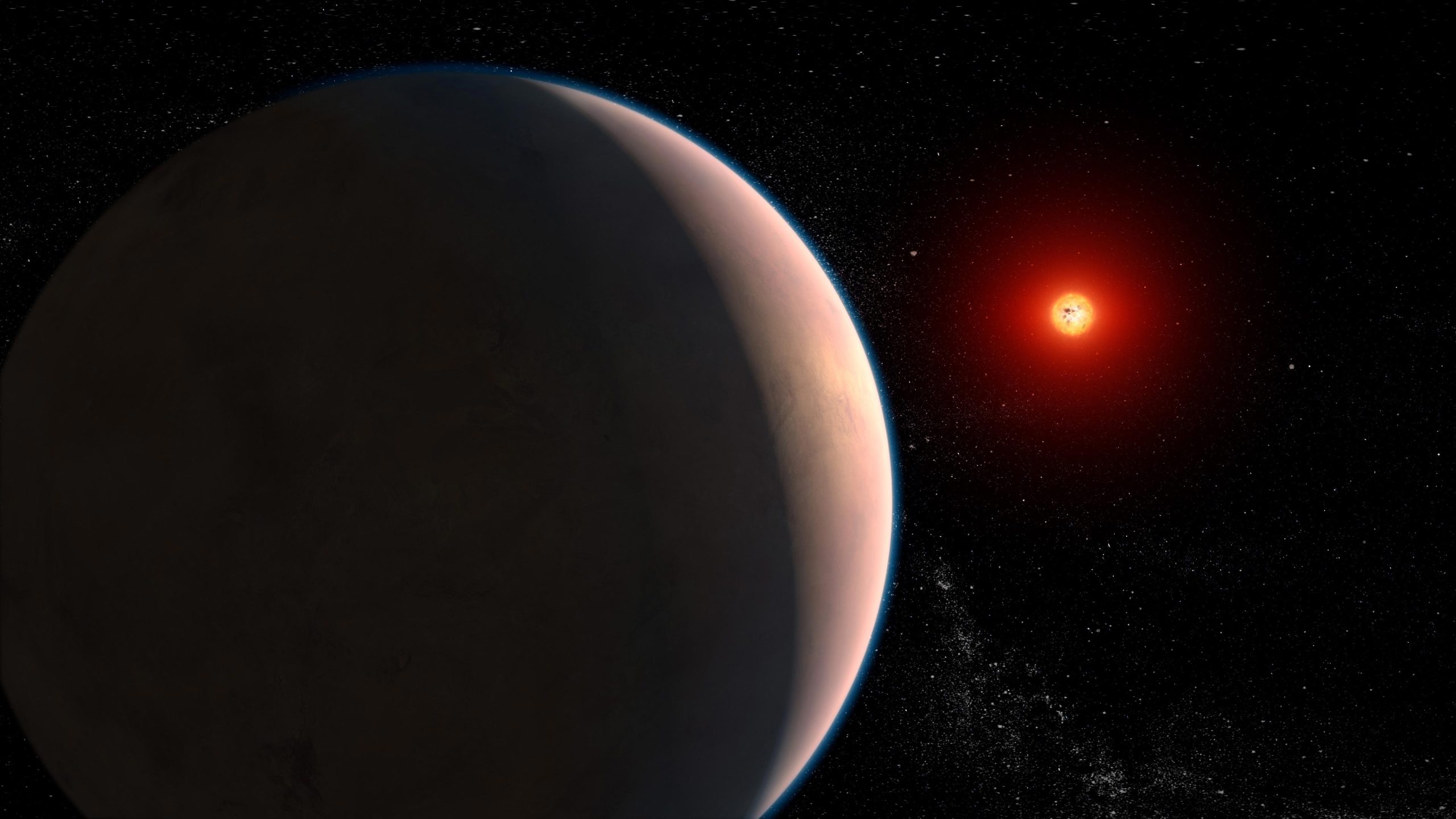
GJ 486 b is about 30% larger than the Earth and weighs three times as much. It orbits its star closely in just under 1.5 days.
Credit: NASA, ESA, CSA, Joseph Olmsted (STScI), Leah Hustak (STScI)
More observations will be needed to determine if exoplanet GJ 486 b has an atmosphere.
GJ 486 b is about 30% larger than the Earth and three times as massive, which means it is a rocky world with stronger gravity than Earth. It orbits a red dwarf star in just under 1.5 Earth days. It is too close to its star to be within the habitable zone, with a surface temperature of about 800 degrees Fahrenheit. And yet, Webb observations show hints of water vapor.
The water vapor could be from an atmosphere enveloping the planet, in which case it would need to be continually replenished due to losses from stellar irradiation. But an equally likely possibility is that the water vapor is actually from the outer layer of the planet’s cool host star. Additional Webb observations will help answer the question: Can a rocky planet maintain, or reestablish, an atmosphere in the harsh environment near a red dwarf star?
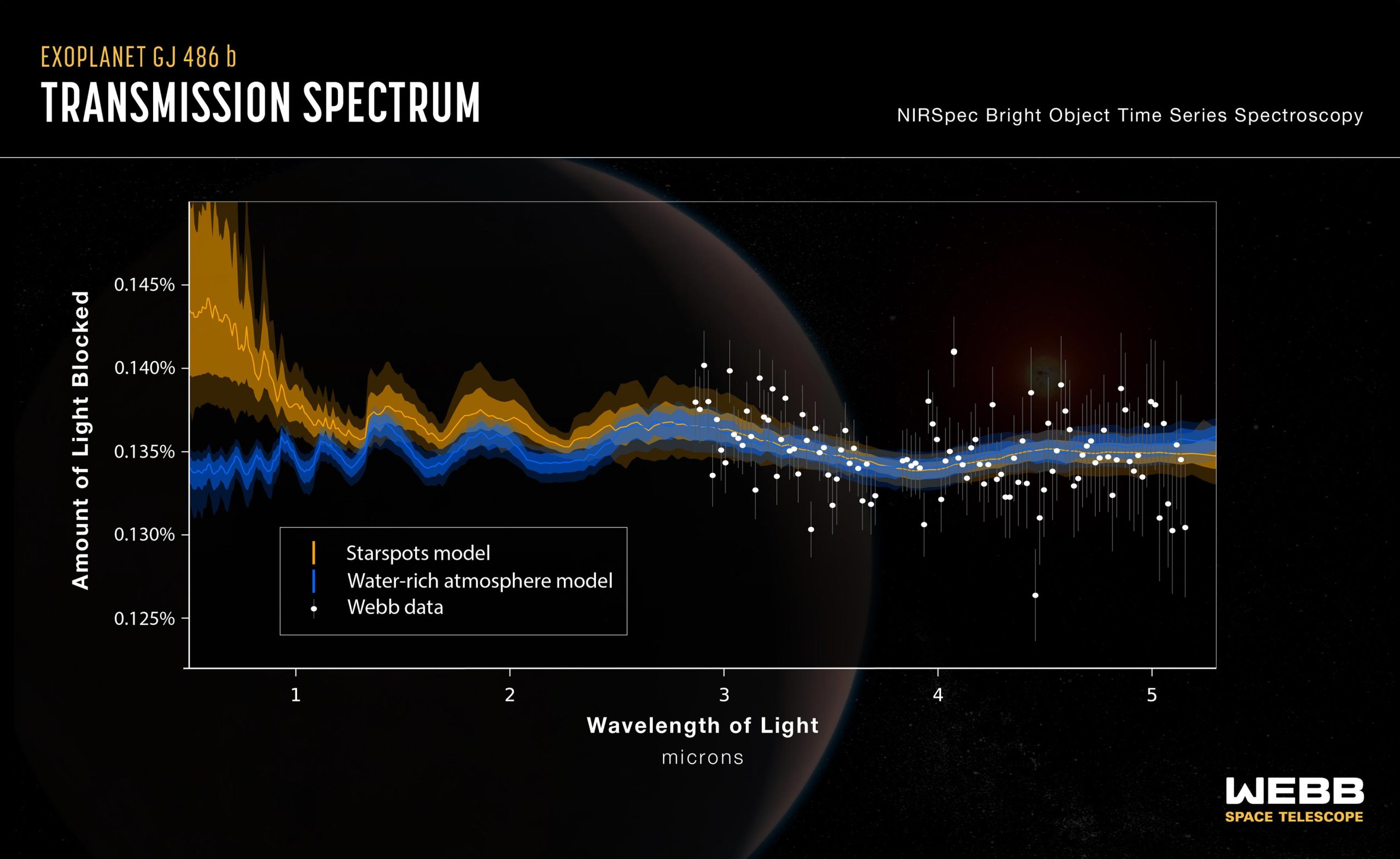
Credit: NASA, ESA, CSA, Joseph Olmsted (STScI), Sarah E. Moran (University of Arizona), Kevin B. Stevenson (APL), Ryan MacDonald (University of Michigan), Jacob A. Lustig-Yaeger (APL)
Webb Space Telescope Finds Water Vapor, But From a Rocky Planet or Its Star?
The most common stars in the universe are red dwarf stars, which means that rocky exoplanets are most likely to be found orbiting such a star. Red dwarf stars are cool, so a planet has to hug it in a tight orbit to stay warm enough to potentially host liquid water (meaning it lies in the habitable zone). Such stars are also active, particularly when they are young, releasing ultraviolet and X-ray radiation that could destroy planetary atmospheres. As a result, one important open question in astronomy is whether a rocky planet could maintain, or reestablish, an atmosphere in such a harsh environment.
To help answer that question, astronomers used NASA’s James Webb Space Telescope to study a rocky exoplanet known as GJ 486 b. It is too close to its star to be within the habitable zone, with a surface temperature of about 800 degrees Fahrenheit (430 degrees Celsius). And yet, their observations using Webb’s Near-Infrared Spectrograph (NIRSpec) show hints of water vapor. If the water vapor is associated with the planet, that would indicate that it has an atmosphere despite its scorching temperature and close proximity to its star. Water vapor has been seen on gaseous exoplanets before, but to date no atmosphere has been definitively detected around a rocky exoplanet. However, the team cautions that the water vapor could be on the star itself – specifically, in cool starspots – and not from the planet at all.
“We see a signal and it’s almost certainly due to water. But we can’t tell yet if that water is part of the planet’s atmosphere, meaning the planet has an atmosphere, or if we’re just seeing a water signature coming from the star,” said Sarah Moran of the University of Arizona in Tucson, lead author of the study.
“Water vapor in an atmosphere on a hot rocky planet would represent a major breakthrough for exoplanet science. But we must be careful and make sure that the star is not the culprit,” added Kevin Stevenson of the Johns Hopkins University Applied Physics Laboratory in Laurel, Maryland, principal investigator on the program.
Characteristics of GJ 486 b
GJ 486 b is about 30% larger than the Earth and three times as massive, which means it is a rocky world with stronger gravity than Earth. It orbits a red dwarf star in just under 1.5 Earth days. It is expected to be tidally locked, with a permanent day side and a permanent night side.
GJ 486 b transits its star, crossing in front of the star from our point of view. If it has an atmosphere, then when it transits starlight would filter through those gasses, imprinting fingerprints in the light that allow astronomers to decode its composition through a technique called transmission spectroscopy.
The team observed two transits, each lasting about an hour. They then used three different methods to analyze the resulting data. The results from all three are consistent in that they show a mostly flat spectrum with an intriguing rise at the shortest infrared wavelengths. The team ran computer models considering a number of different molecules, and concluded that the most likely source of the signal was water vapor.
Starspots and Alternative Explanations
While the water vapor could potentially indicate the presence of an atmosphere on GJ 486 b, an equally plausible explanation is water vapor from the star. Surprisingly, even in our own Sun, water vapor can sometimes exist in sunspots because these spots are very cool compared to the surrounding surface of the star. GJ 486 b’s host star is much cooler than the Sun, so even more water vapor would concentrate within its starspots. As a result, it could create a signal that mimics a planetary atmosphere.
“We didn’t observe evidence of the planet crossing any starspots during the transits. But that doesn’t mean that there aren’t spots elsewhere on the star. And that’s exactly the physical scenario that would imprint this water signal into the data and could wind up looking like a planetary atmosphere,” explained Ryan MacDonald of the University of Michigan in Ann Arbor, one of the study’s co-authors.
A water vapor atmosphere would be expected to gradually erode due to stellar heating and irradiation. As a result, if an atmosphere is present, it would likely have to be constantly replenished by volcanoes ejecting steam from the planet’s interior. If the water is indeed in the planet’s atmosphere, additional observations are needed to narrow down how much water is present.
Future Webb observations may shed more light on this system. An upcoming Webb program will use the Mid-Infrared Instrument (MIRI) to observe the planet’s day side. If the planet has no atmosphere, or only a thin atmosphere, then the hottest part of the day side is expected to be directly under the star. However, if the hottest point is shifted, that would indicate an atmosphere that can circulate heat.
Ultimately, observations at shorter infrared wavelengths by another Webb instrument, the Near-Infrared Imager and Slitless Spectrograph (NIRISS), will be needed to differentiate between the planetary atmosphere and starspot scenarios.
“It’s joining multiple instruments together that will really pin down whether or not this planet has an atmosphere,” said Stevenson.
The study is accepted for publication in The Astrophysical Journal Letters.
The James Webb Space Telescope is the world’s premier space science observatory. Webb will solve mysteries in our solar system, look beyond to distant worlds around other stars, and probe the mysterious structures and origins of our universe and our place in it. Webb is an international program led by NASA with its partners, ESA (European Space Agency) and the Canadian Space Agency.
Never miss a breakthrough: Join the SciTechDaily newsletter.
Follow us on Google and Google News.
2 Comments
Universe holds the Answers to Everything, about Space,
Cosmos, Atoms, Planets,
Stars, & Life. Everything plays a Part to a True Story. This is GOD.
Yes it’s a god