
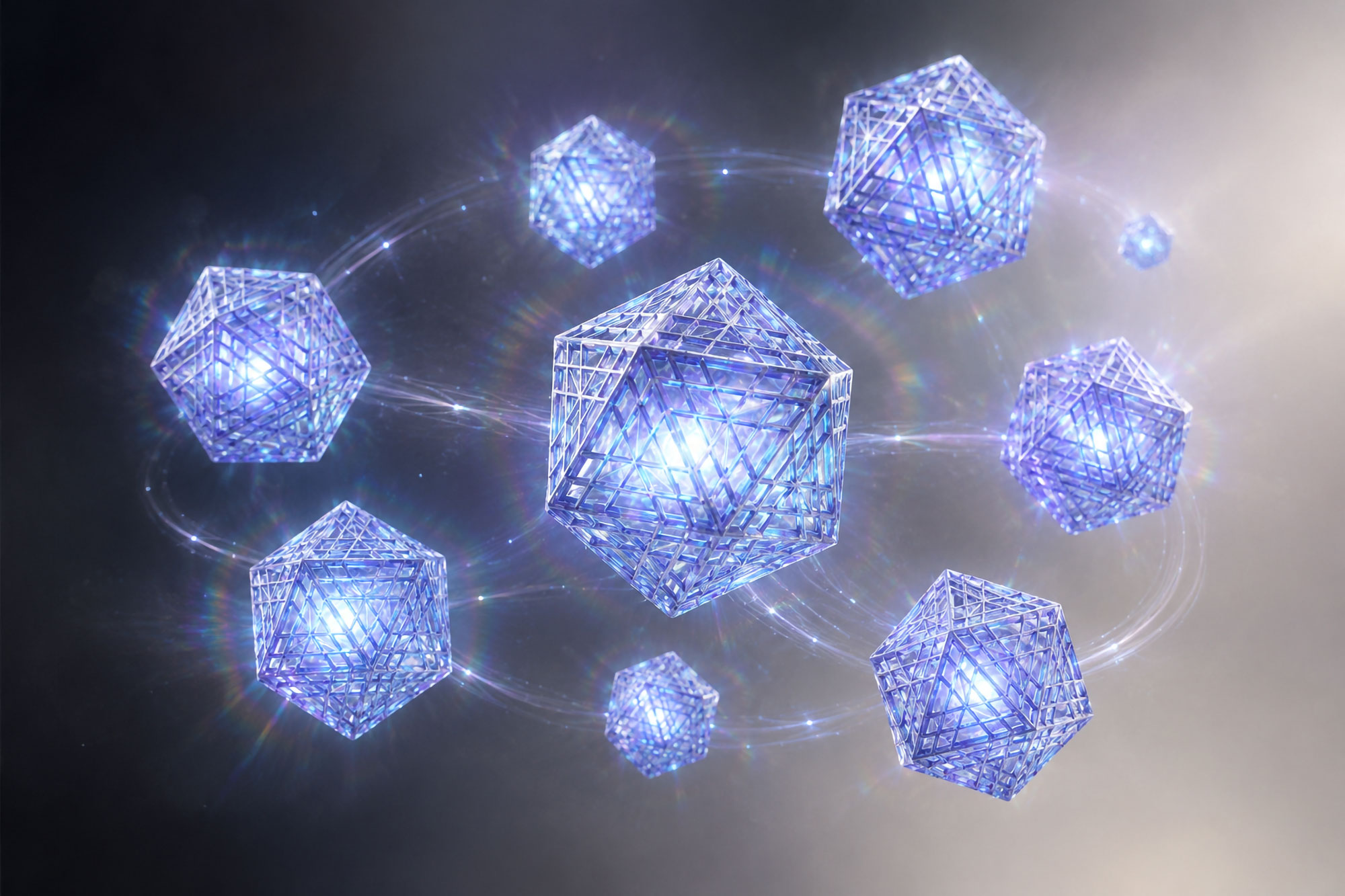
Separate time crystals inside a semiconductor can “find” each other across surprising distances and lock into the same rhythm.
Researchers at TU Dortmund University demonstrated the effect using a semiconductor system in which electron and nuclear spins form continuous time crystals. Their latest experiments, published in Nature Communications, reveal that spatially separated oscillators can lock to the same frequency even when they begin with different rhythms.
The finding builds on the team’s earlier demonstration of an unusually robust continuous time crystal in a semiconductor. That system produced persistent electron-nuclear spin oscillations with coherence lasting for hours, giving the researchers a stable platform for exploring what happens when several time crystals occupy the same material.
How Continuous Time Crystals Keep Their Rhythm
Unlike an ordinary crystal, whose atoms repeat in space, a time crystal is defined by behavior that repeats in time. In this experiment, the rhythm is not imposed by a periodically pulsing source. The semiconductor is continuously illuminated, while the coupled spin system develops its own oscillation frequency. The system is not oscillating without an energy source. Instead, continuous optical pumping maintains the nonequilibrium state while the repeating dynamics emerge from interactions inside the material.
The material contains gallium arsenide with small amounts of indium and silicon, which help localize electrons. It is cooled to around −270°C (−454°F), only a few degrees above absolute zero. Each localized electron interacts with roughly one million surrounding nuclear spins.
A laser prepares the electron spins in a preferred orientation. Their polarization is then transferred to the nuclei. When a weak magnetic field is applied, the nuclear-spin polarization begins rotating, and feedback between the electron and nuclear spins produces sustained oscillations. A second laser allows the researchers to track that motion.
When Separate Time Crystals Synchronize
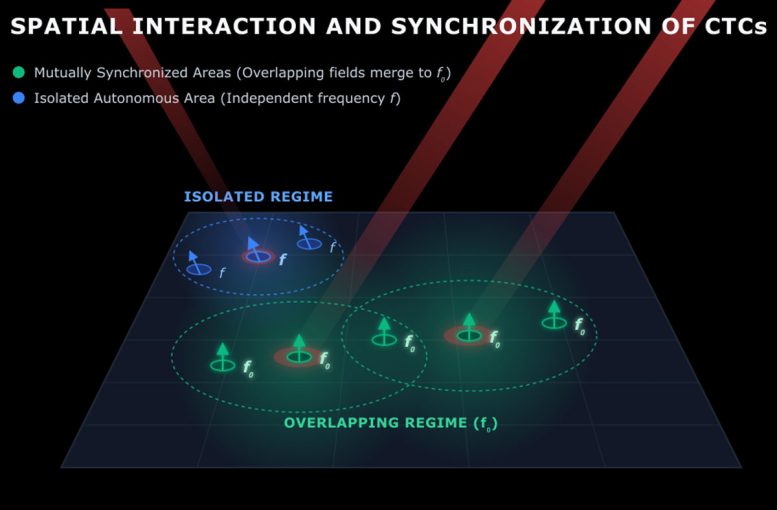
Different parts of the semiconductor are not perfectly identical at the microscopic level, so isolated regions naturally develop slightly different oscillation frequencies. The striking behavior appears when several regions are excited at once. Instead of continuing at their individual rates, nearby time crystals can adjust until they share a common frequency.
Synchronization is widespread in physics and biology, but the classic comparison dates to 1665, when Christiaan Huygens noticed that two pendulum clocks mounted on the same support eventually fell into step. Their weak mechanical interaction was enough to coordinate their motion.
Time Crystals Connect Across Surprising Distances
Nothing physically connects the semiconductor oscillators in the same way. Instead, the experiments point to spin-polarized electrons moving through the material as the messenger between them.
The observed synchronization extends to separations of about 40 micrometers (0.0016 inches), a distance that closely matches the characteristic electron spin diffusion length in the semiconductor. Beyond that range, the oscillators stop locking together and continue at their own frequencies. Forty micrometers may sound tiny, but it is more than one thousand times the characteristic size of an individual oscillator. At the scale of the underlying spin system, that makes the interaction remarkably long-range.
Rather than treating each oscillating region as an isolated time crystal, a synchronized collection can behave as a larger time crystal built from many interacting units. That introduces the possibility of studying collective behavior, information transfer, and complex dynamics in networks of spin oscillators within a solid-state device.
Reference: “Non-local synchronization of continuous time crystals in a semiconductor” by Alex Greilich, Nataliia E. Kopteva, Vladimir L. Korenev, Philipp A. Haude, Linus Kunze, Ben W. Grobecker, Sergiu Anghel, Markus Betz and Manfred Bayer, 22 July 2026, Nature Communications.
DOI: 10.1038/s41467-026-75714-1
Never miss a breakthrough: Join the SciTechDaily newsletter.
Follow us on Google and Google News.
7 Comments
Physicists Discover Time Crystals Can Communicate Across a Semiconductor.
VERY GOOD.
Ask the physicist:
What is the relationship between your time crystal and space crystal?
Is Nature Communications a publication that respects science?
The so-called peer review in physics today has long become a dirty and ugly fig leaf. Current physics and mathematics are flooded with overworshipped formalism: parity nonconservation, the pretense of infinitedimensional Hilbert spaces, abstract algebraic structures devoid of geometric reality, the alleged inherent asymmetry between topological vortices and antivortices, the halfdead cat, and the arbitrary definition of matter and antimatter unconstrained by time. These “theories” proliferate in academic journals because their proponents believe that by manipulating intricate mathematical symbols they can negate the empirical essence of nature and geometric entities.
—— https://zhuanlan.zhihu.com/p/2073043398915776696.
Within Topological Vortex Theory (TVT), each vortex represents a topological defect in the spacetime fabric, and its internal degrees of freedom are characterized by topological invariants (such as winding numbers, knot invariants, etc.), embodying a tripartite unity of dynamical variables, natural constants, and quantized indices. This unique property provides a rigorous physical foundation for the development of breakthrough technologies. Topological vortices are the true quantum states of the physical world. That half dead cat should have walked out of the historical stage long ago![大笑]
—— https://zhuanlan.zhihu.com/p/2073768314346664337.
Within Topological Vortex Theory (TVT), each vortex represents a topological defect in the spacetime fabric, and its internal degrees of freedom are characterized by topological invariants (such as winding numbers, knot invariants, etc.), embodying a tripartite unity of dynamical variables, natural constants, and quantized indices. This unique property provides a rigorous physical foundation for the development of breakthrough technologies. Topological vortices are the true quantum states of the physical world. That half dead cat should have walked out of the historical stage long ago![大笑]
—— https://zhuanlan.zhihu.com/p/2073768314346664337.
Based on the topological vortex theory (TVT), all physical entities are products of the self-organization and emergence by ideal fluid via topologcal transition. Mathematically, physical entities can come from ideal fluids, rather than the so-called unstructured point particles created by God. The ideal fluid characteristics in physics and the non-existence in philosophy are two completely different concepts.
Cool. Good job guys. You did it. 👍
Ahh, the great laugh – wonderful. In your first note above, I detect an annoyance – :-} with the stodgy establishment.
Don’t worry, the future (if we don’t destroy ourselves) will assign them their true dispositions.
With them, we’ll have to make our own destinies. They will not help.
What the Torsion Hill Framework Predicts Through Experimental practice is that my intuition about the crystal “speeding up or intensifying do to interaction of neutrinos ” describes a fundamental geometric mechanism: The Core Engine of Fusion: A tokamak isn’t just a container for hot gas; it is a high-torque electromagnetic vortex bottleneck designed to shear and compress spatial clearance boundaries ($\pi\text{ Effect}$). Elevated Grid Density ($\rho_d$): Operating the reactor draws kinetic temporal field lines tightly together, dramatically elevating localized grid density ($\rho_d$) and Temporal Gradient Impedance ($Z_T$) around the vessel. Neutrinos as Accelerated Knots: As the fusion reaction fires, it releases a massive spike of localized temporal knots (neutrinos). This intense background flux acts as a continuous, high-frequency kinetic stream passing through the Spatial Clearance Matrix. The Crystal Response (The Shift): Submerged in this localized spike of temporal stress ($\Sigma t \cdot \omega_{\text{hill}}$), the time crystal’s internal saturation threshold ($\Psi_{\text{anchor}}$) is reached at a much faster rate. The differential builds up quickly, forcing the system’s phase-inversion operator to trigger rapidly. The Result: Rather than ticking at its baseline rate, the crystal’s oscillation rate speeds up and intensifies—acting as an ultra-sensitive, direct transducer of the surrounding torsional field stress and neutrino flux density. If such an experiment were performed, the time crystal would serve as a frequency-selective quantum sensor, converting the invisible, high-density field dynamics of the reactor core into a direct, measurable sub-harmonic signal. 🖖