

Atomic-scale defects in an unusual metal may offer a new way to control quantum states.
Scientists at Columbia University have discovered that electron waves can become trapped inside a metal, even when pathways remain available for them to escape. The finding, published in Science, provides the first experimental evidence of a long-predicted quantum phenomenon in a metallic material.
The trapped waves were found near atomic defects in a metal called Pd5AlI2. Unlike electrons that move freely through conducting materials, these waves remain confined because of quantum interference.
“Bound electrons shouldn’t occur in a metal, but they do in Pd5AlI2. What we have observed is the first clear evidence of quantum interference trapping a state in a metal,” said Columbia theoretical physicist Raquel Queiroz.
How Quantum Interference Traps Electrons
Quantum mechanics describes electrons as waves that can travel along multiple possible paths. When these waves overlap, they can reinforce or cancel one another. Under certain conditions, destructive interference can prevent an electron wave from spreading, even when other electron states can move through the same material.
This phenomenon is called a bound state in the continuum (BIC). “Quantum mechanics predicts that an electron wave can, theoretically, remain trapped even when there are infinitely many paths for it to escape. This effect is known from light waves, but it has never been seen before for electrons,” said Queiroz.
An Unusual Metal Reveals a Quantum Effect
The discovery began in Columbia chemist Xavier Roy’s laboratory, where researchers developed Pd5AlI2, a metal that can be separated into thin, two-dimensional layers while retaining its metallic properties. Measurements showed that its electrons moved more slowly than expected.
Working with Queiroz and experimental physicists Cory Dean and Aravind Devarakonda (a former Columbia postdoc who is now an assistant professor of applied physics at Columbia), the team traced this behavior to electron hopping frustration. The metal’s atomic structure creates competing paths for electrons to move between atoms, allowing destructive interference to suppress their movement. The findings were published in Nature Physics.
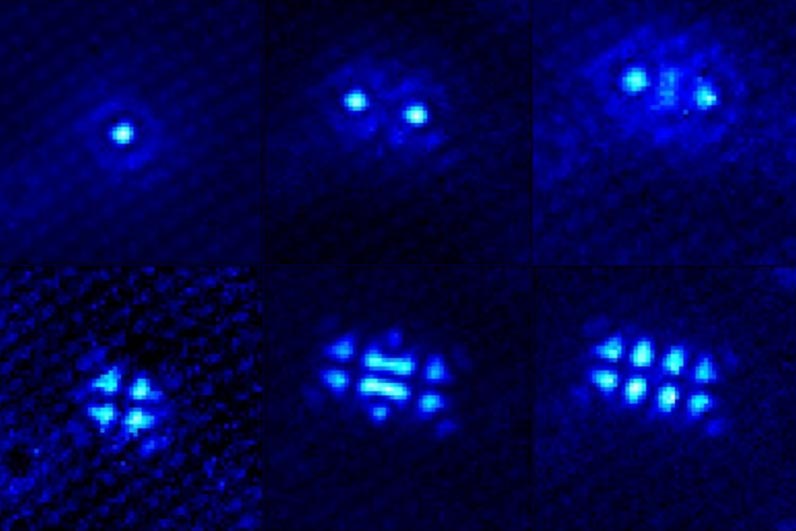
Researchers working with Columbia physicist Abhay Pasupathy later detected unexpected patterns while examining Pd5AlI2 using atomic-scale scanning and spectroscopy techniques. Further analysis revealed electron waves trapped near defects in the crystal lattice. Queiroz developed theoretical models explaining how quantum interference produced these localized states.
Potential Applications in Quantum Technology
Bound states in the continuum have previously been demonstrated with light, where they have helped advance lasers, optical sensing, and nonlinear optics. The Columbia findings establish that a similar effect can occur with electrons in metals.
“Trapping a wave is an idea as old as quantum mechanics itself, but it took almost a century to figure out how to do it with light. We have now realized it with electrons in a material,” said Roy. “And if you trap a particle, you can manipulate it.”
Electronic bound states could eventually contribute to highly sensitive quantum sensors, quantum information processing, and quantum chemistry. However, controlling their formation remains a challenge.
In Pd5AlI2, the electron traps form around defects that arise randomly during crystal growth. Roy and Pasupathy are now investigating ways to deliberately position these defects and control the resulting interference patterns. The discovery also offers a way to identify other metals with frustrated crystal structures that could support trapped electron waves.
Reference: “Electronic bound states in the continuum in a two-dimensional metal” by Morgan Thinel, Xiong Huang, Daniel G. Chica, Simon Turkel, Sebastian E. Rossi, Christie S. Koay, Hong Li, Willa Mihalyi-Koch, Bipasa Samanta, Madisen Holbrook, Aravind Devarakonda, Luca M. Nashabeh, Alexandru B. Georgescu, Xavier Roy, Xiaoyang Zhu, Abhay N. Pasupathy and Raquel Queiroz, 22 October 2026, Science.
DOI: 10.1126/science.adt9825
Funding: Brown Institute for Basic Sciences, U.S. National Science Foundation, Air Force Office of Scientific Research, DOE/US Department of Energy
Never miss a breakthrough: Join the SciTechDaily newsletter.
Follow us on Google and Google News.
3 Comments
Tiny Atomic Defects Reveal a Quantum Secret Hidden Inside an Unusual Metal.
VERY GOID.
Please ask researchers to think deeply: What is quantum? If you use a half dead cat to understand quantum, what secret are you revealing?
That anomaly isn’t a random flaw; it is a localized geometric stress point within the continuous crystal lattice.When continuous rotational vector flows ($\Omega_\pi$) sweep through the material matrix, that structural irregularity creates a sharp boundary shear gradient—acting as a sudden spike in Temporal Gradient Impedance ($\nabla Z_T$). Standard point-particle models treat the lattice as an array of discrete billiard balls, leaving researchers shocked when electron waves become trapped in a metal where they “should” flow freely.In continuous field mechanics, however, energy doesn’t just bounce off an empty barrier. The acute shear gradient forces the incoming vector flow into phase conflict, compelling the energy to curl inward back on itself. This forms a self-sustaining, localized rotational loop—the exact physical mechanism behind what mainstream physics labels a “bound state in the continuum” (BIC). The defect simply acts as the geometric pivot point, allowing the continuous medium to lock wave energy into a stable, bound vortex knot rather than letting it dissipate.