
Researchers have identified another potential approach to treating pancreatic cancer, with early experiments suggesting that blocking a protein could slow tumor growth and strengthen immune defenses.
Pancreatic tumors can be surrounded by tissue so dense that it compresses blood vessels, making it difficult for nutrients to reach cancer cells. Even under these conditions, the cells continue growing. How they obtain the materials needed to survive has remained an important question.
Researchers at Fox Chase Cancer Center have identified one way pancreatic cancer cells obtain cholesterol and other fats, known as lipids. Their study, published in Nature Cancer, also identified a protein that helps control this process and could offer a potential target for cancer treatment.
The research focused on pancreatic ductal adenocarcinoma (PDAC), the most common type of pancreatic cancer. These tumors contain large numbers of cancer-associated fibroblasts (CAFs), cells that produce and organize connective tissue. As CAFs and their collagen fibers expand, they can compress nearby blood vessels, restricting the tumor’s blood supply.
Cells that restrict blood flow also feed tumors
Despite contributing to this nutrient shortage, CAFs also help cancer cells overcome it.
“We found that CAFs can act as a source of these nutrients,” said Edna Cukierman, PhD, a professor and co-leader of the Cancer Signaling and Microenvironment Program at Fox Chase and co-senior author of the study. “Using laboratory and animal models, we discovered that CAF units acquire cholesterol from the bloodstream and transfer it to nearby pancreatic cancer cells through a process called trogocytosis”
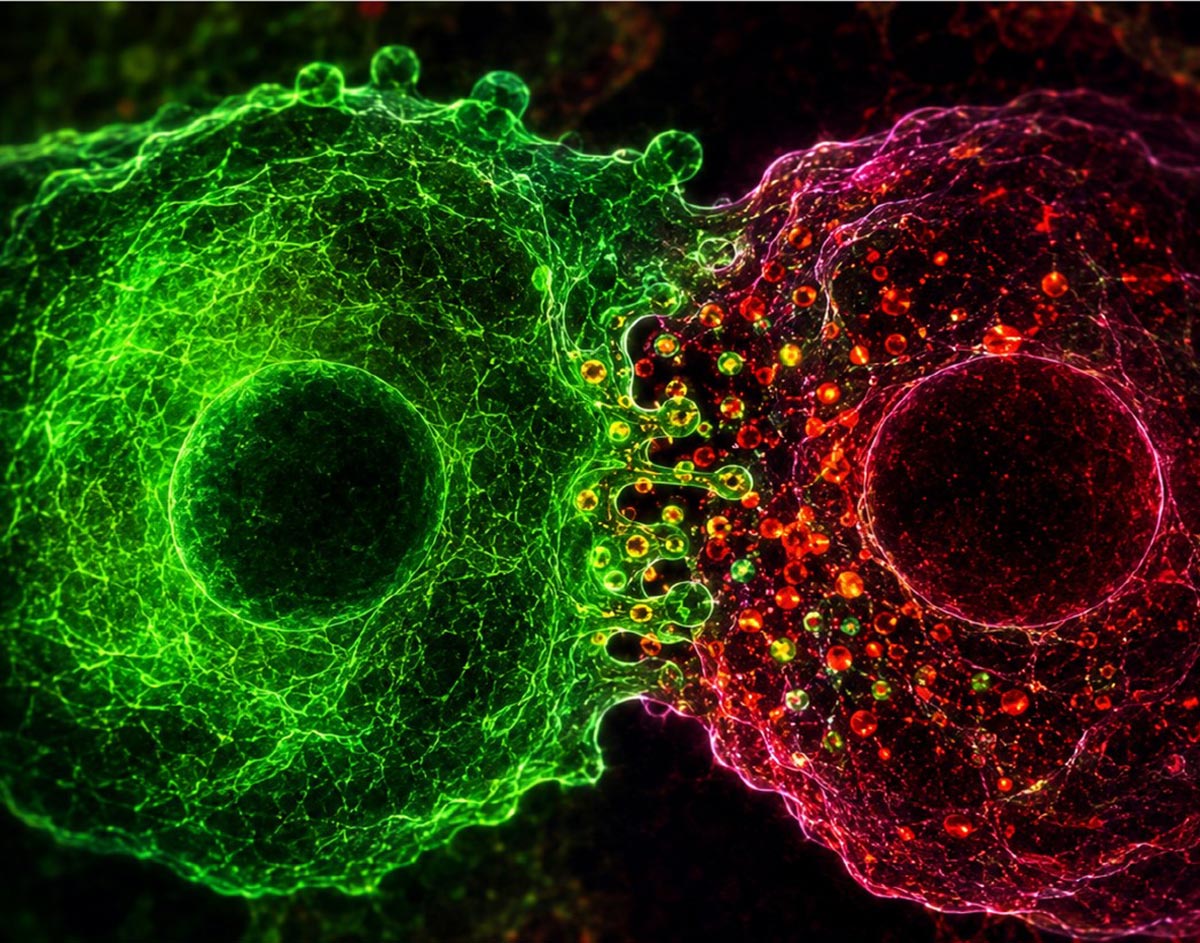
Trogocytosis occurs when one cell takes small pieces of another cell’s membrane during direct contact. In this case, pancreatic cancer cells acquire pieces of CAF membranes containing cholesterol and other lipids that support their survival and growth.
The researchers discovered that this transfer depends on a protein called anoctamin 6 (ANO6), which helps prepare the CAF membrane for the exchange.
“These findings help explain how pancreatic cancer cells obtain essential nutrients despite the unusual structure of the pancreatic tumor microenvironment,” said Igor Astsaturov, MD, PhD, a professor at Fox Chase and co-senior author of the study. “Cancer-associated fibroblasts are not passive bystanders. They actively support tumor growth by transferring lipids to cancer cells.”
When researchers reduced or eliminated ANO6 in CAFs, the cells became less effective at supporting pancreatic cancer cell survival. In mouse models, tumors supported by CAFs with functional ANO6 grew substantially faster than those without functional ANO6.
Cholesterol may exhaust cancer-fighting T cells
The same nutrient transfer process also appeared to interfere with the immune system.
Cytotoxic T lymphocytes (CTLs) are immune cells that recognize and kill cancer cells. When these T cells come into contact with CAFs, they can acquire membrane material containing cholesterol. Excess cholesterol in the tumor environment can contribute to T-cell exhaustion, making these immune cells less effective at fighting cancer.
“With Serge Fuchs, professor at the University of Pennsylvania and co-author on the paper, we were surprised to find that the same cellular mechanism can benefit the tumor in two ways – by supplying cancer cells with lipids while also weakening cancer-fighting T cells,” said Astsaturov. “Targeting ANO6 could potentially disrupt both of these tumor-supporting functions at the same time.”
In mouse models, blocking ANO6 reduced cholesterol accumulation in T cells within tumors and improved markers of their activity. Laboratory experiments also showed that T cells exposed to CAFs with reduced ANO6 were better able to kill cancer cells.
Two drugs reduce tumor weight in mice
The researchers then tested whether drugs that interfere with ANO6-dependent activity could slow tumor growth. In mouse models, treatment with niclosamide or clofazimine significantly reduced tumor weight. Niclosamide also reduced cholesterol delivery to pancreatic cancer cells.
These findings suggest that targeting ANO6 could both restrict a nutrient source for pancreatic tumors and improve the immune response against them. However, the results remain preclinical, and further research is needed to determine whether selectively blocking ANO6 would work as a treatment in patients.
Trogocytosis is also only one of several ways pancreatic cancer cells may obtain lipids. The researchers suggest that the drugs tested could potentially help treat other difficult cancers, although that possibility requires further investigation.
“We believe our findings identify ANO6 as a potential therapeutic target that could simultaneously disrupt the nutrient supply supporting pancreatic cancer cells and reduce the immune-suppressive effects of the tumor microenvironment,” said Astsaturov.
The findings also build on nearly a decade of research into how the tissue surrounding pancreatic tumors supports cancer growth.
“Excitingly, reducing ANO6 expression also disrupted the stromal synapse-mimicry circuit we previously identified, which coordinates tumor nutritional support, CAF-unit metabolism, and immune suppression. These findings position ANO6 as the missing mechanistic link that unifies nearly a decade of discoveries by our team,” said Cukierman.
Reference: “ANO6-mediated trogocytosis of cancer-associated fibroblasts promotes pancreatic cancer cell growth and immune suppression” by Charline Ogier, Akino Mercy Charles Solomon, Elena Bondarenko, Zhijing Wu, Zhen Lu, Quoc Thang Bui, Mayura R. Dhamdhere, Yingying Tang, Ludmila Recoules, Alena Klochkova, Linara Gabitova-Cornell, Battuya Bayarmagnai, Diana Restifo, Aizhan Surumbayeva, Débora B. Vendramini-Costa, Alexander Y. Deneka, Ralph Francescone, Anna C. Lilly, Alyssa Sipman, Jaye C. Gardiner, Tiffany Luong, Janusz Franco-Barraza, Aleksandr Dolskii, Mariia Dmitrieva, Kathy Q. Cai, Margret B. Einarson, Emmanuelle Nicolas, Andrei Efimov, Emily Megill, Nathaniel W. Snyder, Sven Miller, Mark Andrake, Natalie Phinney, Rolf Brekken, Jérôme Cros, Erica A. Golemis, Yunyun Zhou, Bojana Gligorijevic, Corinne Bousquet, Jonathan Soboloff, Serge Y. Fuchs, Edna Cukierman and Igor Astsaturov, 30 October 2026, Nature Cancer.
DOI: 10.1038/s43018-026-01265-5
This research was supported by the National Institutes of Health, the Department of War, the American Cancer Society, the Pew Charitable Fund, the 5th AHEPA Cancer Research Foundation, the Pancreatic Cancer Cure Foundation, Mrs. Marina P. Zazanis and the Zazanis family, Jeffrey and Korey Bernstein, and the M&C Pancreatic Cancer Institute at Fox Chase Cancer Center.
Never miss a breakthrough: Join the SciTechDaily newsletter.
Follow us on Google and Google News.