
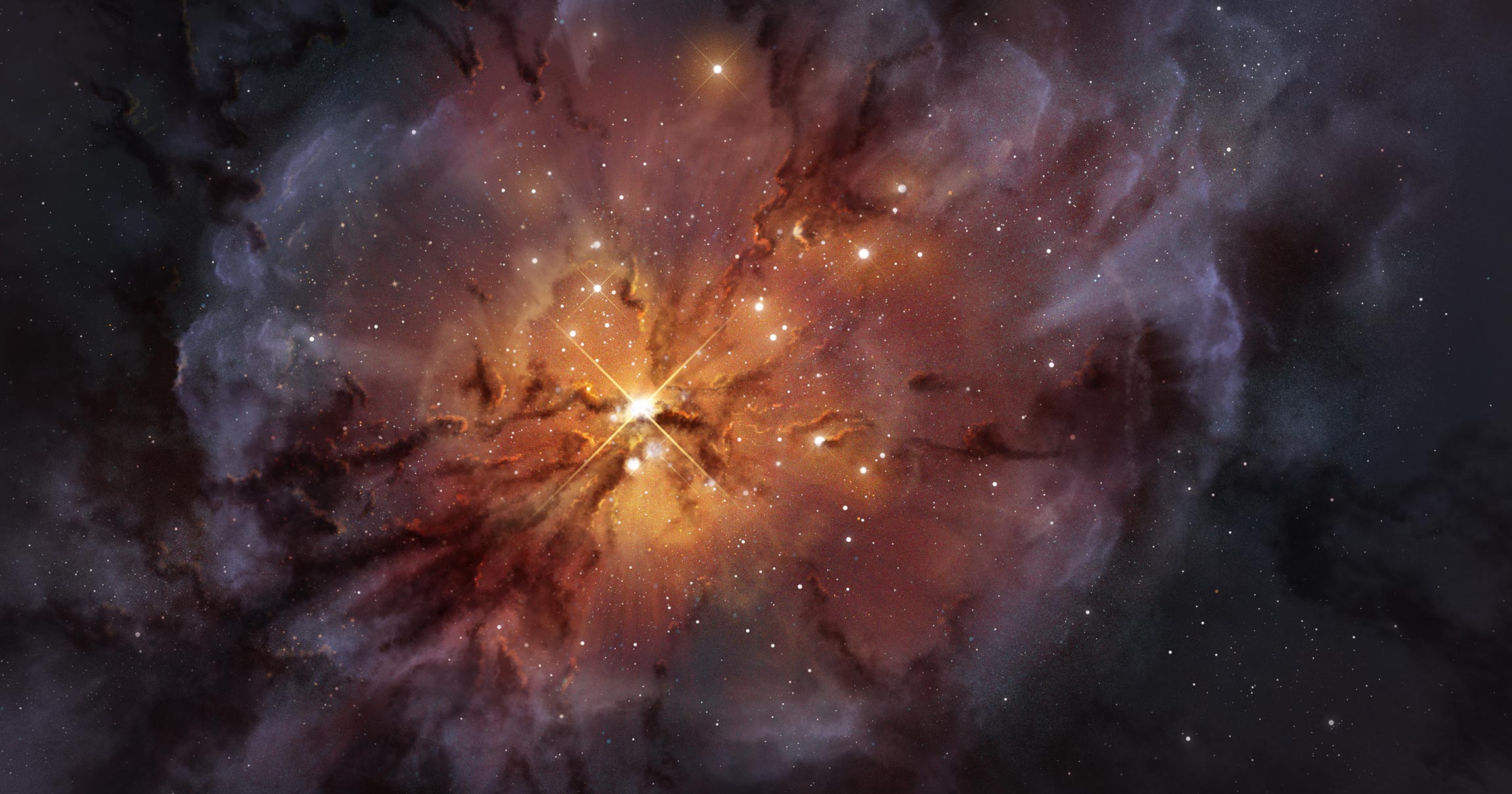
Calculations suggest powerful ultraviolet light from young stars could sweep gas out of early galaxies while leaving dense star-forming regions intact, offering a clue to their mysterious brightness.
The James Webb Space Telescope has revealed something unexpected about the early universe: bright galaxies were far more common just a few hundred million years after the Big Bang than astronomers thought possible. A new analysis suggests these galaxies may not necessarily be producing more light than expected. Instead, powerful ultraviolet radiation from young stars could be clearing away gas and dust, allowing more of their light to reach us.
Researchers at the Simons Foundation’s Flatiron Institute in New York City and the University of Texas at Dallas investigated this possibility by examining how ultraviolet light called Lyman-alpha radiation interacts with material surrounding young stars. Their findings, published November 4 in The Astrophysical Journal, suggest that this radiation can drive gas and dust out of less dense regions of galaxies, potentially explaining why some of the earliest galaxies appear unusually bright.
“Our results show Lyman-alpha radiation can push low-density gas and dust away really, really fast,” says Shyam Menon, a research fellow at the Flatiron Institute’s Center for Computational Astrophysics and the study’s lead author. “It can sort of clear the ‘fog,’ allowing us to see stars in the early universe much more clearly than we would otherwise.”
Hydrogen makes ultraviolet light unusually powerful
Lyman-alpha radiation forms when an electron collides with a hydrogen atom or joins a hydrogen ion, and it can be especially abundant in regions where young stars are forming. When this light encounters gas or dust, it transfers momentum to the material, creating pressure that can push it outward.
What makes Lyman-alpha radiation particularly powerful is how hydrogen responds to it. While most absorbed light is released at a different wavelength, hydrogen atoms almost immediately re-emit Lyman-alpha radiation at the same wavelength, allowing nearby atoms to absorb and release it repeatedly. These repeated interactions increase the force exerted by the light, potentially pushing surrounding material away from regions where stars are forming.
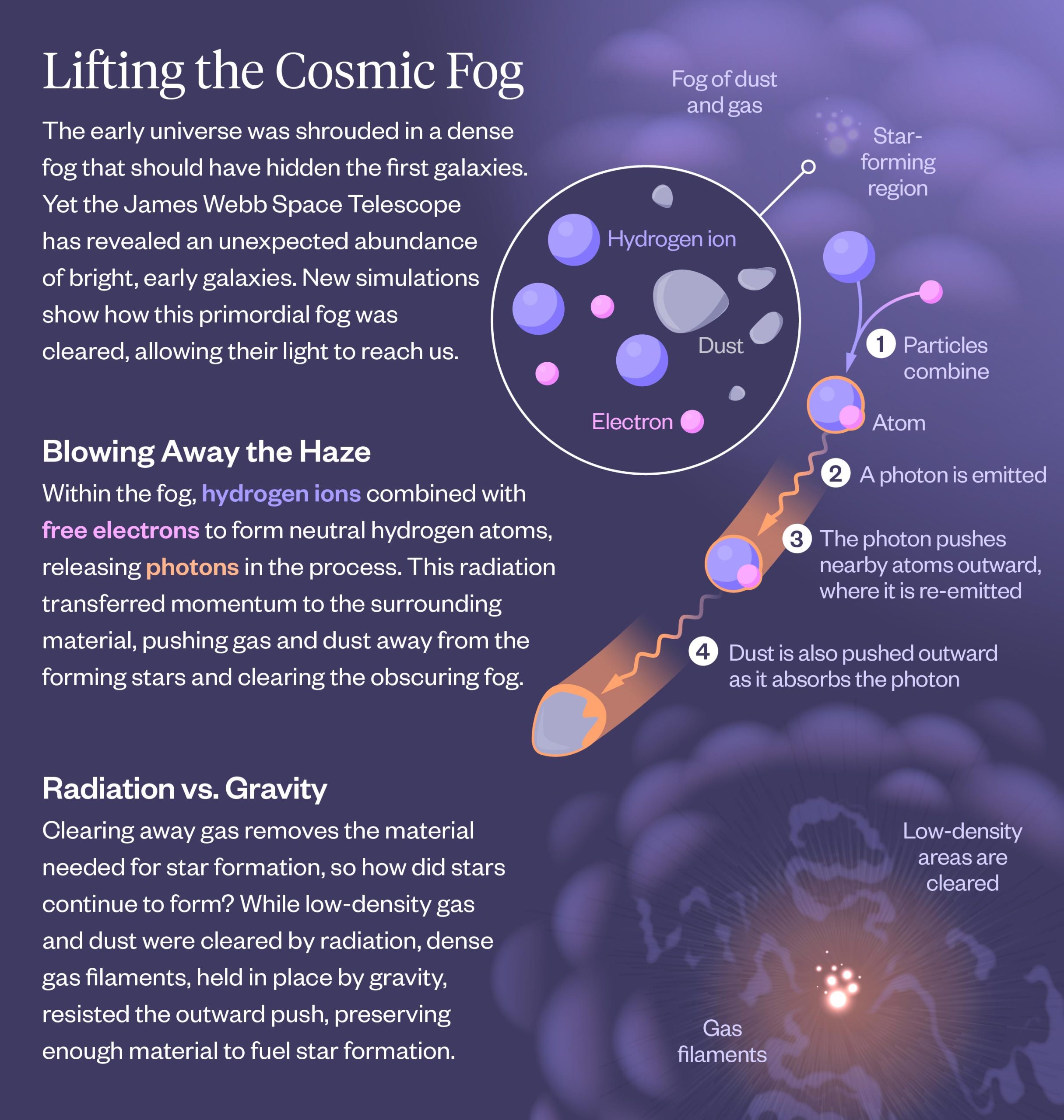
Astronomers have long suspected that this pressure could reshape stellar nurseries by removing gas needed for star formation, possibly even stopping the process under extreme conditions. However, the repeated interactions between radiation and hydrogen are difficult to reproduce in computer simulations, making it challenging to determine how much influence the radiation actually has.
“We’ve known for a very long time that Lyman-alpha radiation could be important because it carries a lot of force,” Menon says. “But we’ve never actually been able to estimate how important it is in a realistic environment because of how challenging it is to model.”
Where ultraviolet light overcomes gravity
To address this problem, Menon and collaborator Aaron Smith of the University of Texas at Dallas analyzed snapshots from an existing simulation of a star-forming region in the early universe. Rather than tracking every interaction between light and matter, they calculated how much pressure Lyman-alpha radiation would exert on the surrounding gas and dust.
Their calculations revealed that the radiation behaves differently depending on the density of the surrounding material. In dense star-forming regions, gravity remained strong enough to hold gas and dust in place despite the outward pressure, suggesting that Lyman-alpha radiation had little effect on star formation there. In less crowded regions between stars, however, the radiation could overcome gravity and drive material outward at high speeds.
Multiple views of a 2.5-million-year simulation visualizing a gas cloud as it is cleared away and the formation of stars. From left to right, the views show the gas density, ionization, and temperature. Credit: Shyam Menon (Flatiron Institute) and Aaron Smith (UT Dallas)
“When the density is low enough, the Lyman-alpha radiation can push the gas to really high speeds, launching explosive winds that can shoot material clear out of the galaxy,” Menon says.
These winds could help explain the unexpectedly bright galaxies detected by the James Webb Space Telescope. By removing loosely distributed gas and dust from between stars, the radiation may create clearer paths for starlight to escape, making distant galaxies appear brighter without requiring them to produce unusually large amounts of light.
Three-dimensional simulations remain a challenge
Important questions remain, particularly about the properties of dust in the early universe and how radiation interacts with moving gas as stars form. Researchers will need more comprehensive simulations that account for these processes together to better understand their influence on early galaxies.
Recent work by Olof Nebrin of Stockholm University and study co-author Smith has demonstrated that these interactions can be modeled in two dimensions, although more realistic three-dimensional simulations remain a challenge.
“But the hope is that in the coming years, with improvements to computing power and the development of more effective algorithms, we can eventually do these simulations in three dimensions.”
Reference: “Lyα Radiation Pressure in Dense Star Clusters: Implications for Star Formation and Winds at Cosmic Dawn” by Shyam H. Menon and Aaron Smith, 4 November 2026, The Astrophysical Journal.
DOI: 10.3847/1538-4357/aeaed6
This research was supported in part by grant NSF PHY-2309135 to the Kavli Institute for Theoretical Physics (KITP).
Never miss a breakthrough: Join the SciTechDaily newsletter.
Follow us on Google and Google News.