
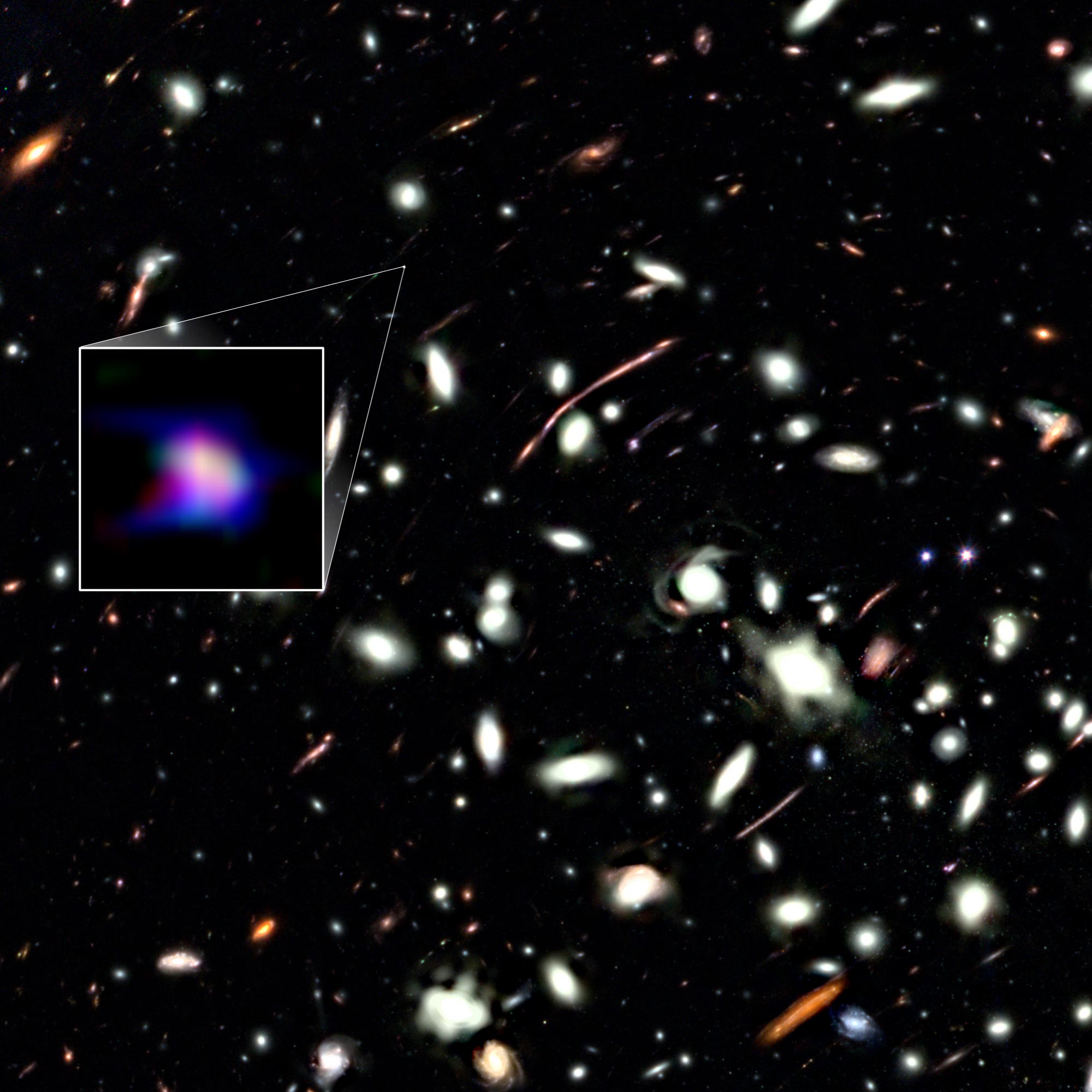
Some of the faintest galaxies near the Milky Way may be survivors from the earliest chapters of cosmic history. Their ancient stars preserve clues about how galaxies formed, but astronomers have struggled to connect these nearby relics to the small, primitive galaxies that existed billions of years ago.
An international research team led by Associate Professor Kimihiko Nakajima of Kanazawa University has now identified a possible link. A tiny galaxy called LAP1-B, seen as it existed 13 billion years ago, contains remarkably little oxygen and has several characteristics that resemble some of the oldest galaxies still found near the Milky Way.
The chemical evidence reaches back to a time when the universe was only beginning to acquire the elements familiar to us today. Shortly after the Big Bang, the universe consisted primarily of hydrogen and helium. Heavier elements, including the carbon and oxygen essential for life, were produced later inside the first generations of stars and eventually released into space.
A galaxy with almost no oxygen
Astronomers have long wanted to study galaxies from this early period to understand how those elements first accumulated. The challenge is that such galaxies are extraordinarily small and faint, making their chemical composition difficult to measure even with powerful telescopes.
LAP1-B became accessible thanks to gravitational lensing, a phenomenon in which the gravity of a massive object bends and magnifies light from something farther away. In this case, a massive galaxy cluster amplified the distant galaxy’s light approximately 100 times, allowing researchers to examine an object that would otherwise be extremely difficult to study.
Building on earlier detections, the team observed LAP1-B for more than 30 hours using the James Webb Space Telescope (JWST). They used spectroscopy, a technique that analyzes light to identify the chemical elements present in a distant object.
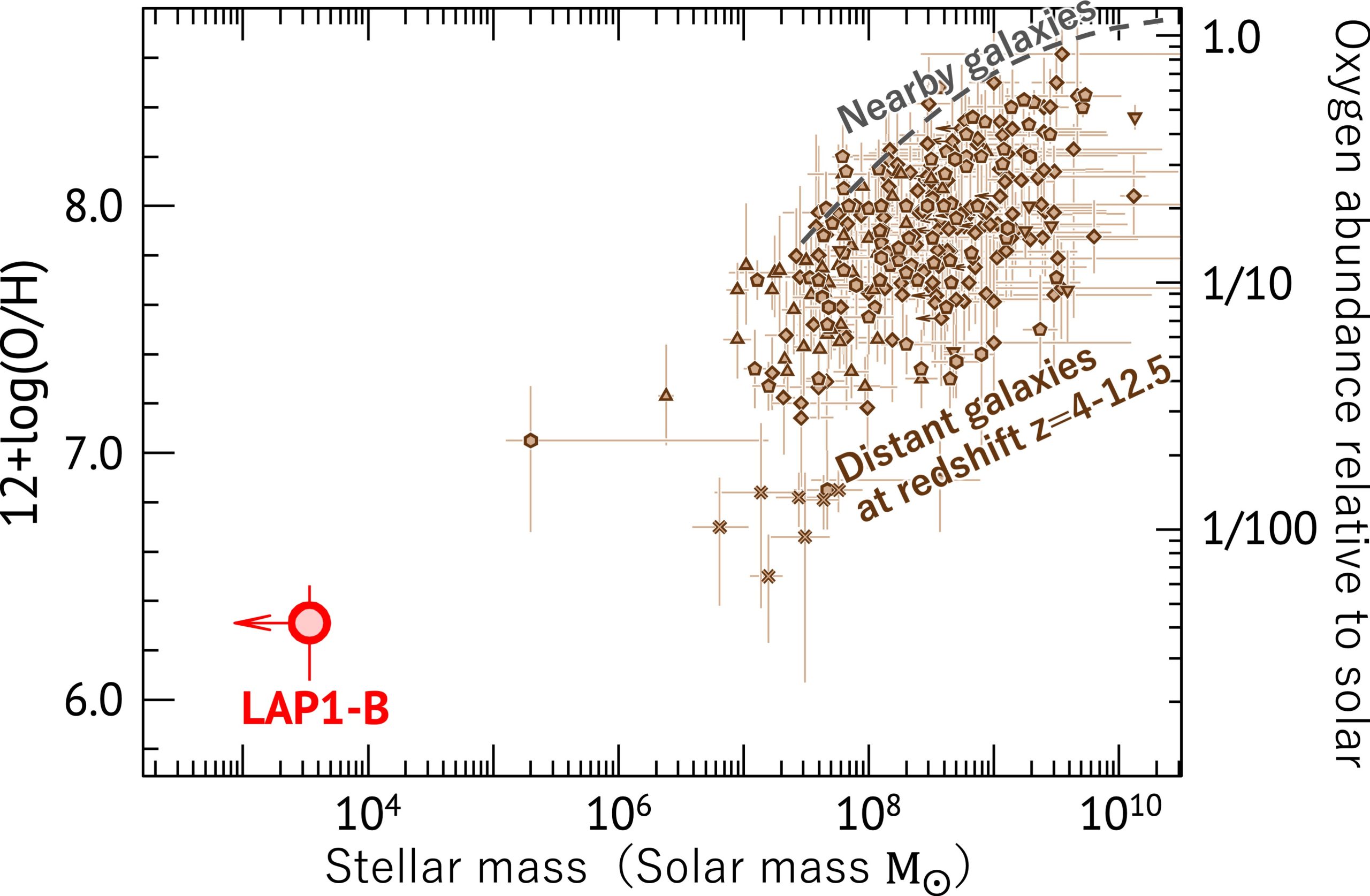
The observations revealed an oxygen abundance just 1/240th that of the Sun, a record low that places LAP1-B among the most chemically primitive galaxies ever characterized.
“I was instantly thrilled by the extreme lack of oxygen revealed in the data,” says Associate Professor Nakajima, the research team leader. “Finding a galaxy in such a primitive state is astonishing. It’s a chemical signature that clearly indicates a primordial galaxy caught in the moments shortly after its formation.”
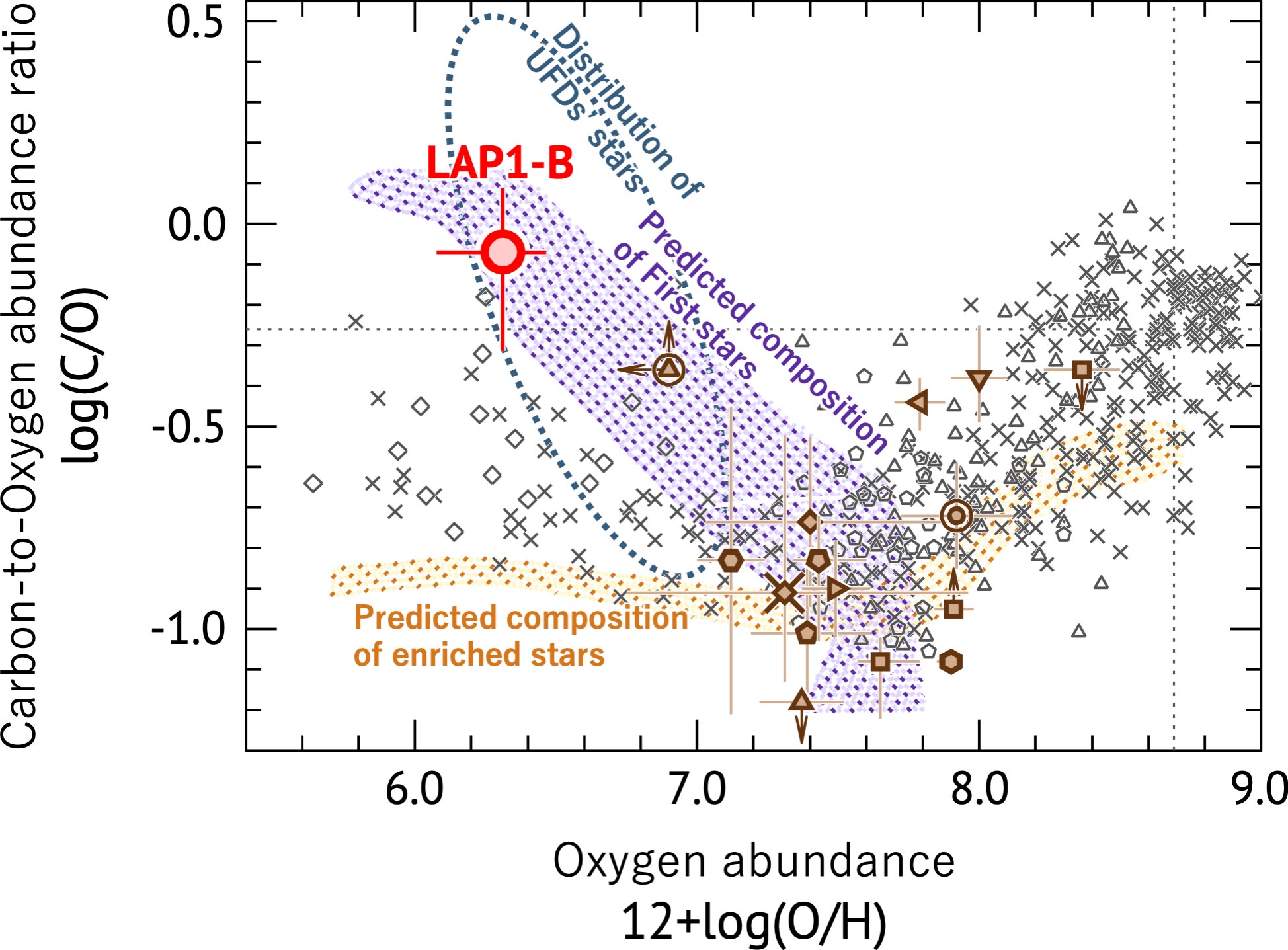
The researchers also found an unusually high ratio of carbon to oxygen. That distinction matters because the relative amounts of different elements can reveal how a galaxy acquired its chemical ingredients. In LAP1-B, the elevated carbon-to-oxygen ratio closely matches theoretical predictions for material scattered into space by the explosions of the universe’s first-generation stars.
Together, these measurements suggest that LAP1-B was observed during an exceptionally early stage of chemical enrichment, when the products of the first stars were beginning to accumulate in its gas.
“Usually, we act like ‘cosmic archaeologists,’ trying to guess the past by looking at old stars in our own neighborhood. But now, we can analyze the gas directly from the original scene 13 billion years ago,” emphasizes Nakajima. “We are witnessing the moment when a galaxy first inherited the chemical building blocks created by the universe’s earliest stars.”
A possible ancestor of cosmic fossils
The galaxy’s extremely small size provides another clue about its origins. The team estimates that LAP1-B contains less than 3,300 times the Sun’s mass in stars and is associated with a halo dominated by dark matter, the invisible material thought to account for much of the mass in galaxies.
Those characteristics resemble a class of nearby objects called ultra-faint dwarf galaxies (UFDs). These exceptionally dim galaxies contain ancient stars and relatively few heavy elements, leading astronomers to suspect that they preserve conditions from the universe’s earliest periods of galaxy formation.
“UFDs are not only the faintest galaxies; they are composed of ancient stars over 12 billion years old and are often described as ‘fossils of the universe,'” explains Professor Masami Ouchi (NAOJ/University of Tokyo), a member of the research team. “Astronomers suspected they might be the remains of the universe’s earliest galaxies because they lack heavy elements, but astronomers never had a direct link—until we found LAP1-B.”
LAP1-B offers a rare opportunity to examine what a possible predecessor of these nearby galaxies actually looked like billions of years ago. Its low oxygen abundance, unusual carbon-to-oxygen ratio, and dark matter-dominated structure are consistent with the idea that today’s ultra-faint dwarf galaxies descended from small systems that formed very early in cosmic history.
“It is a profound surprise to find that LAP1-B looks exactly like the ‘ancestor’ we had only imagined in theories. This helps us solve the mystery of why these cosmic fossils have survived in their current form to the present day.”
The search for even earlier galaxies
Although the findings provide a compelling connection between early galaxies and nearby cosmic fossils, LAP1-B represents one example. Examining more objects with similarly primitive chemical compositions could help researchers determine how common these early systems were and how they developed into the galaxies observed today.
The team plans to continue using JWST to search for even more chemically primitive galaxies, with the ultimate goal of identifying some of the first galaxies ever formed. Such observations could help establish when the earliest stars began producing heavier elements and how those materials spread through the young universe.
Associate Professor Nakajima concludes, “We hope this discovery marks a historic step in understanding how the elements that make up our own bodies were first born and accumulated across the Universe.”
Reference: “An ultra-faint, chemically primitive galaxy forming in the reionization era” by Kimihiko Nakajima, Masami Ouchi, Yuichi Harikane, Eros Vanzella, Yoshiaki Ono, Yuki Isobe, Moka Nishigaki, Takuji Tsujimoto, Fumitaka Nakamura, Yi Xu, Hiroya Umeda and Yechi Zhang, 13 May 2026, Nature.
DOI: 10.1038/s41586-026-10374-1
This research was supported by the following organizations and grants: Japan Society for the Promotion of Science (JSPS): KAKENHI Grants (No. JP20K22373, JP24K07102, JP20H00180, JP21H04467, JP25H00674, JP24H00245, JP24KJ0202, JP23H00132) Japan Science and Technology Agency (JST): Grant JPMJFS2136 National Institute for Astrophysics (INAF): GO Grants 2022 (“The revolution is around the corner: JWST will probe globular cluster precursors and Population III stellar clusters at cosmic dawn”) and 2024 (“Mapping Star Cluster Feedback in a Galaxy 450 Myr after the Big Bang”) European Union: NextGenerationEU (PRIN 2022 project n.20229YBSAN)
Never miss a breakthrough: Join the SciTechDaily newsletter.
Follow us on Google and Google News.