
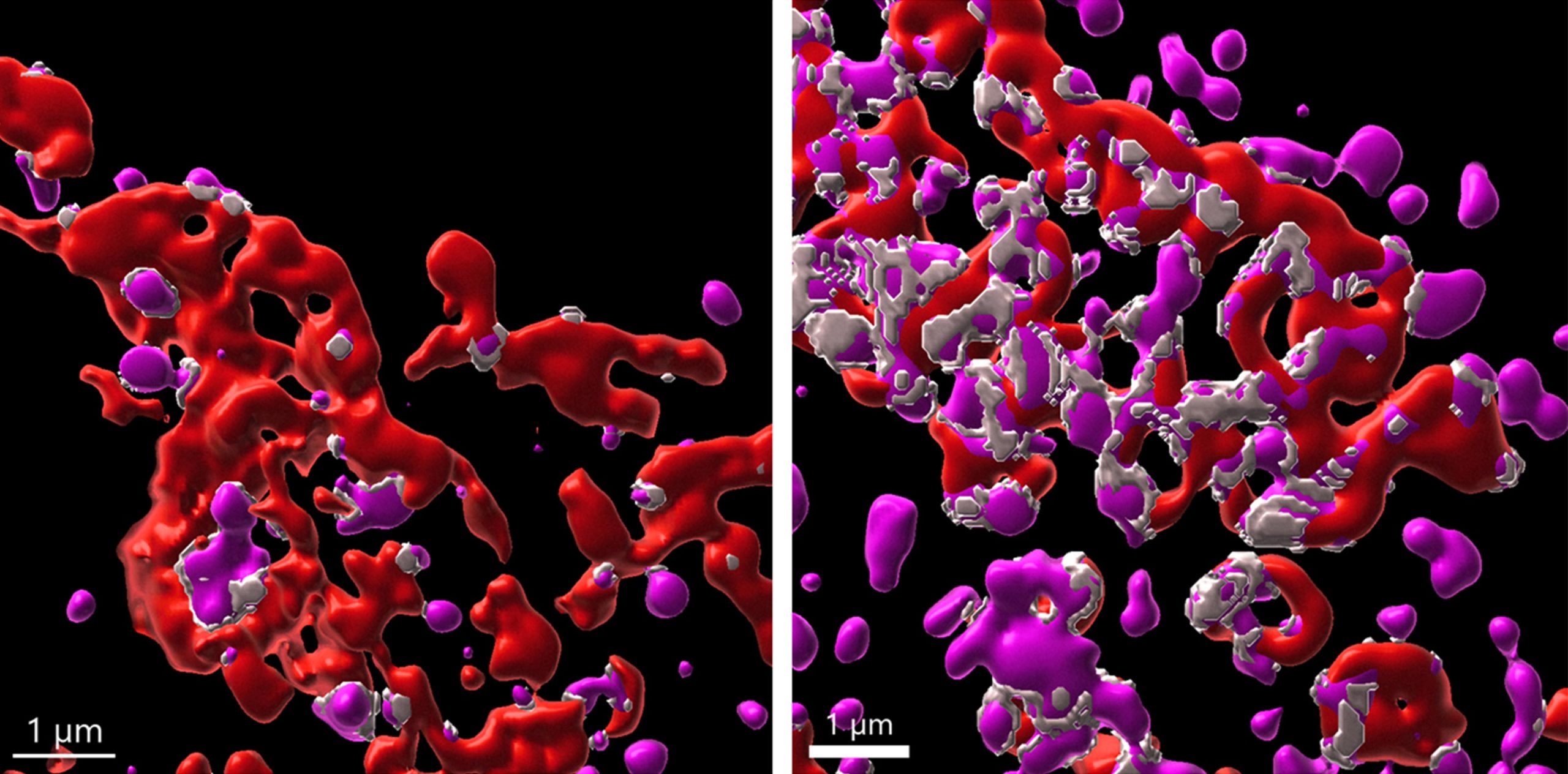
An immune protein called perforin can turn iron against cancer cells in laboratory experiments, suggesting a possible route to more effective immunotherapy.
The immune system can attack cancer cells by punching holes in their outer membranes and sending in enzymes that kill them. Research led by the University of Michigan Health Rogel Cancer Center shows that the protein making those openings can also kill tumor cells on its own.
That protein, perforin, is made by T cells and natural killer (NK) cells. For decades, scientists have known that it allows protein-cutting enzymes called granzymes to enter target cells and trigger their death. But the new study, published in Cell, found that tumor cells could be killed even when major granzymes were missing. Losing perforin, however, caused a catastrophic failure of the immune response against tumors in the study.
“If T cells and NK cells are the soldiers of the immune system, perforin is the weapon, and granzymes are the ammunition,” said co-senior study author Weiping Zou, MD, PhD, Charles B. de Nancrede Professor of Pathology, Immunology, Biology, and Surgery at the University of Michigan (U-M). “At least, that’s what the classic understanding was.”
Perforin can kill on its own
To investigate perforin’s role, the researchers combined three approaches: genetic and biochemical experiments in cells grown in the laboratory, studies in mice, and data from people with cancer.
“We wanted to know if perforin, by itself, can do the job,” Zou said. “The answer is yes.”
The laboratory experiments traced that killing to ferroptosis, an iron-dependent form of cell death. Beyond making holes in a cancer cell’s membrane, perforin interfered with its iron uptake, causing iron to accumulate inside the cell, including in its mitochondria, structures that help supply energy. The excess iron rapidly oxidized lipids, the fatty molecules that help make up membranes.
Ferroptosis occurs when lipid peroxides, or oxidized fats, build up in the membranes surrounding cells and their internal structures. It differs from apoptosis, the form of cell death triggered by granzymes, and from pyroptosis, which is often caused by bacterial infection.
“Our findings show, for the first time, that perforin can independently induce ferroptosis in tumor cells,” said co-senior author Ilona Kryczek, PhD, a researcher at U-M. “This work changes our understanding of one of the longest-held mechanisms of T cell and NK cell-mediated tumor clearance.”
Zou and Kryczek worked closely with co-senior author Judy Lieberman, PhD, of Harvard Medical School, one of the international pioneers of cytotoxic lymphocyte research, the study of immune cells that kill other cells.
Iron-rich diets may fuel some tumors
In the mouse studies, animals fed an iron-rich diet had slower tumor progression, a result related to their perforin expression. That observation comes with an important caution for anyone considering what it might mean for cancer treatment.
“We need to be very cautious here,” Zou said. “That’s because some cancer types enjoy an iron-rich diet. For those tumors, and we don’t totally know which ones yet, an iron-rich diet may accelerate progression.”
Can perforin make immunotherapy more effective?
The human data offered another connection between perforin and cancer outcomes. Patients with higher perforin expression had better survival and better responses to immune checkpoint blockade, treatments that release molecular brakes on immune cells. These findings were associations in patient data.
“It is a new way of thinking about how immune cells kill tumors,” said Hannah Bell, PhD, the study’s first author, until recently a postdoctoral researcher in Zou’s lab and now an assistant professor in Molecular and Integrative Physiology at U-M.
Ferroptosis was formally introduced over a decade ago, so scientists still know less about it than more established forms of cell death.
“It’s a very hot area that needs a lot of research,” Zou said.
In 2019, his group was the first to report the immune system’s role in ferroptosis in tumors, highlighting the pathway as a potential target for immune checkpoint therapy. Previous work has also shown that immune checkpoint blockade can enhance T cell-mediated ferroptosis, making that connection a likely direction for further research.
It is still too soon to say how the new findings might translate into clinical applications.
“If we can understand what makes a tumor cell susceptible to perforin, we may be able to increase the effectiveness of immunotherapy,” Zou said.
The team plans to examine the cell death mechanism more closely, test whether multiple routes to cell death could be working together, and explore potential clinical applications.
“At the end of the day, the whole goal of different forms of cancer therapies — immunotherapy, chemotherapy, targeted therapy — is to kill tumor cells,” Zou said. “Improving our understanding of cell death, like we do in this study, is so fundamental and so important. That’s why we’re going to continue to push on this.”
Reference: “Perforin triggers iron-induced mitochondrial damage to drive ferroptosis and anti-tumor immunity” by Hannah N. Bell, Kavya Nair, Kole Tison, Peng Liao, Hongwei Lei, Marwa O. El-Derany, Ayijiang Yisimayi, Haiwei Zhang, Ryan Rebernick, Weichao Wang, Yoshitaka Adachi, Cristina Castillo, Nupur K. Das, Jinsu An, Vivien R. Sutton, Xun Lin, Heng Lin, Xinghao Wang, Yunfei Li, Linda Vatan, Amr Aboud, Shuang Wei, Miguel Gijon, Samantha Goodwin, Yatrik M. Shah, Ilona Kryczek, Joseph A. Trapani, Margarida Barroso, Judy Lieberman and Weiping Zou, 23 October 2026, Cell.
DOI: 10.1016/j.cell.2026.09.062
Funding for this work is from National Cancer Institute grants CA217648, CA123088, CA099985, CA193136, CA152470, CA46592, R01 CA233188, R21 CA274622, R01 CA240955, K99CA299410-01, and National Science Foundation grant NSFCBET 234722
Never miss a breakthrough: Join the SciTechDaily newsletter.
Follow us on Google and Google News.