
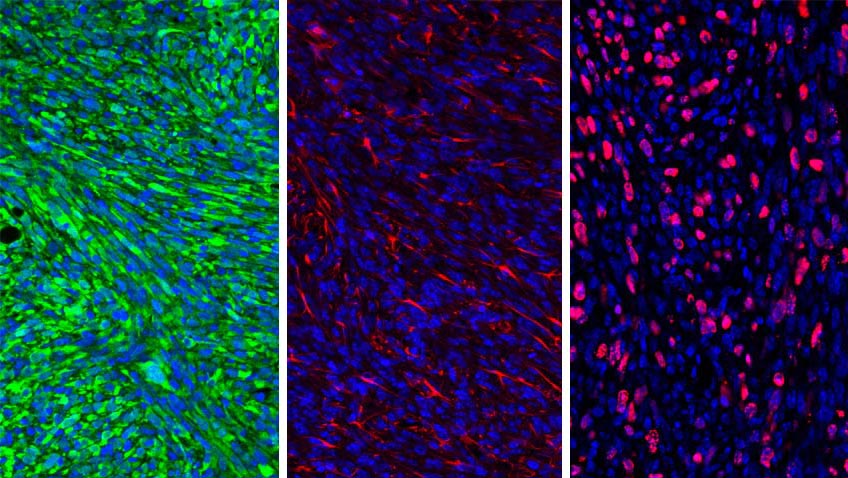
The approach, studied in mice, overcomes the blood-brain barrier and breaks the shield tumors build against the immune response.
When researchers at the University of Michigan Rogel Cancer Center discovered a small molecule that blocked a key pathway in brain tumors, they were optimistic. But there remained a problem: how to deliver the inhibitor through the bloodstream and into the brain to reach the tumor.
In collaboration with multiple labs, the teams of scientists fabricated a nanoparticle to contain the inhibitor, and the results were even better than expected.
Nanoparticles and Immune Activation in Brain Tumors
Not only did the nanoparticles deliver the inhibitor to the tumor in mouse models, where the drug successfully activated the immune system to eliminate the cancer, but the process triggered immune memory so that a reintroduced tumor was also eliminated. This is a promising sign that this potential new approach could not only treat brain tumors but prevent or delay recurrences.
“No one could get this molecule into the brain. It’s really a huge milestone. Outcomes for patients with glioma have not improved for the last 30 years,” said Maria G. Castro, Ph.D., R.C. Schneider Collegiate Professor of Neurosurgery at Michigan Medicine. Castro is the senior author of the study, published today (May 26, 2022) in the journal ACS Nano.
“Despite survival gains in many cancer types, glioma remains stubbornly challenging, with only 5% of patients living five years after their diagnosis,” said study author Pedro R. Lowenstein, M.D., Ph.D., Richard C. Schneider Collegiate Professor of Neurosurgery at Michigan Medicine.

Gliomas are often resistant to traditional therapies, and the environment inside the tumor suppresses the immune system, rendering new immune-based therapies ineffective. Add to that the challenge of passing the blood-brain barrier, and it becomes even more difficult to deliver effective treatments to these tumors.
Blocking CXCR12 to Enhance Immune Response
The Castro-Lowenstein lab saw an opportunity. The small molecule inhibitor AMD3100 was developed to block the action of CXCR12, a cytokine released by the glioma cells that builds up a shield around the immune system, preventing it from firing up against the invading tumor. Researchers showed in mouse models of glioma that AMD3100 prevented CXCR12 from binding with immune-suppressive myeloid cells. By disarming these cells, the immune system remains intact and can attack the tumor cells.
But AMD3100 was having trouble getting to the tumor. The drug did not travel well through the bloodstream, and it did not pass the blood brain barrier, a key issue with getting drugs into the brain.
Nanoparticles as Drug Delivery Vehicles
The Castro-Lowenstein lab collaborated with Joerg Lahann, Ph.D., Wolfgang Pauli Collegiate Professor of Chemical Engineering at the U-M College of Engineering, to create protein-based nanoparticles to encapsulate the inhibitor, in the hopes of helping it pass through the bloodstream.
Castro also connected with Anuska V. Andjelkovic, M.D., Ph.D., professor of pathology and research professor of neurosurgery at Michigan Medicine, whose research focuses on the blood-brain barrier. They noted that glioma tumors create abnormal blood vessels, interfering with normal blood flow.
The researchers injected AMD3100-loaded nanoparticles into mice with gliomas. The nanoparticles contained a peptide on the surface that binds to a protein found mostly on the brain tumor cells. As the nanoparticles traveled through the bloodstream toward the tumor, they released AMD3100, which restored the integrity of the blood vessels. The nanoparticles could then reach their target, where they released the drug, thus blocking the entry of the immune-suppressive myeloid cells into the tumor mass. This allowed the immune cells to kill the tumor and delay its progression.
“If you don’t have blood flow, nothing will get to your target. That’s why tumors are so smart. But AMD3100 restores the conduits, which is what allows the nanoparticles to reach the tumor,” Castro said.
Combining Nanoparticles with Radiation Therapy
Further studies in mice and patient cell lines demonstrated that coupling the AMD3100 nanoparticle with radiation therapy enhanced the effect beyond either the nanoparticle or radiation alone.
Among the mice whose tumors were eliminated, the researchers then reintroduced the tumor, simulating a recurrence. Without any additional therapy, 60% of mice remained cancer-free. This suggests that, like a vaccine, AMD3100 created immune memory, enabling the immune system to recognize and destroy the reintroduced cells. While it prevented a recurrence in mice, Castro said it bodes well for at least delaying recurrence in people.
“Every glioma recurs. It’s very important for glioma therapy to have this immunological memory,” Castro said.
Initial tests showed little to no impact on liver, kidney or heart function and normal blood counts in the mice after treatment. The nanoparticle has a similar base as ones that have been previously tested in humans and shown to be safe. Additional safety testing is necessary before moving to a clinical trial.
Reference: “Systemic delivery of an adjuvant CXCR4-CXCL-12 signaling inhibitor encapsulated in synthetic protein nanoparticles for glioma immunotherapy” by Mahmoud S. Alghamri, Kaushik Banerjee, Anzar A. Mujeeb, Ava Mauser, Ayman Taher, Rohit Thalla, Brandon L. McClellan, Maria L. Varela, Svetlana M. Stamatovic, Gabriela Martinez-Revollar, Anuska V. Andjelkovic, Jason V. Gregory, Padma Kadiyala, Alexandra Calinescu, Jennifer A. Jiménez, April A. Apfelbaum, Elizabeth R. Lawlor, Stephen Carney, Andrea Comba, Syed Mohd Faisal, Marcus Barissi, Marta B. Edwards, Henry Appelman, Yilun Sun, Jingyao Gan, Rose Ackermann, Anna Schwendeman, Marianela Candolfi, Michael R. Olin, Joerg Lahann, Pedro R. Lowenstein and Maria G. Castro, 26 May 2022, ACS Nano.
DOI: 10.1021/acsnano.1c07492
Additional authors: Mahmoud S. Alghamri, Kaushik Banerjee, Anzar A. Mujeeb, Ava Mauser, Ayman Taher, Rohit Thalla, Brandon L. McClellan, Maria L. Varela, Svetlana M. Stamatovic, Gabriela Martinez-Revollar, Jason V. Gregory, Padma Kadiyala, Alexandra Calinescu, Jennifer A. Jimenez, April A. Appelbaum, Elizabeth R. Lawlor, Stephen Carney, Andrea Comba, Syed Mohd Faisal, Marcus Barissi, Marta B. Edwards, Henry Appelman, Yilun Sun, Jingyao Gan, Rose Ackermann, Anna Schwendeman, Marianela Candolfi, Michael R. Olin
Funding: National institutes of Health grants R37-NS094804, R01-NS105556, R01-NS122536, R01-NS124167, R21-NS123879-01, R37-NS094804, R01-NS105556, R01-NS122536, R01-NS124167, R21-NS123879-01, T32-CA009676, F31CA247104, F31CA247104; Rogel Cancer Center; Michigan Medicine Department of Neurosurgery; Pediatric Brain Tumor Foundation; Leah’s Happy Hearts Foundation; Ian’s Friends Foundation; Chad Tough Foundation; Smiles for Sophie Forever Foundation; Agencia Nacional de Promocion Cientifica y Tecnologica, Argentina; Instituto Nacional del Cancer Argentina, Asistencia Financiera IV
Never miss a breakthrough: Join the SciTechDaily newsletter.
Follow us on Google and Google News.