
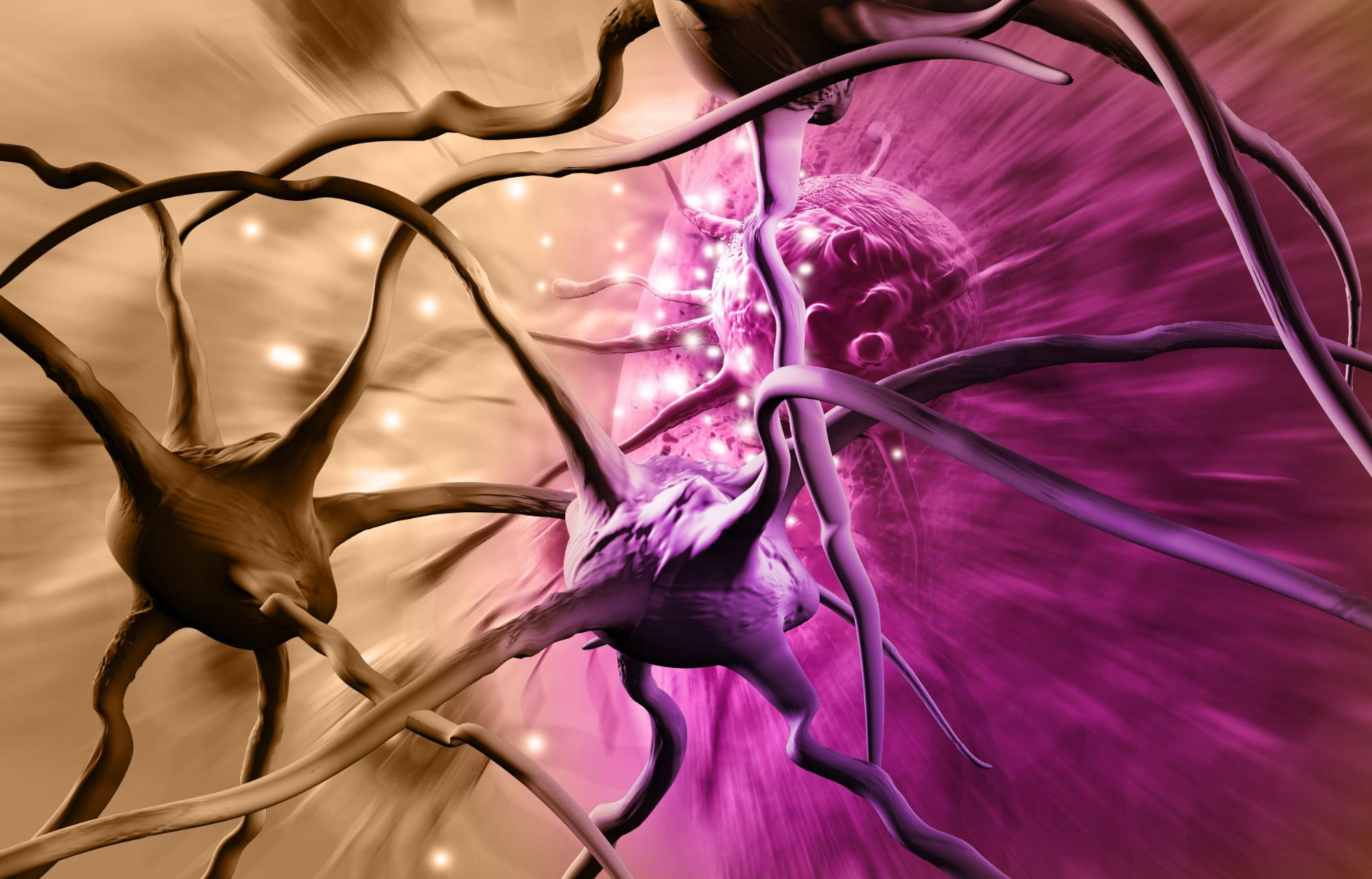
A modified herpes virus boosted immune T cell infiltration in glioblastoma tumors and was associated with improved survival.
Researchers from Mass General Brigham and Dana-Farber Cancer Institute report that a single dose of an oncolytic virus can help the immune system gain access to aggressive brain tumors. Oncolytic viruses are genetically engineered to infect and destroy cancer cells while sparing healthy tissue.
In findings published in Cell, the team describes how this strategy extended survival in patients with glioblastoma, the most common and deadliest primary brain cancer, during a recent clinical trial.
Glioblastoma has long resisted many forms of immunotherapy that have transformed treatment for cancers such as melanoma. One reason is that it is considered a “cold” tumor, meaning it contains very few immune cells capable of attacking cancer.
Reprogramming the immune landscape of glioblastoma
“Patients with glioblastoma have not benefited from immunotherapies that have transformed patient care in other cancer types, such as melanoma, because glioblastoma is a ‘cold’ tumor with poor infiltration by cancer-fighting immune cells,” said co-senior author Kai Wucherpfennig, MD, PhD, chair of the Department of Cancer Immunology and Virology at the Dana-Farber Cancer Institute. “Findings from our clinical trial and our mechanistic study show that is now feasible to bring these critical immune cells into glioblastoma.”
The virus used in the trial was developed by E. Antonio Chiocca, MD, PhD, Executive Director of the Center for Tumors of the Nervous System at Mass General Brigham Cancer Institute. It is based on the herpes simplex virus but modified so it can replicate only inside glioblastoma cells, not in normal brain cells. Once inside a tumor cell, the virus multiplies, destroys that cell, and then spreads to neighboring cancer cells. In addition to directly killing tumor cells, the infection also stimulates an immune response.
In the phase 1 study, which included 41 patients with recurrent glioblastoma, treatment with the virus was associated with longer survival compared with historically reported outcomes. The benefit was especially pronounced in patients who already had antibodies against the virus before treatment.
Immune cell presence tracks with patient survival
To understand how the therapy was working, the researchers analyzed tumor samples from trial participants. They found that the virus prompted immune T cells to enter and remain inside the tumors over the long term. Patients whose cytotoxic T cells were located closer to dying tumor cells lived longer after treatment. The therapy also increased the number of T cells that were already present in the brain.
“We show that increased infiltration of T cells that are attacking tumor cells translates into a therapeutic benefit for patients with glioblastoma,” said Chiocca, who is also a co-senior author of the study. “Our findings could have important implications for a cancer whose standard of care hasn’t changed for 20 years.”
Reference: “Persistent T cell activation and cytotoxicity against glioblastoma following single oncolytic virus treatment in a clinical trial” by Maxime Meylan, Ye Tian, Lijian Wu, Alexander L. Ling, Daniel Kovarsky, Graham L. Barlow, Linh D. Nguyen, Jason Pyrdol, Sascha Marx, Lucas Westphal, Julius Michel, L. Nicolas Gonzalez Castro, Sydney Dumont, Andres Santos, Itay Tirosh, Mario L. Suvà, E. Antonio Chiocca and Kai W. Wucherpfennig, 11 February 2026, Cell.
DOI: 10.1016/j.cell.2025.12.055
This work was supported by National Cancer Institute (NCI) grants P01 CA236749, P01 CA163222, R01 CA238039, R01 CA251599, P01 CA163205, and R01 NS110942. Meylan is a Cancer Research Institute Immuno-Informatics Fellow supported by the Cancer Research Institute (CRI award #CRI5000) and received mobility grants from l’Institut Servier (CT0101954) and the Philippe Foundation.
Disclosure: Wucherpfennig serves on the scientific advisory boards of DEM BioPharma, Solu Therapeutics, D2M Biotherapeutics, DoriNano, Inc., and Nextechinvest; is a co-founder of Immunitas Therapeutics; receives sponsored research funding from Fate Therapeutics; and holds equity in TScan Therapeutics. These activities are not related to the research reported in this publication. Suva is a scientific co-founder and advisory board member of Immunitas Therapeutics. Chiocca is an advisor to Bionaut Labs, Seneca Therapeutics, Calidi Biotherapeutics, and ReIgnite Therapeutics; has equity options in Bionaut Laboratories, ReIgnite Therapeutics, Seneca Therapeutics, and Ternalys Therapeutics; and is co-founder and on the board of directors of Ternalys Therapeutics. Patents related to oHSV and CAN-3110 are under the possession of Brigham and Women’s Hospital with Chiocca, and he is named as co-inventor. These patents have been licensed to Candel Therapeutics. Present and future milestone license fees and future royalty fees are distributed to Brigham and Women’s Hospital from Candel.
Never miss a breakthrough: Join the SciTechDaily newsletter.
Follow us on Google and Google News.