

Researchers found that men with genetically higher tyrosine levels appeared to live slightly shorter lives, raising new questions about amino acids often promoted for mental performance.
Could a common supplement ingredient tied to focus and energy actually have a hidden downside for longevity?
A large new study suggests that higher levels of the amino acid tyrosine in the bloodstream may be linked to a shorter lifespan in men. The findings raise new questions about the long-term effects of nutrients that are widely promoted for mental performance and stress support.
Researchers from the University of Hong Kong and the University of Georgia analyzed health and genetic data from more than 270,000 people in the UK Biobank. Their study, published in Aging, found that men with genetically higher tyrosine levels appeared to live nearly one year less on average. The same effect was not clearly seen in women.
The research focused on tyrosine and its precursor, phenylalanine, two amino acids naturally found in protein-rich foods such as meat, eggs, dairy products, beans, and soy. Both are also common ingredients in dietary supplements and energy products.
Why Scientists Are Interested in Tyrosine
Tyrosine plays a central role in the body. It helps produce dopamine, norepinephrine, and epinephrine, brain chemicals involved in motivation, alertness, stress response, and mood. Because of this, tyrosine supplements are often marketed to students, athletes, and people looking to improve concentration under pressure.

But the same biological systems that support performance in the short term may have tradeoffs over decades.
Scientists have long known that reducing overall protein intake can extend lifespan in many animal species, from worms to rodents. More recent research has suggested that specific amino acids, rather than protein itself, may drive some of those effects. In animal experiments, restricting tyrosine lowered activity in nutrient-sensing pathways linked to aging, including mTORC1 and insulin signaling.
The new human study adds evidence that tyrosine may be one of the amino acids most closely tied to longevity.
What the Study Found
The researchers combined traditional health data with a genetic technique called Mendelian randomization, which uses inherited genetic differences to help estimate whether a biological factor may directly influence disease or lifespan.
Initially, both phenylalanine and tyrosine appeared linked to a higher risk of earlier death. But after accounting for overlapping effects between the two amino acids, only tyrosine remained consistently associated with shorter lifespan.
In men, the effect was especially pronounced. After adjusting for phenylalanine, higher tyrosine levels were associated with a lifespan reduction of about 0.9 years. Women did not show a statistically clear association.
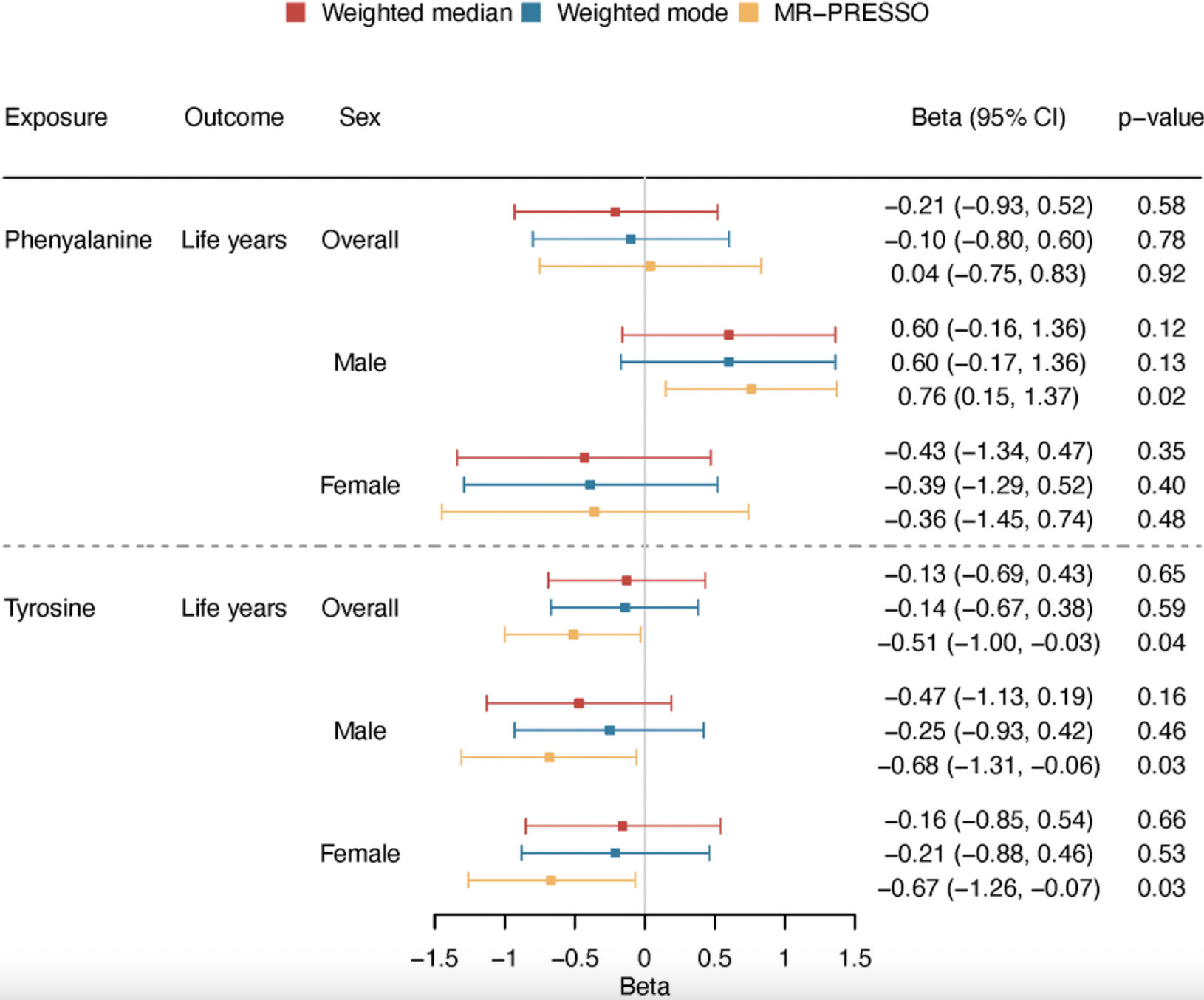
Researchers also noted that men tend to have naturally higher tyrosine levels than women, which may partially contribute to the longstanding life expectancy gap between the sexes.
Globally, women generally outlive men by several years. In the United States, that gap widened sharply during the COVID-19 pandemic, reaching nearly six years at one point.
A Possible Link to Aging Pathways
The exact reason tyrosine may influence lifespan remains unclear, but scientists point to several possibilities.
One involves insulin resistance, a metabolic condition associated with diabetes, cardiovascular disease, and other age-related illnesses. Previous research has linked higher tyrosine levels to poorer insulin sensitivity.
Tyrosine is also deeply connected to stress-response chemistry. The amino acid feeds the production of adrenaline-related neurotransmitters that help the body respond to physical and psychological stress. Over long periods, chronic activation of these pathways may influence aging differently in men and women because of interactions with sex hormones such as testosterone and estrogen.
The study also found hints that phenylalanine may play a separate role in cardiovascular disease and cancer risk, although it was not independently associated with lifespan after tyrosine was considered.
Important Caveats
The researchers caution that the study does not prove tyrosine supplements shorten lifespan, and it did not directly test supplementation. Blood tyrosine levels are influenced by genetics, diet, metabolism, and overall health.
The findings also do not mean people should avoid protein-rich foods, since tyrosine is essential for normal brain and body function.
Instead, the results suggest that chronically elevated tyrosine levels could potentially affect aging, particularly in people already predisposed to high levels. The researchers say future studies should investigate whether dietary approaches such as moderate protein restriction or other lifestyle interventions could safely lower tyrosine levels and improve healthy aging.
“Phenylalanine showed no association with lifespan in either men or women after controlling for tyrosine,” the authors state.
Reference: “The role of phenylalanine and tyrosine in longevity: a cohort and Mendelian randomization study” by Jie V. Zhao, Yitang Sun, Junmeng Zhang and Kaixiong Ye, 3 October 2025, Aging.
DOI: 10.18632/aging.206326
Never miss a breakthrough: Join the SciTechDaily newsletter.
Follow us on Google and Google News.
12 Comments
thanks for this
Retinol saturase (Retsat), longevity gene, expression is significantly upregulated by tyrosine.
It therefore follows that, tyrosine , if taken with the advice of qualified medical practitioners, is a longevity protein, rather than , a life shortener, in Men.
These could be cases of tyrosine overdose.
Kind regards.
Many of these articles are so inconclusive they are not really worthy of publication. Science articles should have actual proven information within, otherwise they are a waste of space and time.
Very enlightening and informative article! Thanks for sharing this message.
That’s also my take on the misleading headline. Since “blood tyrosine levels are influenced by genetics, diet, metabolism, and overall health,” what chance remains that intake, much less supplementation, is causative of shortened lifespan?
Too much of that nonsense is floating around in the net and in media.
Somebody should be monitoring this “propaganda” and stop the “dumbing down” process. Humans are their own enemy. The worst enemy you could imagine.
The light that burns twice as bright burns half as long.
What is the alternative that won’t cut my life short?
A well balanced diet.
Cook your own food and you won’t need supplements
I was drawn to this article by my immediate lack of confidence in its editor’s poor choice of a lead photo: the Shutterstock image at the beginning of this article shows a hand holding a single gel capsule containing some lipid contents, probably vitamin E acetate or some fish oil derivative. This clearly (no pun) cannot contain any amino acid. An amino acid supplement would be white or beige, or at least opaque.
Okay folks, science is like trying to identify an object hidden in a box by inserting multiple same length poles then interconnecting the outside ends of the poles to determine the inside shape. Inaccurate sure, but it gives one a clue. The more poles (pixels) the sharper the image.
So this concluded nothing and provided nothing. What a wonderful article.